Monday, July 7, 2025
Steve Robson's recumbent construction guide, now available here in PDF format
Wednesday, June 18, 2025
40th annual Michigan HPV Rally report
The most ever velomobiles at the Michigan rally, and their owners. From left, Charles - Antoine Daignault, Laval, Quebec, VT 1; Jonathan Walters, Cincinnati, Bulk; Jonathan Minuci, Louisville, Ky., Quatro Velo 4-wheeler; Pedal Prix trike; Jane Hunn, North Manchester, Ind., motorized Quest; Dave Johnson, Olivet, Quest; Jeff Hunn, Quest; Ray Mickevicius, Wasaga Beach, Ontario, owner of the green and blue Pedal Prix trikes; and Paul Pancella, Kalamazoo, motorized Quest. (Mike Eliasohn photo)
- Waterford 2025…Final.pdf (1.9 MB)
- Waterford 2025…Results Map.jpg (1.2 MB)
- If you see any errors or omissions or have questions, please email the author at mikethebike2325@comcast.net
The 40th annual Michigan Human Powered Vehicle Rally June 7-8, 2025, at the Waterford Hills sports car racing track in Clarkston saw the best turnout in years, and possibly the most widespread geographically.
There were about 40 racers, plus other participants. The record is 50 in 2001.
And thank you Canada. The University of Toronto HPV Design Team was there with 21 students (not all raced), three student-built streamliners and five unfaired vehicles (three team-owned and two owned by students). This was the 13th year (not all consecutive) the U-T has been at our event.
Five young men and their three HPVs came from Montreal, Quebec, about 1,000 km / 621 miles, bringing one velomobile and two recumbent bicycles.
And Ray Mickevicius and his wife came from north of Toronto with two fully-faired Pedal Prix tricycles and one unfaired. The trikes were very popular for test rides.
On this side of the border, people came from Michigan (of course), Wisconsin, Iowa, Illinois, Indiana, Ohio, Kentucky, Florida, Tennessee, Pennsylvania, and South Carolina. (Apologies if I missed any states.)
The University of Toronto HPV Design Team came with 21 students (the most ever), three student-built streamliners and five unfaired vehicles (three team and two student-owned). This was the 13th year the U of T team was at the rally. (Mike E. photo)
Here's the top three from each class:
Stock (29 riders / 26 vehicles) – tie: 1) Jonathan Walters, Cincinnati, Ohio, 1) Thom Ollinger, West Milton, Ohio, 3) Daryl Hanger, Mooresville, Ind., NoCom Velocraft.
Streetliner (5 riders) – 1) Jonathan Walters, 2) Ray Mickevicius, Wasaga Beach, Ontario, 3) 3) Jonathan Minuci, Louisville, Ky.
Streamliner (16 riders / 6 vehicles) – 1) Dennis Grelk, Donnellson, Iowa, 2) John Simon, Portland, 3) Tony Levand, Lemont, Ill.
Tricycles (3 riders / vehicles) – 1) Joe Pixley, Springfield, Va., 2) Eric Penn, Detroit, 3) ?.
E-assist (2 riders / vehicles) – 1) Jane Hunn, North Manchester, Ind., 2) Paul Pancella, Kalamazoo.
Women (3 riders / 2 vehicles) – 1) Kai Zabitsky, University of Toronto, 2) Erin Price, U-T, 3) Katherine Elder, U-T.
Jonathan Minuci of Louisville, Ky., gets paid by a local law firm to display the advertising on the sides of his QuattroVelo 4-wheeler. (But what if the driver was distracted by his QuattroVelo?) He finished third in the streetliner class. (Mike E. photo)
Following are the top two in each class in each event.
Saturday
One-hour: Streamliner – 1) Dennis Grelk, 24 laps, average speed 33.9 mph, 2) John Simony, 22 laps, 31.1 mph.
Streetliner – 1) Jonathan Walters, 21 laps, 29.4 mph, 2) Ray Michevicius, 19 laps, 25.5 mph.
Stock – 1) Robert Lloyd, Whitmore Lake, 19 laps, 26.9 mph, 2) Larry Oslund, Hilton Head, S.C., 19 laps, 26.7 mph.
E-assist – 1) Jane Hunn, 18 laps, 25.3 mph, 2) Paul Pancella, 18 laps, 25.1 mph.
Tricycle – 1) Joe Pixley, 16 laps, 22.3 mph, 2) Larry Seidman, 14 laps, 18.6 mph.
Tony Levand created an interesting front steering setup to avoid having a conventional head tube sticking up. (Daryl Hanger photo)
For more about Tony's creation, go to hhttp://recumbents.com/forums/topic.asp?TOPIC_ID=14142
Coast down (when riders get to the top of the hill in the hill climb, they stop pedaling, coast as far as they can go, then mark where they stopped with chalk on the pavement. Distance is not measured) : Streamliner – 1) Dennis Grelk, 2) John Simon. Streetliner – 1) Jonathan Walters, 2) Jeff Hunn. Stock – 1) Dennis Grelk, 2) Ron Wyatt, Pittsburgh, Pa. E-assist – 1) Jane Hunn, 2) none. Tricycle – 1) Joe Pixley, 2) Eric Penn. Women – 1) Kai Zabitsky, 2) Erin Price.
The standing start kilometer event, scheduled last on Saturday, was cancelled because we were running late.
Coming all the way from Quebec, about 1,000 kilometers, were (from left) Timothee Marye , Victor Chabot, Thomas Bergeron, Olivier Mangeau and Charles-Antoine Daignault. Timothee is from France, studying construction engineering at a university in Montreal. All and their HPVs came in Victor's four-door pickup truck. (Mike E. photos)
Charles-Antoine Daignault in his VT 1 waiting to start the hill climb. He and Thomas Bergeron worked for the maker, Velomtek, which closed in May, after having been in business since 2019. As of mid-June, its website was still up – www.velomtek.com.
Sunday
Flying start 200-foot sprints: Streamliner – 1) Dennis Grelk, 43.4 mph, 2) Tempest, 43.3 mph. Streetliner – 1) Jonathan Walters, 44.8 mph, 2) Ray Mickevicius, 39.5 mph. Stock – 1) Dennis Grelk, 40.2 mph, 2) Thom Ollinger, 39.6 mph. E-assist – 1) Jane Hunn, 33.7 mph, 2) Paul Pancella, 33.0 mph. Tricycle – 1) Joe Pixley, 31.8 mph, 2) none. Women - none.
Lap races – Preceding each race was a one-lap ride of silence to remember Bill Frey and David "Doc" Pearson,
25 laps (15.6 miles: Streamliners – 1) John Simon, 25 laps, 27.1 mph, 2) Tony Levand, 20 laps, 21.2 mph. Dennis Grelk dropped out after 8 laps because his chain derailed. Streetliners – 1) Jonathan Walters, 24 laps, 25.1 mph, 2) Ray Mickevicius, 24 laps, 24.0 mph. E-assist – 1) Paul Pancella, 22 laps, 23.1 mph.
In addition to competing in the rally, Mike Mowett was co-organizer, did the course set-up, posted his photos online and was key person working on the results. Here's his brief summary of the weekend (slightly edited by co-organizer Mike E.: "Well as usual, we managed to 'pull it off,' make the weekend a success. So many people helped, like Dan Glatch, Tony Levand, John Simon, Terry Gerweck, just to name a few. And of course Dennis Grelk on transponders and registration and Robert Lloyd with results, trying to crunch everything on the GoogleSheets program he set up." (photo by Hannah Dempster, U of T)
In 1982, Mike Eliasohn (left) and Terry Gerweck organized a gathering of fellow recumbent cycle owners the evening before the River Raisin Tour in the Monroe area. That led to creation of what became the Michigan HPV Rally. See article below, "40 years + of HPV Racing in Michigan." At the 40th annual, they are standing behind Terry's Tour Easy. (Steve Webber photo)
For Dennis Grelk, it's about a 530-mile drive from Donnellson, Iowa, to Clarkston – and then doing the reverse. Imagine how many "what the ?" reactions there must have been from passing or following motorists on his way to the rally and return. No. 421 is his stock class bike; the other is his streamliner. (Mike E. photo)
Wednesday, June 11, 2025
Charles Brown at the 2025 Michigan HPV Rally
Last year’s bike seemed to be taking things a little too leisurely, so I resolved that this year’s bike should pick up the pace a little.
I have an artist friend who says, “A painting is never really finished- you just hit a point where you give up on it”, and in that sense, that's what happened with my 2025 racing bike.
The goal for this year was to work on a more aerodynamic rider position. Indeed, I started out flat on my back, which didn’t work.
The first attempt was a front-wheel-drive monster, whose steering proved so intractable it was aborted after a few test rides.
Charles’ attempt at a front-wheel-drive.
Then this spring I tried again, with a rear-wheel-drive design (above),
I don’t think I’ve ever built a bike that had more teething problems. I’ve chopped up and rebuilt this thing a number of times. Even so, on what I euphemistically term my “training rides” along local side streets, hills were surmounted with a mighty tugging on the handlebars – not very efficient, and its progress down said streets can best be described as “stately”.
Prior to the rally, I could only hope my rolling track obstruction trundled along a little better than last year. I’ve been able to learn a lot about rider position, although more about what doesn’t work than what does!
To this end, I designed it with the rider (me) completely flat on my back for minimum air drag. My torso was secured in place by an extreme lumbar support, a belt to strap me in, shoulder hooks, and (planned) clipless pedals.
Test rides proved disappointing, and constant butchering and rebuilding continued up to race day. At least I learned some new things.
It was great to see old friends at the rally, even Jay Hoover, who I used to bike with in Florida!
The innovation award goes to a guy from Canada (Ray Mickevicius of Wasaga Beach, Ontario) who brought two Pedal Prix racers, designed in Australia. These are the smallest faired tricycles I have ever seen. Instead of the rider’s head sticking up in a bubble, the rider lies very, very flat, with no head bulge. There’s a row of windows around the craft so you can see out.
He was generously letting a long queue of people ride them. Visibility seemed okay. It’s a bit of a greenhouse, even with the opaque top, but you could use infared blocking window film, and the windows could be smaller.
I’d rather use a velomobile for commuting, but this design has the potential to beat them on the track.
John Simon and I realized we both started coming to Waterford in 1987. He had a bit of a slump the last few years, but he was kicking ass and taking names this weekend. He said the only change he made to his Moby streamliner was to install Vittoria ‘graphene’ tires. I looked it up on ‘www.bicyclerollingresistance.com’ and ‘Vittoria Corsa Pro Speed TLR 28’ had the lowest rolling resistance of anything on the list. He might be on to something.
Back to my bike, in my own testing, I found the best steering with narrow handlebars at 0-6 inches of “tiller” (the distance from handlebars to the steering axis) and a little more with wider bars. In contrast, Dennis Grelk prefers 1 to 1-1/2 feet, and feels uncomfortable with anything less! Why the discrepancy?
It would be neat to have a way of testing rider power at the races.
In 1986, I was riding a long-wheelbase low racer in traffic when I almost became a much lower racer.
Since then, I’ve built my bikes with the rider’s head high enough to see and be seen in traffic. This creates more air drag than low racers, and I can’t compete. I’d like it if those building practical vehicles could put an ‘R’ after their vehicle number, for "roadworthy." After the races, we could compare and see how we did against the other real world vehicles.
I’d like to see more development of partial fairings. If it doesn’t make it hard to get on and off the bike or get knocked around by the wind, why not?
There was a time when upright riders thought we were cheating. It’s not cheating, it’s using our mind as well as our bodies!
Testing to see how hard I could press the scale with my seat at different angles. I learned that static tests do not correlate well with power when pedaling.
Monday, June 2, 2025
40 + years of HPV racing in Michigan
By Mike Eliasohn
June 7-8, 2025, will be (or was, depending on when you read this) the 40th annual Michigan Human Powered Vehicle Rally, but HPV racing / gatherings in Michigan go back more than 40 years.
It started on July 11, 1982, when Monroe County Cycling conducted its first annual River Raisin Tour. The author of this article, then living in Cass City, and Terry Gerweck of Monroe, who was one of the organizers of the RRT, had both built recumbent bicycles, so decided to invite other recumbent riders. (I had previously lived in Monroe, where Terry and I bonded over a mutual interest in non-usual bicycles.)
The result was six recumbent riders participating in the RRT that day, riding 31 or 62 miles. Terry on his Dragonwind, the second recumbent he built; Mike on his first homebuilt; Doug Kelly of Farmington on his homebuilt Tiara; and three riders on production Avatars (long wheelbase with under-seat steering), Reuben Chapman of Ann Arbor; Bob Cook of Lapeer; and Don Beacher of Toledo.
Participating in the Monroe area River Raisin Tour July 11, 1982, were, from left, Bob Cook, Don Beecher and Reuben Chapman (hidden), all on production Avatars; Doug Kelly, homebuilt Tiara (prototype for what was intended to become a production bike), and Mike Eliasohn, homebuilt. The sixth recumbent rider was Terry Gerweck, who presumably took the photo.
The first gathering inspired Terry and Mike to organize the first Midwest HPV Rally on July 9, 1983, the evening before the second RRT. The rally was held in the Monroe County Community College parking lot, where Terry set up a maneuverability course. About 15 HPVs were there. The 23 people attending decided to form a Michigan - western Ohio HPV group, with Terry elected president and Garrie Hill of Granville, Ohio, treasurer. The next morning, nine HPVS (seven of which were at the rally) were ridden in the RRT.
The second Midwest HPV Rally was July 7, 1984, again in the MCCC parking lot and the evening before the RRT. The rally included a 3-mile time trial in the parking lot, won at an average speed of 22.6 mph by Jon Stinson of Plymouth on his homebuilt long wheelbase recumbent with two 27-inch wheels and a small Zzipper fairing. At the meeting following the rally, it was decided to form a chapter of the International Human Powered Vehicle Association, with Mike E. as president and newsletter editor and Doug Kelly as treasurer.
Jon Stinson on his homebuilt recumbent won the 3-mile time trial in the Monroe County Community College parking lot that was part of the second annual Midwest HPV Rally July 7, 1984. His time was 7 minutes, 58 seconds, for an average speed of 22.6 mph.
There were at least 16 HPVS at the rally, but unlike 1983, not enough riders returned Sunday for a mass start in the RRT.
The third rally was July 20, 1985, in conjunction with the World Hot Air Balloon Championships in Battle Creek. Others had organized races for regular bicycles at Kellogg Regional Airport, so we organized two 5-mile races for HPVs. Rick Dregne of Kenosha, Wisconsin., won the race for streamliners in Terry Hreno's Moby. In the other, Brian Bartter of Bedford, Ohio, finished first on his prone position homebuilt two-wheeler, while Bill Frey of Grosse Pointe Farms was first in the semi-faired class on his production Tour Easy with a Super Zzipper fairing.
Brian Bartter of Bedford, Ohio, won the 5-mile race for unfaired vehicles at the third annual Midwest HPV Rally July 20, 1985 in Battle Creek. To get used to the prone position, he rode his homebuilt Super B to work daily.
Starting in 1986, the rally has been every year at the Waterford Hills sports car racing track on the grounds of the Oakland County Sportsmen's Club in Clarkston, with two exceptions: In September1989, we hosted the 15th annual International Human Powered Speed Championships, with most events at Michigan International Speedway, and about 75 competitors from the U.S., Canada and France. And in July 2009, we conducted the Michigan Human Powered International Speed Challenge at the Ford Motor Co. proving grounds near Romeo, with 54 competitors from the U.S., Canada, the Netherlands, France and Slovenia.
And for those doing the math, the 2020 Michigan HPV Rally was cancelled due to the COVID pandemic. If not for that, the 40th annual rally would have been in 2024.
Through 1999, the Michigan rally was on Saturday only. Starting in 1990, Mark Bannen and others organized on the next day what originally was the Delta College Challenge, then the Saginaw Valley Challenge on the Saginaw Valley State University campus. The Michigan rally has been on Saturday and Sunday since 2000.
In 1995, we changed the name from Midwest Human Powered Vehicle Rally to Michigan Human Powered Vehicle Rally, likely because other HPV events were springing up in the Midwest. (I don't remember the specific reason.)
The record turnout was 50 entries in 2001, with entries coming from Michigan, Minnesota, Wisconsin, Illinois, Indiana, Ohio, Pennsylvania, New York, Florida and Ontario.
I (Mike E.) am pretty sure I am the only person who has attended all rallies so far, plus the two international events, though I missed Saturday's events in 2012 because of a conflict and one year when the rally was one day, I missed the morning events because of car troubles.
The Michigan Human Powered Vehicle Association, formed in 1984, officially came to an end in 2016 due to a lack of people willing to serve as officers, but there were enough willing to keep running the rally.
Since 2021, I and Mike Mowett have been co-organizers. Mike M. first competed at the Michigan rally in 1988. In 1996, he was there as part of the Wayne State University HPV team.
Friday, May 2, 2025
Monroe bicycle show / swap meet - April 27, 2025
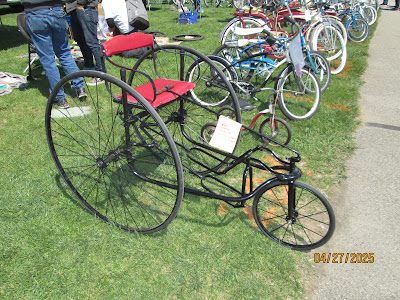
An early 1960s Five Rams from China. It doesn't fold; rather the front assembly via the rectangular top tube slides to the rear to drastically shorten the bike for transporting or storage. 16-inch wheels. I neglected to ask the price.
A Puppy (or maybe Road Puppy) folding bike. Tires are 16x1.6 (40-305). From what I found online, these were made by Shimura Seiki Co. and were a civilian version of bikes used by Japanese paratroopers in World War II .
The bicycle show inside the Expo Center is a small part of the overall event. Judging takes place in several categories. The red bike (above) with white tires is a 1966 Raleigh RSW 16.
Tuesday, April 29, 2025
40th annual Michigan HPV Rally T-shirts - ordering deadline May 18
Here's the design of the T-shirt for the 40th annual Michigan Human Powered Vehicle Rally.
The artwork was done by Charles Brown and his computer (thank you, Charles), with the lettering added by Teresa at Parkside Printing Ink in Port Huron, which will be printing the shirts. Red is the only color available.
The deadline to order, originally May 14, has been extended to Sunday, May 18. Parkside will be ordering the blank shirts on May 19, to give it enough time to receive them and then print the image on the shirts.
Standard shirts are available in sizes S - XL. If you want larger than XL, or female specific shirts, ask and I will ask Parkside for the price.
Shirts will NOT be available to purchase at the rally, so that I (Mike Eliasohn) don't end up with unwanted shirts. I will pay Parkside for the entire order, then at the rally, those who ordered by the deadline can pay me and get their shirt or shirts. I will take cash or a check, made out to Michael Eliasohn.
As of May 15, the price will be $22 per shirt, subject to change. So if you plan to pay by check, don't write the amount in until you get to the rally.
If you want to order a shirt, but won't be at the rally, the cost will be $10 additional, for postage and envelope.
TO ORDER A SHIRT, email mikethebike2325@comcast.net and give me the size needed (or number and sizes, if more than one shirt).
If you are at the rally, but did not order a shirt, then decide you want one, I will ask Parkside if an extra shirt or shirts can be made, but can't guarantee.
Mike Eliasohn
Friday, February 7, 2025
40th annual Michigan HPV Rally - June 7-8, 2025
The 40th annual Michigan Human Powered Vehicle Rally will take place June 7-8 at the Waterford Hills sports car racing track in Clarkston, on the grounds of the Oakland County Sportsmen's Club, the location since 1986.
Come see some unusual – and fast – 2- and 3-wheel cycles. Spectators admitted free.
Classes for streamlined, unstreamlined cycles, tandems, women, youth and tricycles.
Free camping available at track Friday after 5 p.m. ( a car event is scheduled to run until 5) and Saturday nights. (OCSC clubhouse open for dinner until 9 p.m.)
Entry fees (same as in 2024): $30 for one day, $45 for two days. High school & college teams, $40 for first vehicle and rider; $10 for each additional vehicle or rider.
40th anniversary T-shirts can be ordered until Sunday, May 18, with delivery and payment made at rally. Ordering information and prices are in the posting above this one. DEADLINE IS PAST
To register in advance, which saves time Saturday or Sunday morning, click here:
Saturday, June 7: Registration starts at 8.
ONE-HOUR TIME TRIALS: Separate races for faster & slower vehicles, starting at 9:30 (streamliners, street liners, other fast vehicles) & 11.
Concession stand open for lunch, 11:30-1. NOTE: Every year we have to convince the concession stand operators – Waterford Hills Road Racing and OCSC – there will be enough customers to make it worthwhile to operate the concession stand, so please plan to buy your lunch there, rather than bringing it or eating off site.
After lunch: HILL CLIMB / COAST-DOWN; riders start at bottom of hill and race up it one at a time. At top, they start coasting until they stop.
Then, standing start KILOMETER.
After kilometer event, we will have a one-lap memorial ride of silence to honor David "Doc" Pearson and Bill Frey, who died in the past year and did so much for HPV racing.
If time and enough interest in afternoon, we might also conduct the urban transportation contest or tricycle race or old-timers race.
Trackside dinner Saturday evening, catered by Mark Berend, who has catered many of our Saturday evening dinners in the past. Cost will be $15.
Sunday, 8:30 a.m.- 12:30 approximately. SPRINT (top speed) EVENT: Racers start at top
of hill, pedal down it one at time, then timed over 200-foot stretch. Then, ROAD RACES on short course, not including hill, usually faired classes in first race, 12 miles, then unfaired classes, 9 miles.
Then, awards ceremony.
Concession stand will NOT be open, however, OCSC clubhouse opens for lunch at noon.
We will need volunteers to help set up and run events, so please be prepared to help.
| if you have questions, suggestions or comments, contact rally organizers Mike Mowett, mowett@aol.com, or Mike Eliasohn, mikethebike2325@comcast.net TO GET TO THE RALLY: From I-75, get off at exit 91. Take M-15 south to Dixie Hwy. (US-24). Turn left, continuing south about 1 mile and turn left onto Waterford Road, then proceed to track. If coming from the west, take U.S. 23 north (or south) to M-59 (Highland Road). Go east on M-59 to Airport Road, then left (north) to US-24. Turn left, then immediately right onto Waterford Road. Go about a half-mile to track. CAMPING Free camping available overnight Friday and Saturday in the infield of the Waterford Hills track, starting at 6 p.m. Friday. Restrooms, showers and electrical hookups. Oakland County Sportsmen's Club clubhouse open for dinner Friday until 9 p.m. STATE CAMPGROUNDS (www.michigan.gov/dnr, then click on "make a reservation. Highland Recreation Area, 5200 E. Highland Road (M-59), White Lake, 248-889-3750. Two miles east of Highland. Holly Recreation Area, 8100 Grange Road, Holly, 248-634-8811. Five miles east of Holly. Pontiac Lake Recreation Area, 7800 Gale Road, Waterford, 248-666-1020. Closest to Waterford Hills track, about 4 miles west. OAKLAND COUNTY: Groveland Oaks County Park, 5990 Grange Hall Road, Holly, northeast of Holly, 248-634-9811. HOTELS / MOTELS (with approximate distances/direction from Waterford Hills track) Clarkston - Olde Mill Inn of Clarkston, 5835 Dixie Hwy., 248-623-0300. Across Dixie Highway from Waterford Road leading to track. This is the closest motel to the track. Hartland - Best Western of Hartland, 10087 Highland Road (M-59) at US-23, 810-632-7177, 61 rooms. About 18 miles west. Waterford – American Inn and Suites, 7076 Highland Road (M-59), 248-666-8555, 111 rooms. About 3 miles southwest. Waterford – Holiday Inn Express & Suites, 4350 Pontiac Lake Road, 248-674-3434, 83 rooms. About 7 miles southwest. Whitmore Lake - Days Inn, 9897 Main St. (off US-23, exit 53), 734-550-0105, 60 rooms. About 33 miles southwest. | |||