Monday, March 9, 2015

MHPVA annual meeting – changes & the future


David Middleton, WMU adjunct assistant professor of product design, talks about the Velo-Electric Sidecar, a project by three senior product design students. It's attached to a no-longer-produced Sun Sunray bike. There's an electric motor in the rear hub, a battery on the rear rack and inside the sidecar, a larger battery and space for groceries or other cargo.  Bottom photo: What makes the V-ES "trick" is that the upper strut can be unbolted, thus allowing the rider/bike to lean when cornering. But if roads are slippery, the strut can be attached to the bike to create a "solid" three-wheeler for extra stability.  (Photos by Mike Eliasohn unless indicated.)


The annual meeting of the Michigan Human Powered Vehicle Association took place Saturday, Feb. 28, in the College of Engineering and Applied Sciences building on the Western Michigan University Parkview Campus in Kalamazoo. Twelve people attended.
President Mike Mowett had to be at work, so was unable to attend. Vice President Mike Eliasohn presided in his absence. Following are the minutes from Secretary Paul Pancella, with editing and some other changes made by Mike E.
Michigan HPV Rally
The first item discussed was planning for the 31st annual rally June 13-14 at the Waterford Hills sports car racing track in Clarkston. 
Paul Pancella volunteered to run the urban transportation contest again on Saturday afternoon. 
There was strong sentiment against running the standing start 1-kilometer timed race and no one present advocated for it.  It was decided to replace it with a fun event that would potentially be easier to run and score (who finished first, second, etc., rather than having to time each competitor). It would be a fairly short race with a Le Mans-style start (riders running across the track and then climbing on or into their vehicles), with possibly some cargo carrying requirement and a mid-course mandatory pit stop.  Further details are to be determined and the finishing order may be incorporated into points for the UTC.  The rest of the event schedule will remain the same as in previous years.
We then discussed  Charles Brown's idea for creating a "sport" sub-class within the Human Powered Race America (HPRA) “stock” class that would favor vehicles which are more “streetable” than the low racers which now dominate the category. 
Charles' argument, expressed in a letter to Mike E., is the stock or unfaired class was created to encourage development of practical vehicles for use on the road, but, "This group is now being dominated by the lowracers, which enjoy an aerodynamic advantage over bicycles with a higher seating position." The higher seating position makes such "sport" bikes more visible to motorists, hence are safer.
Accordingly, Charles suggested to qualify for the sport class, riders eyes must be a minimum of 42 inches above the ground.  
The consensus was not to formally define and score such a subclass at Waterford this year, but to measure the height of a rider’s eyes above the ground on stock class entries during tech inspection.  Then we can see if there is a logical place to make a cutoff, how the potential qualifiers perform (if there are any) and gauge the level of interest among competitors  and use the information to decide whether to include a "sport" subclass in future years. (Note: After everyone got home, some got their tape measures and climbed on their bikes. Their eye height measurements were: Tour Easy, 49 in.; Lightning P-38, 48 in.; Ryan Vanguard, 53 in.; and a lowracer, 27 in.) 


Jake Meyers, who graduated from WMU in December, shows the Handi-Bike, a combination wheelchair/bicycle, he helped design as a student in product design engineer. Rather than conventional handrims attached to the wheels for propulsion, the Handi-Bike uses an elliptical drive system, with the user moving levers back and forth, one for each wheel, which also enables him or her to steer. The rear wheel is suspended. It's mounted to a beam, which can be slid inward to make it the Handi-Bike shorter when used inside.  Bottom photo:  Terry Gerweck holds the levers, which slide back and forth to drive the red sprockets, which are linked by chains to the hubs. There's individual drive for each wheel, so the system also can be used to steer, that is, propelling only the left wheel makes the Handi-Bike turn right and vice-versa.  (Paul Pancella photo)


Then we moved to a discussion of the rally’s fee structure and the problem of multi-rider/vehicle teams and riders sometimes "jumping in" just before the start of a race. 
Bruce Gordon said the 2014 rally broke even financially, but we should nevertheless consider raising entry fees.  The related issue of “team” entries occupied the bulk of the discussion time.  We resolved the following:
1)  For the normal competitor, every vehicle must be registered and pay the same fee as last year – $30 to compete on one day, $40 to compete on both days.  An individual racer may compete in multiple vehicles when the schedule and class structure allow (at the discretion of the race director), but each vehicle must have a paid registration and its own number, per HPRA requirements.
2) For the past few years, college and other teams were paying $100, regardless of the number of riders and vehicles. The change: For teams, defined as any group in which multiple riders may compete in the same vehicle over the course of the rally, every unique combination of rider and vehicle must register separately in order to participate in any event.  Every such combination will be charged $15 for the weekend and have its own unique number, consisting of the vehicle number (appropriate to the competition class) and a letter suffix.  Registrations must be complete and paid for by Saturday  morning for all participating combinations, to prevent a rider deciding just before the start of a race to participate.  It will be the team’s responsibility to prominently display the correct number on the vehicle for every event.  
For example, the same vehicle would display the number 305-A when raced by Joe Smith, then 305-B when raced by Celia Jones, even if it is in the same event (such as the sprints).   Then observers don’t have to record names at the starting grid.  All such numbers must be traceable to a registration sheet that has the proper rider name on it.  At the discretion of the treasurer or race director,  additional team registrations may be accepted on Sunday morning for that day's events.  Since this will be a change from recent practice, we need to publicize this widely ahead of time.


David Middleton of Kalamazoo also brought his Cruzbike Quest, which he bought last year. Wheels are 26 in/559mm and gearing is a SRAM Dual Drive, which combines a 3-speed hub with nine deraileur sprockets. It folds. Dave previously rode a mountain bike converted with a Cruzbike conversion kit into a front-wheel-drive recumbent. 

Since Bruce Gordon volunteered to do the work, members agreed to have advance registration available online, along with the option to pay ahead of time via PayPal.  The fees mentioned above apply only if the registration takes place in advance.  Any registration that takes place at Waterford will cost $10 more (regardless of whether it is for one or both days).  Advance payment is not required to avoid this extra $10 fee, only advance registration.  We did not discuss a specific deadline for advance registration; Bruce will have to determine what is reasonable and publicize it appropriately.  I (Paul) think we meant this extra $10 to apply to team entries as well, so that if a team anticipates all of its rider/vehicle combos, they only cost $15 each, but adding another one on Saturday morning would cost $25.  (Note: Although Bruce is no longer MHPVA treasurer, he did agree to being treasurer of the rally.)
Future of the MHPVA
We had extensive discussion about matters relating to leadership, finances, insurance, and the legal status of the Michigan HPVA now and in the future.  Being a chapter of the International Human Powered Vehicle Association, as specified in our articles of incorporation, seems to have lost any relevance it may have had, but we as an association still feel like more than just an event organizer for the HPRA series. 
The bylaws and articles of incorporation were written in 1989, before there was e-mail, so one needed update is that they currently require that notification of the annual meeting be mailed to members.
After a bit of communal soul-searching, we determined that there is no immediate crisis, and that we should continue more or less as we are.  Bob Krzewinski volunteered to study needed changes to the bylaws and articles of incorporation to modernize the requirements for communication or other things, and then pass them around to the other officers. Any changes will have to be approved by the board and/or the members.


MHPVA co-founder Terry Gerweck of Monroe showed his latest creation, an ice bike using an old Dan Hanebrink Design bike.  Self-taping screws were screwed into the tire to provide traction. Rather than attaching the ice boat blade directly to the fork, Terry attached it to a ski so that the front end will slide over any holes in the ice, rather than "wiping out." 

Elections 
Prior to the meeting, Mike Mowett, who was president since 2008, said he didn't want to be president any more and Bruce Gordon didn't want to continue as treasurer. So elected or re-elected were:
President, Mike Eliasohn, St. Joseph; vice president, Mike Mowett,  St. Clair Shores;secretary, Paul Pancella, Kalamazoo, treasurer, Bill Frey, Grosse Pointe Farms; and members at-large, Wally Kiehler, Grosse Pointe Woods, and Bob Krzewinski, Ypsilanti.
Note from Mike E.: I am a co-founder of the MHPVA and long-time president or vice-president and Bill Frey was treasurer for 12 years before Bruce became treasurer at the 2014 meeting. Both of us are in our 70s and, I think it's correct to say, both of us view our new positions as temporary.
Accordingly, there was discussion during the meeting about the future of the MHPVA, and whether it has a future. As expressed by Bill in his e-mailed summary of the meeting, we need to "take a serious look at whether the MHPVA and the rally are sustainable in future years, given the difficulty we have had to get new people more involved in the organization and on the board."
The Michigan HPV Rally is the only event on the Human Powered Race America schedule that is run by an organization, as opposed to individual race organizers, so it would be possible for the rally to continue – if one or two people are are willing to organize and run it each year. And instead of an annual meeting, there could continue to be an annual winter gathering, if desired and someone wants to organize it, and this blog also could continue.


John Foltz of Haslett brought his Baron, to show his latest modifications, a carbon fiber fork and a front disk brake caliper where both brake pads move, rather than one pad moving and the other being in a fixed position.


Tim Bazzinett of Brighton was riding his upright road bike when he got passed by someone on a low racer and he decided he had to own one. He bought his used Baron last fall and, "I've been riding it ever since." On a downhill, he reached 46.7 mph. "It was a thrill."


Sunday, January 4, 2015

2015 meeting, rally dates set

The annual meeting of the Michigan Human Powered Vehicle Association will be Saturday, Feb. 28, in Kalamazoo, while the 31st annual Michigan HPV Rally will be Saturday and Sunday, June 13-14, at the Waterford Hills sports car racing track in Clarkston, the location since 1986.
The meeting will be in Room D-115 (tentatively) in the College of Engineering building, 4601 Campus Drive, on the Western Michigan University Parkview Campus. 
The location continues our rotation of recent years of meeting at WMU one year (the last meeting there was in 2012), the next year on or near the Michigan State University campus in East Lansing and the following year in the Ann Arbor-Detroit area.
MHPVA board members will meet at 11 a.m. for lunch, but all members are invited. We will meet at Sophia's House of Pancakes, 4700 Stadium Drive (north side of the road), about a half-mile east of U.S. 131, and close to Drake Road.
Then mingling and talking HPVs in the College of Engineering building will start at 12:15 p.m., with the meeting starting at 1 and hopefully ending no later than 4.
We will start the meeting with show-and-tell, so if you have something pedal-powered and interesting, please bring it.  Following will be discussion of the Michigan HPV Rally and other events and then election of officers and board members for one-year terms.  Currently serving are:   President, Mike Mowett, St. Clair Shores; vice president, Mike Eliasohn, St. Joseph; secretary, Paul Pancella, Kalamazoo; treasurer, Bruce Gordon, Buchanan; and members at-large, Wally Kiehler, Grosse Pointe Woods, and Bob Krzewinski, Ypsilanti.

Driving directions from I-94 – At exit #74, turn north on U.S. 131, go 2.8 miles, then follow the directions listed below for U.S. 131.
Driving directions from U.S. 131 – At exit #36A, turn east onto Stadium Drive, then turn right at first light, which is Drake Road. Continue on Drake through the next light (at Parkview Ave.) into the WMU Parkview Campus. You will now be on Campus Drive. 
The College of Engineering and Applies Sciences building is at the rear of the campus, is  is the largest building and there is an adjacent large parking structure and a parking lot. Parking permits aren't required to park in the structure on Saturdays.
Anyone with vehicles or other heavy items to show can unload at the main entrance at the front of the building.  All doors to the building should be unlocked.

The 31st annual Michigan Human Powered Vehicle Rally will be June 13-14 at the Waterford Hills sports car racing track on the Oakland County Sportsmen's Club grounds,  4770 Waterford Road, Clarkston, near Pontiac (map link - https://google/maps/RrMBM). Free camping is available on Friday and Saturday nights.
The schedule of events will be decided at the annual meeting and then posted on the blog and website (www.mhpva.org), but no doubt will be similar to past rallies. For a track map, visit www.waterfordhills.com/facility.shtml

Thursday, October 23, 2014

Recumbent Cycle-Con – Oct. 10-12, 2014


Fran Kowalik of Deerfield, Ill., well-known in HPV racing circles, on the new ICE Full Fat FS (full suspension), before pedaling it outside for a test ride. The Full Fat is the "civilian" version of the similar trike that Maria Leijerstam pedaled 396 miles from the edge of the Antarctic continent to the South Pole last December. The Full Fat will be available from the British trike maker for somewhere between $5,000 and $7,000. (www.icetrikes.co)

Words and photos by Mike Eliasohn

It was recumbent heaven for laid-back cycling enthusiasts who attended Recumbent Cycle-Con Oct. 12-14 in St. Charles, Ill., west of Chicago.
It was the third such event conducted by Recumbent and Tandem Rider Magazine (www.rtrmag.com). The first two, in 2011 and 2013, were in Pomona, Calif.  The 2015 RC-C will be in (or near) Cincinnati, Ohio.
The event drew about 17 manufacturers, plus a few recumbent dealers (as exhibitors) and makers of accessories, such as car carrier racks. Human Powered Race - America also had a display of racing bikes and trikes, organized by Warren Beauchamp.
The first day (Friday) was limited to "those in the business," while Saturday and Sunday were open to the public. Admission was $10 for "looking only," while those wanting to look and ride bikes and trikes on the test track paid $20.
There also were workshops, with some sessions limited to dealers, such as ways to increase their business, while others were of general interest, such as touring on recumbents and racing.
TerraTrike in Grand Rapids showed its new Traveler folding trike, but I neglected to take photos.(www.terratrike.com)  It goes on sale in January.
For more information about it and other bikes and trikes shown at Recumbent Cycle-Con, go to www.bentrider.bike. from which I got some of this information. (Bentrider editor Bryan Ball had a booth at the show.)
Recumbent and Tandem Rider publisher Charles Coyne and his wife, Janette Bijl, both said they found that Recumbent Cycle-Con draws people mostly within a 500-mile radius, which presumably precludes the event being held in the future on the East or West coasts. If you're shopping in the future for a recumbent, or simply want to see (and ride) what's available, the event is worth going to.


Sun Seeker had numerous bikes and trikes on display and available for test rides.  The blue trike is the new Eco Tad SX ($900) and behind it is the new Eco Delta SX ($830), with the two wheels in the rear. J and B Importers has rebranded its recumbents "Sun Seeker," to distinguish them from its "Sun" brand upright bikes and trikes. Most bike shops can order them. (www.sunseeker.bike)


The very flat test ride area outside the DuPage Expo Center consisted of a short straight, turn right, another short straight, followed by a U-turn, another short straight, turn left, then go back to the start, seen here. Test riders could pedal "whatever" from inside the building through the large overhead door opening onto the track.  The young lady at left is riding (I believe) a hand-cranked Greenspeed Hand Magnum.


Linear Recumbents debuted its Minear, designed for shorter riders. The front wheel is 16-inch; the rear, 20-inch.  It also introduced folding versions of its Roadster short-wheelbase and Limo long-wheelbase. The frames are aluminum and the bikes are built in New York state. (www.linearrecumbent.com)


Tim Brummer (yellow shirt) has headed Lightning Cycle Dynamics for at least 30 years.  Among the bikes he had at the show was the new Phantom II ($1,795), with improved frame and seat. It's available with a 16-inch front wheel and 160mm cranks for shorter riders, as well as a 20-inch front wheel and 170mm cranks for non-short riders.  (www.lightningbikes.com.)


Fred Watner of Louisville, Ky., tries the BerkelBike, sold by Rad Innovations in Granville, Vt. (www.rad-innovations.com).  The front wheel is driven by conventional foot cranks, as well as the handlebars, when "pedaled" forward. Braking is done by cranking the handlebars backwards. The handlebars also do the steering, of course. The BerkelBike is intended for people with disabilities, but also can be used by anyone who wants to strengthen their arm muscles, as well as their legs. There's a choice of 8- or 11-speed transmissions.


Another view of the Rad-Innovations display area. The Tri-Rad is in front, which would be ideal for anyone who wants a recumbent three-wheeler, but doesn't have much storage space. It sells for around $1,700.  Behind it is a tricycle, pedal-powered by the rider in the rear, with a platform in front for carrying a person in a wheelchair. In addition to cycles for people with disabilities, Rad-Innovations also is a distributor of Hase Bikes (which makes 2- and 3-wheelers, including some for people with disabilities) and Birdy folding bicycles.


Tuesday, September 16, 2014

Michigan Recumbent Rally - West, Sept. 6, 2014


Words and photos by Mike Eliasohn

The annual Michigan Recumbent Rally - West, organized by Paul Pancella, took place Saturday, Sept. 6, in the parking lot outside the College of Engineering building on the Western Michigan University Parkview Campus in Kalamazoo.
There was a good turnout of recumbent two- and three-wheelers, some of them for sale, and some non-recumbent cyclists who took advantage of the opportunity to try some laid-back cycles.


David Middleton of Kalamazoo has been at the past few rallies with a mountain bike converted into a front-wheel-drive recumbent with use of a Cruzbike conversion kit.  He's now taken the financial plunge and bought a Cruzbike Quest, which folds. Wheels are 26 in/559mm and gearing is a SRAM Dual Drive, which combines a 3-speed hub with nine deraileur sprockets.  Learning to ride a FWD with moving bottom bracket takes patience.


Gabe Lagina (tan shirt, gray cap) from Breakaway Bicycles and Fitness in Portage came with two TerraTrike three-wheelers and two Bacchetta two-wheelers. In addition to those brands, it also sells Sun recumbents – and lots of upright bikes. There's also Breakaway stores in Grand Haven and Muskegon. The orange TerraTrike Rambler by the van's rear wheel now belongs to the editor of this blog.


Richard Tool came from Dayton, Ohio, with his ICE Sprint FS. All three wheels are suspended, it folds, has 30 speeds (3x10 gearing) and weighs 43 pounds. He bought it in February 2014 due to equilibrium problems and is his first recumbent. He said it's only slow going up hills. The next day he rode it in the nearby Vineyard Classic Bicycle Tour, which starts and ends in Paw Paw.


Andy Knight of Cooper Township (Parchment area) brought his Day 6 Journey, which has a Shimano Nexus 7-speed hub gear.  Last year, he rode it 41 miles to South Haven. Day 6, which apparently is having business problems, is based in New Hudson in southeastern Michigan.


This bike was not at the recumbent rally, but I (Mike E.) thinks it's cool, hence the photo here. Builder/owner Joel Wiggins of Kalkaska brought it to the fourth annual Cycle-Re-Cycle bicycle show and ride Aug. 23 in Benton Harbor. (C-R-C is a all-volunteer non-profit bicycle shop.) Joel built the bike using an old Huffy tandem frame. It's what's called a burrito bike, described as long and low. Add a backrest and more than one gear and it becomes a recumbent.

Wally Kiehler's Coast-to-Coast Adventure


Wally Kiehler started his journey June 15 by dipping the rear wheel of his Lightning P-38 in the Pacific Ocean at Everett, Wash.


My Coast-2-Coast Tour with Cycle America
or
Over 1 Million Pedal Revolutions in 9 Weeks


By Wally Kiehler, Grosse Pointe Woods

More than 1 million pedal revolutions is what my fellow riders and I figured we pedaled when we rode coast to coast (C2C) from Seattle to Boston with Cycle America this summer (9 weeks / 4,200 miles).
We got this number by using the average number of hours on our bikes each day and our average cadence each day. 
Each day we cycled 60 to 100 miles.  My average cadence is 60.  Almost every day we climbed hills.  Some were steep hills for me.  A few times I decided to walk.  Some times I just couldn't pedal up 15 percent hills for a long distance.  A few times I decided to walk because I could only pedal 4 mph and it was much easier to walk 3 mph.
(Editor's note: The journey started June 15 in Everett, Wash., and ended 4,244 miles later on Aug. 16 in Gloucester, Mass.)
When we crossed through Michigan, I decided to exchange my heavy Lightning P-38 with both panniers for my lighter/more aero carbon fiber M5 with small cargo bag.  I found this increased my average speed by 15 percent. 
None of the riders on their 15-to-20-pound  diamond frame bikes had to walk any hills.  Many of their bikes only had two chainrings.  They were at an advantage at climbing – but a disadvantage in comfort.  I noticed some of the male riders using butt creams in the locker room.  I heard that it helps relieve their butt sores.
We started in the state of Washington in June.  The weather, as expected, was terrible.  Cold and rainy.  And hilly.  We had a few major climbs that required rain jackets and gloves.
I remember one 16-mile climb.  I was in my lowest gear all the way up.  Then we rode through the most scenic areas out west such as Yellowstone, Tetons, the Badlands, Crazy Horse and Mount Rushmore. 
As we crossed the middle of the country we were blessed with moderate weather because it usually is 90 to 100 degrees there during the days in July.  As we rode to the eastern part of our tour we visited Niagara Falls and Lake Pacid.
For more descriptive entries (including photos) you can read my daily journal at:
www.crazyguyonabike.com/, then click on "journals," then search for "wallyk." (www.crazyguyonabike.com/wallyk also works.)
This adventure was a long range goal of mine for several years.  And now that it is over, I don't have another bike adventure to look forward to.  Nine weeks was a very long time to be on the road and away from home.  I think I will stay with much shorter touring adventures.


Wally ended his journey Aug. 16 by dipping the front wheel of his carbon fiber M5  in the Atlantic Ocean at Gloucester, Mass.

Following is Wally's last journal entry, which gives some additional information.

Aug. 21, 2014

It has been five days since this long tour ended. Five days without riding. Just trying to catch up on chores around my house. Lots of mail to open. My bike arrived byFedEx yesterday. I put it together today. I don't feel like riding this week, since I rode almost everyday for nine weeks.
As of today I rode 5,200 miles since last winter. My normal year is only 2,000 miles. This coast-2-coast tour has been my long range biking goal for several years.
I knew that the tour would take over two months and that I would be retired when I did it. Another bike club member, Bob Krzewinski of Ypsilanti, said he wanted to join me. At first we discussed riding either "supported" or "self supported." Each method has its advantages and disadvantages.
We eventually agreed that "supported" was the best fit for us. We chose Cycle America because it was the least expensive, it toured the preferred northern route, and it started in June. We made the right decision.
Cycle America owner, Greg, does an amazing job on this tour. He was on the tour and in control of everything for all nine weeks. He has an experienced staff of 10 to 12 that knows how to make everything go smoothly. We crossed the country from town to town like an experienced traveling circus. Three passenger vans pulling three trailers, one router car, and around 50 riders each week. Cycle America has been running this northern route for 20 years. They know what destinations are worth riding to, the best roads and bike paths to take, and what towns to spend our Sundays off.
I rode a recumbent. So I was challenged almost every day with hills. Some were steep enough that I had to walk them. But all were fun to come down on. A few downhills were up to 10 miles long and fast.
Thirty-four riders started the coast-2-coast, 30 finished. Bob K had to drop out at the end of week No. 2 because of health issues. He since has had surgery and is doing fine. Around 15 riders rode every mile cross-country. I missed 1.5 days.
It was amazing to experience the bond between the 30 C2C riders. We all had the same goal. We got to know each other quite well. We rode from town to town in small groups determined by each biker's speed. Some of us tent camped. Some slept inside. We ate our breakfasts and dinners together. I already miss seeing and riding with the riders.
I would highly recommend Cycle America for your C2C tour. They also offer one-week tours that I'm sure would be just as fun.
But I would not recommend doing the hillier tours on a recumbent unless you can climb hills a lot easier than I can. I ended up changing recumbents when we crossed through Michigan to my lighter/faster recumbent. And that helped me a lot.


Tuesday, August 26, 2014

Northbrook - Kenosha HPV races - July 2014

Photos and captions by Mike Eliasohn

The annual human powered vehicle races at the velodromes in Northbrook, Ill., and Kenosha, Wis., on July 19 and 20 respectively drew the usual good turnout and lots of streamliners.
For the results, go to www.recumbents.com, then click on "forums," then "HPV racing." Results are listed separately for the two days.


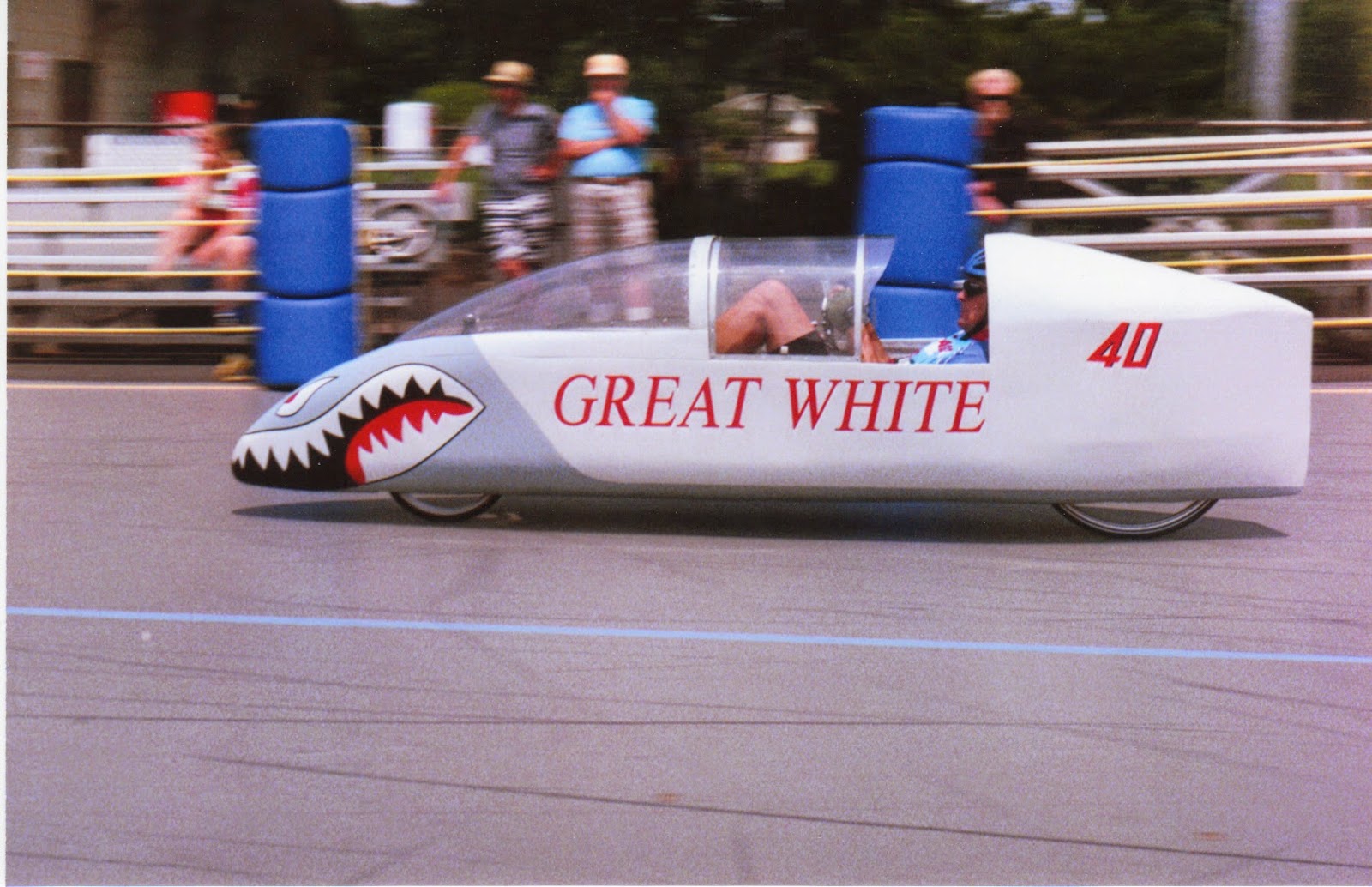
On July 5, Dave Johnson was in Rick Wianecki's garage in Okemos, doing some patching with resin to Great White's fairing before a new paint job. On July 19 at Northbrook, Dave was racing the streamliner, which had been toothless in recent years, with its new paint job, which he did.  Dave, from Olivet, owns Great White, built by Rick in the late 1990s. At Northbrook, Dave finished second overall in the 200m flying start at 36.76 mph. In the 100-lap race, he finished sixth, 18 laps behind, at an average speed of 29.1 mph. At Kenosha, he was third overall in the standing start kilometer and in the 70-lap race, he finished fourth overall, 12 laps behind, at 27.71 mph.


MHPVA President Mike Mowett of St. Clair Shores on his Morciglio M1 leads Dennis Grelk of Donnellson, Iowa, at Northbrook. Mike won the 50-lap race for unfaired vehicles at an average speed of 27.94 mph, with Dennis second. Mike also was fastest of stock class vehicles in the 200 meter flying start at 36.57 mph. At Kenosha, Mike was first in the standing start kilometer at 31.14 mph and also won the 30-lap race for unfaired vehicles. Speed was unavailable.


Clifford Lofgren, age approximately 5-3/4, of Buchanan, raced his KMX trike at Northbrook. In the 200-meter flying start, he averaged 15.22 mph and he completed 11 of the 25 laps in the junior/multi-rider race, at and average speed of 8.74 mph.


Also in the junior/multi-rider race at Northbrook were Clifford's grandparents, Bruce and Linda Gordon of Buchanan on their Organic Engines Troika. Clifford can be seen in the distance behind them – or maybe he was almost a lap ahead of them, since he finished ahead of them in the race. In the 200-meter flying start, Bruce and Linda averaged 21.98 mph.


At the Michigan HPV Rally May 17-18, Genevieve Kowalik, 9, of Deerfield, Ill., raced an upright bike But at the Northbrook-Kenosha weekend, she was racing her new low-racer that her father, Fran, had Rick Gritters build for her. The seat can be moved back as she grows. At Kenosha, shown here, she averaged 20.27 mph in the standing start kilometer. In the 10-lap race for juniors, she finished second at 19.75 mph. Rick, from Pella, Iowa, has built several low-racers for HPRA competitors and also races his own creations.

In the 70-lap race at Kenosha, Arne Toman in his Blue Velo Quest duels with Marc Jutras in the University of Toronto Ace. Arne, from West Chicago, Ill., has pedaled the carbon fiber Quest as much as 225 miles in a day, to Indianapolis, and to Green Bay, Wis., which took him 12-1/2 hours. He finished fifth in this race, completing 56 laps at an average speed of 26.79 mph. Arne's Quest, which has lights front, rear and underneath, had the only streetliner, so was competing against streamliners intended only for racing. In the standing start kilometer, he was 10th overall, at an average speed of 26.5 mph. Marc finished third in the 70-lap race, completing 64 laps at an average speed of 30.67 mph.

Wednesday, July 2, 2014

First Berrien Tricycle Rally - June 21, 2014


Daryl Hanger on his Catrike Trail leads Warren Beauchamp in one of the races. Daryl was the overall winner. Warren had the only leaning-trike at the rally – a front-wheel-drive low racer he built, fitted with a Dennis Grelk-built two-wheel attachment that bolts to the rear dropouts.

Words and photos (except one) by Mike Eliasohn; results by Bruce Gordon

The first Berrien Tricycle Rally took place Saturday, June 21, 2014, at Rolling Green Raceway, a quarter-mile kart racing track near Buchanan in Berrien County in the southwest corner of Michigan.
The rally was organized by, and was the idea of long-time HPV racer Bruce Gordon of Buchanan, with help with help from his wife, Linda. (Thank you, Linda, for the homemade muffins and sandwiches.)


Bruce Gordon, shown here on his Greenspeed SLR during the time trial – three laps of a short triangular section of the track – organized the first Berrien County Tricycle Rally.

The rally attracted 11 competitors, from Michigan (Bruce, Brian Stevens, Douglas Dodd and Clifford Lofgren), Illinois (Warren Beauchamp, Chris and Dora Cortez), Indiana (Daryl Hanger and Jeff Hunn), Ohio (Garrie Hill) and Ontario (Jim Iwaskow).
Here's the results:

                  Best Tm Best Spd In Lap   Diff   2nd Best 2nd Spd 2nd Lap
1   Daryl Hanger     38.891    23.142     8         - -        39.608   22.723   2
2   Brian Stevens    43.302    20.784     6     +4.411    44.725   20.123   3
3   Jeff Hunn          43.351    20.761     9     +4.460    44.719   20.126    3
4   W. Beauchamp  44.112    20.403     4     +5.221    44.883   20.052    3
5   Chris Cortez       44.983    20.008     6     +6.092    48.215   18.666    2
6   Bruce Gordon     47.066    19.122     5     +8.175    48.335   18.62      6
7   Jim Iwaskow      50.719    17.745     1     +11.828  50.883   17.688    3
8   Douglas Dodd     51.308    17.541     3     +12.417  52.627   17.101    1
9   Garrie Hill           54.726    16.446     1     +15.835     -.---      -            0
10 Dora Cortez        56.806    15.843     1     +17.915  58.001   15.517    4
11 Jim Iwaskow       58.639    15.348     2     +19.748  1:05.2    13.793    1
12 Clifford Lofgren   1:37.782   9.204     4     +58.891  1:47.7    8.351      2

Separate races by fours, based on hot lap times, were won by Daryl Hanger, Chris Cortez and Dora Cortez. A race for non-prize winners was won by Jim Iwaskow. Daryl Hanger's team won the relay race, and Daryl was the quickest in the short track time trial. 


 Jim Iwaskow on the Mike Sova-built trike, which Mike gave to him. It may look crude – notice the "stadium seating" – but it has rear suspension. (The pivot is the small circle behind the handlebars.) Jim also rode the trike the following day in the Berrien County Cancer Service Bike Ride.


Jim, from Richmond Hill, is listed twice because he competed on two vehicles, an ICE Vortex (7th place) loaned to him by Garrie Hill, and an aluminum (welded and bolted) trike (11th place) built by Mike Sova of Toronto "some time ago," Jim said, possibly a couple of decades or more. Sova, who gave the trike to Jim, has gone on to building streamliners raced at Battle Mountain. Garrie, from Granville, Ohio, raced his Greenspeed SLR.
Daryl Hanger, from Greenwood, Ind., finished first on a Catrike Trail, which isn't built for racing. (In other words, if he had a racing trike, he would be even faster.)


Clifford Lofgren finished last, but he has a good excuse – he's only 5-1/2 years old. He's Bruce and Linda's grandson and the son of Eric and Charlotte Lofgren, who also live in Buchanan. He raced a kid-sized KMX trike and likely is the youngest-ever competitor in Human Powered Race America sanctioned competition. (Bruce Gordon photo)


Special thanks to Grand Rapids-based manufacturer TerraTrike (www.terratrike.com). Director of marketing Jeff Yonker, his son, Gabe, and marketing assistant Michelle Oswald brought several TerraTrikes for test rides, plus a display of accessories. Likely the most popular for test rides was the Rover Tandem.

Also present for a couple of hours to spectate was Jerome Hediger, Greenspeed USA distributor, who rode his BMW motorcycle (only two wheels) from Highland in southern Illinois. For the unknowing, Greenspeed is an Australia-based recumbent trike manufacturer (www.greenspeed.com.au)


Chris Cortez lifts a wheel during the time trial on a short triangular section of the Rolling Green Raceway. The kart racing track is twisty and isn't level.


In addition to the pure racing events, there were some "fun" events, including a relay race, with competitors passing a tire, instead of a baton. Here, Bruce Gordon passes the tire to Jim Iwaskow, who was riding Garrie Hill's ICE Vortex.


Mark Bannan of Owosso came to the rally to spectate, with this trike that he built in the 1980s. Back then, he also built several other two- and three-wheel HPVs, all from aluminum tubing.In addition, from 1990-98, he organized the Delta College Challenge HPV races on the Sunday following the Michigan HPV Rally, which back then was on Saturday only.rail

 leads Warren Beauchamp in one of 
Words and photos (except one) by Mike Eliasohn; results by Bruce Gordon

Thursday, June 12, 2014

Articles worth reading

By MIKE ELIASOHN

If you missed these magazine articles when they were new, they're worth reading next time you're at your public or school library and maybe, like me, making photocopies.

"The Beastie Bike," Popular Science, January 2014 – Three pages and four photos of Graeme Obree, "The Flying Scotsman" (a movie worth renting), and the lever-drive, prone position two-wheel streamliner he built and raced at the World Human Powered Speed Challenge at Battle Mountain, Nev. in 2013. Popular Science might be accused of celebrity journalism. Obree went 56.62 mph, the fastest speed ever for a prone-position bike, but Sebastiaan Bowler of the Netherlands setting a top speed record of 83.13 mph in the Velox 3 streamliner at the same event earned only one sentence in the article.

"The Improbabable Flying Machines of Sywell," Popular Mechanics, February 2014. Eight pages and five large photos of the second Icarus Cup competition for human powered airplanes at Sywell Aerodrome in the United Kingdom, conducted by the Royal Aeronautical Society Human Powered Aircraft Group. Which leads to the question, why doesn't someone organize a similar competition in the United States?

Muskegon Chronicle, March 1, 1987. Jerry Mattson used  this article
as a source of information for his Michigan History article about the Bowden Spacelander.

"The Bowden Spacelander," Michigan History, January-February 2014. Five pages and seven photos (sort of).  The Bowden isn't a recumbent, but its molded fiberglass frame made it unique and it was manufactured in Michigan – hence the article in Michigan History. The bike is now highly prized by collectors. The author of the article is Jerry Mattson, who as a free-lance writer  working for the Romeo Observer newspaper, covered the Michigan Human Powered Speed Challenge, conducted by the MHPVA, in 2009, .

"How to Build a Bicycle-Powered Generator," Popular Mechanics, April 2014. Three pages and six photos or illustrations. The author, Rachel Arndt, started her project because she got tired of riding her bicycle trainer in her apartment in bad weather and going nowhere. When she finished, she still went nowhere, but had a cycle-generator that could put enough charge into batteries to power small electronics during power outages. 

Monday, June 9, 2014

Preview: Berrien County Tricycle Rally - June 21, 2014

Photo taken at Michigan Human Powered Vehicle Rally

The first Berrien County Tricycle Rally is on Saturday, June 21, at Rolling Green Raceway, a quarter-mile kart racing track with lots of turns. The track is at 2090 Miller Road, northwest of Buchanan, in southwest Michigan.

THE SCHEDULE: 
7:30 a.m. – Gates open.
7:30 - 9 – Registration, trike safety inspection 
9 - 11 – Solo racing.
11 – Group racing begins and will continue, with a lunch break, through the afternoon. How long it takes to give everyone their fill of racing will depend on how many show up to race.

Registration can be done online at http://bostonandpop.com/trike_rally until June 18. The cost is $20 if you register in advance online; $25 if you register at the rally.  

The rally will be conducted under the rules of Human Powered Race - America, which are posted at www.recumbents.com/hpra, then click on "rules and classes."

SPECIAL PRIZES: Azee Prize for the best performing team in the solo event. Team members must be separated in age by 58 years or by having one member of the team less than 12 years old and the other older than 50.
Ceepee Team Prize awarded in the solo event for best parent-child team using combined times. Stepchildren, foster children and grandchildren are eligible. Other relationships, such as niece, nephew, etc., will be considered at the race director's discretion.

Grand Rapids-based recumbent tricycle manufacturer TerraTrike plans to be at the rally from 9 a.m.-3 p.m. with various models available for test rides.

DIRECTIONS: The track is located 2 miles west of Redbud Trail on Miller Road. 
From the north: Take US 31 south to Snow Road. Exit #13. Go (right) west for about a mile and turn (left) south on Redbud Trail (at stop sign.)  Go about 4 miles south and turn right on Miller Road (name is on yellow junction sign.)
From the south: Take US 31 north to US 12. Exit #3. Go (left) on US 12 west for about 2 miles and turn (right) north onto Redbud Trail at traffic light. Go through Buchanan (traffic light) and continue on Redbud Trail for about 4 miles and turn left on Miller Rd (name on yellow junction sign.) 
From the west: Take US 12 east Exit #4a off I-94 (4 miles from Indiana border). Go (right) east for about 16 miles and turn north (left) onto Redbud Trail (second traffic light.) Go through Buchanan (traffic light) and continue on Redbud trail for about 4 miles and turn left on Miller Road (name on yellow junction sign.) 

If you have questions or need to cancel or make changes to your registration, e-mail pop@bostonandpop.com.

Participants in the rally Saturday are encouraged to also participate in the Berrien County Cancer Service Bike Ride the following day, starting at its office at 7301 Red Arrow Hwy., Stevensville.
Riders can start between 7 and 11 a.m., but must finish by 2 p.m. Routes are 15, 25 and 42 miles and 100k (62 miles). The cost is $20 ($35 for families) until June 13, $25 ($40) after that. Registration/payment can be done online at www.berriencancerservice.org/bccs-bike-ride. Proceeds help the BBCS provide free nursing care and support services to Berrien County residents with cancer.

The nearest restaurants to Rolling Green Raceway are in Buchanan. From the track, go east to North Main Street, then south into town. Some restaurants are downtown and others, including fast food, are clustered up the hill east from downtown.
The best locations for finding hotels/motels are near the junction of Route 51 and the Indiana Toll Road
(exit #77) or along I-94 in Michigan.

Sunday, June 8, 2014

30th annual Michigan HPV Rally - May 17-18, 2014

By Mike Eliasohn

Note:  Some of these results are incomplete, due to either more than one college team member racing the same vehicle or information being incomplete on some entry forms. 
Complete rally results and more photos are posted at www.recumbents.com/hpra, then click on "race results and pictures," then "2014 Michigan HPRA race results" or "pictures."    Mike E.

"Old and cold" describes the 30th annual Michigan Human Powered Vehicle Rally May 17-18, the oldest such event in North America and maybe the world.
How cold was it? The uniform of the day for those who had it, especially on Saturday, was a hoodie with the hood up, under a jacket – and gloves.  It was so cold that cars parked at the Waterford Hills track overnight Saturday "woke up" with frost on windshields and roofs.
There were 46 entries, but that doesn't translate into 46 riders or 46 vehicles. Some riders raced in more than one class and for the University of Toronto and Rose-Hulman Institute of Technology teams, there was more than one rider per vehicle, which caused some confusion in scoring results.
The Univ. of Toronto team consisted of 12 people, including faculty adviser Jun Nogami, and five or six vehicles, he said.  Rose-Hulman, in Terre Haute, Ind., had five people, including faculty adviser Michael Moorhead, and three streamliners, plus three other vehicles.
The third "team" competing was Fran Kowalik of Deerfield, Ill., and four of his children, Florian, 15, Mathias, 13, Cecilia, 11, and Genevieve, 9. But all five each had their own cycle to race.


Mike Mowett on his Morciglio M1 carbon fiber low racer recovers after winning Sunday morning's road race, 15 laps/9 miles on the short course (0.6 mile).  (Mike Eliasohn photo)

As usual, the stock class had the most entries, 20.  The top three were: 1) MHPVA President Mike Mowett, St. Clair Shores, on his Morciglio M1, 340 points; 2) Dennis Grelk, Donnellson, Iowa,homebuilt low racer, 307; and Warren Beauchamp, NoCom low racer, Elgin, Ill., 279. As usual, Dennis was the only person to compete in every event.
The top three in the other classes were:
Streamliner (8 entries): 1) Dennis Grelk in his Warren Beauchamp-built Barracuda, 312; 2) rider?, Rose-Hulman Celeritas, 310; and 3) Warren Beauchamp, homebuilt Barracuda, 283.
Wally Kiehler in/on his Lightning F-40, leads Richard Myers during the Sunday morning 20 lap/12-mile road race. They finished second and third respectively. On June 14, Wally and Bob Krzewinski, both riding similar bikes, but minus the fairings, depart on a 4,200-mile trip from Seattle to Boston, ending Aug. 16. Wally will blog about their journey, with hoped-for daily updates. Go to www.crazyguyonabike, then click on "journal," then "wallyk." (John Heiam photo)

Streetliner (6 entries): 1) Wally Kiehler, Gross Pointe Woods, Lightning F-40; 340; 2) Rich Myers, Xenia, Ohio, "Chiquita Banana" (it's yellow), 297; and John Simon, Portland, Lightning P-38 with fairing, 205. John only competed on Saturday. At a "young" 77, Rich was the oldest competitor.
Women: Dora Cortez of Chicago, riding a Gritters low racer or Bacchetta Corsa 24, was the lone competitor, 360,
Tricycle  (4 entries):  1) Daryl Hanger, Greenwood, Ind., Catrike Trail, 325; 2) Bruce Gordon, Buchanan, Greenspeed SLR, 300; and 3) Dennis Grelk, homebuilt low racer with his two-wheels-in-the-rear conversion, 295.
Junior (4 entries):  1) Florian Kowalik, M5 low racer, 360; 2) Cecelia Kowalik, Earth Cycles Sunset, 320; Genevieve Kowalik, upright bike, 295.
Tandem (3 entries):  Tedd and Donna Wheeler, Reed City, BikeE, 275. There was a tie for second place, 180 points, with the same Trek tandem from Rose-Hulman. R-H HPV team faculty adviser Mike Moorhead and Calvin Moes from the Univ. of  Toronto formed one team and students Louis Vaught, Chapel Hill, N.C., and Matt Skoria, Walla Walla, Wash., both R-H students, were the other.

Dan Zolyniak of Toronto, in the streamliner built by him and his wife, Amanda, leads the tandem team of Matt Skorian (front) and Louis Vaught from Rose-Hulman. In the rear, Rose-Hulman HPV team faculty adviser Michael Moorhead gets the R-H streamliner, ridden by ??, back on its wheels. This was during the 20-lap/12-mile road race Sunday morning.  (John Heiam photo)
   
    Here's the top two from each event:

Saturday: 

One-hour time trial:  Streamliner – 1) Warren Beauchamp, 22 laps of the 1.4 mile track at average speed of 30.794 mph, 2) tie: Dennis Grelk and ???, riding U-T Ace.  Streetliner – 1) Bill Hannon, Springfield, Ohio, Milan velomobile. 18 laps/24.375 mph; 2) Chris Evans, Flint, Quest velomobile. Stock – 1) Mike Mowett, 18 laps, 25.077 mph, 2) Dennis Grelk.  Women – 1) Dora Cortez, 12 laps, 15.485 mph.  Tricycle – 1) Daryl Hanger, 14 laps/18.141 mph, 2) Bruce Gordon.  Junior – 1) Florian Kowalik, 17 laps, 22.313 mph, 2) Cecelia Kowalik. Tandem – 1) Michael Moorhead and Calvin Moes,  15 laps, 20.442 mph, 2) Tedd and Donna Wheeler. 
Hill climb:  Streamliner – 1) Trefor Evans, U-T, 2) rider?  R-H Celeritas.  Streetliner – 1) Wally Kiehler, 2) John Simon.  Stock – 1) Trefor Evans, 2) Peter Wen, Univ. of Toronto???  Women – 1) Dora Cortez.  Tricycle – 1) Daryl Hanger, 2) Dennis Grelk.  Junior – 1) Florian Kowalik, 2) Cecelia Kowalik.  Tandem – Matt Skorian and Louis Vaught, R-H, 2) Tedd and Donna Wheeler.
Coast down ((combined with the hill climb; when riders reach the top of the hill, they stop pedaling and then coast):  Streamliner – 1) Trefor Evans, U-T) Dennis Grelk.  Streetliner – 1) Wally Kiehler, 2) Rich Myers. Stock – 1) Fran Kowalik, M5 M-Racer, 2) Dennis Grelk.  Women – 1) Dora Cortez. Tricycle – 1) Dennis Grelk, 2) Chris Cortez, xxxx.  Junior – 1) Florian Kowalik, 2) Cecelia Kowalik, 3) Genevieve Kowalik. Tandem – 1) Matt Skorian and Louis Vaught, R-H, 2) Tedd and Donna Wheeler.
Standing start 1-kilometer:  Streamliner – 1) Dennis Grelk, 1 minute, 22.78 sec./27.02 mph, 2) rider?  R-H Celeritas, 1:24.63, 26.43 mph. Streetliner – Wally Kiehler, 1:37.13/23.03 mph, 2) John Simon, 1:51.91/15.99 mph. Stock – 1) Mike Mowett, 1:29.29/25.05 mph, 2) Dennis Grelk, 1:30.72/24.66. Women – 1) Dora Cortez, 1:48.59/20.60 mph. Tricycle – 1) Dennis Grelk, 1:37.38/22.97 mph, 2) Daryl Hanger, 1:49.05/20.51 mph. Junior – 1) Florian Kowalik, 1:27.25/25.64 mph, 2) Genevieve Kowalik, 2:51.53/13.04 mph.  Tandem – 1) Mike Moorhead and Calvin Moes, 1:49.44/20.44 mph, 2) Tedd and Donna Wheeler, 2:12.91, 16.83 mph.

Among those waiting for the start of the hill climb / coast down are Fran Kowalik on his M-5 M-Racer and daughters Cecelia, 11, (green jersey) on an Earth Cycles Sunset and Genevieve, 9, (orange jersey) on an upright bike.  (Mike Eliasohn photo)

Urban vehicle competition: Points were awarded for time in the hill climb; finishing position in the coast down; time around two loops of an oval in the parking area, with braking performance evaluated at the finish; and points for each feature during an evaluation of the vehicle. Points were awarded for lights and fenders, front and rear; reflectors; daytime visibility; cargo carrying capacity; brakes; rearview mirrors; security against theft; convenience (getting on and off or in and out of the vehicle); weather protection; horn; bell; tools; tire pump; spare inner tube or tube repair kit; and "anything else."
Daryl Hanger on his Catrike Trail and Wally Kiehler on his Lightning F-40 tied for first with 32 points,  while John Simon with his Lightning P-38 with fairing was third. Tied for fourth were Univ. of Toronto HPV team adviser Jun Nogami on his Rock Lobster upright bike, which he uses for daily commuting and Dennis Grelk with his Barracuda streamliner, 25 points. Sixth was Tedd and Donna Wheeler on their BikeE tandem, 17 points.

         Our thanks go to Mark Berend, a friend of Mike Mowett, who brought his grill to the track, bought the food (for which he was reimbursed) and cooked the chicken, hamburgers and hot dogs. There were perhaps 50 people eating. With so much time spent next to the grill, Mark may have been the only person there who was warm (albeit smoky). Making his long day longer, his vehicle ran out of gas while he and his family were going home.
         Thanks also to Mike Mowett, who ordered the 30th anniversary cake from the nearby Kroger's.
         A special guest was former International HPV Association President Marti Daily, who drove with  her friend from Indianapolis, in time for the barbecue and reminiscing with old friends. Because Marti had to work Sunday at Home Depot, she and her friend left after dinner and drove home.


Fran Kowalik and three of his kids (left) apply the condiments during the barbecue following Saturday's events. Mark Berend did the cooking on the grill he brought to the track, as well as buying the food.  (Mike Eliasohn photo)

After dinner, Donna Wheeler, who handled everything involving the 30th anniversary T-shirts, presented special yellow shirts to Mike Eliasohn of St. Joseph and Terry Gerweck of Monroe, who started the first Michigan rally in 1983 in Monroe and have been involved ever since.  (For those doing the math, instead of the Michigan HPV Rally, in 1989, the Michigan HPV Association conducted the International HP Speed Championships in 1989 and the Michigan HP Speed Challenge in 2009.)


Michael Hinterseher moved last August from Germany to Farmington Hills with his family and his Milan SL velomobile. He commutes in it to work at Bosch. He spectated and took photos at the rally on Saturday, then competed on Sunday. He finished first in the streetliner class in the 200-foot sprints (39.77 mph) and in the 20 lap/12-mile road race.  (Mike Eliasohn photo)

Sunday:

Flying start 200-foot sprint: Streamliner – 1) Trefor Evans, U-T, 45.74 mph, 2) rider?, R-H Celeritas, 42.17 mph.  Streetliner – 1) Michael Hinterseher, Farmington Hills, Milan SL velomobile, 39.77 mph, 2) Wally Kiehler, 34.71 mph.  Stock – 1) Mike Mowett, 38.73 mph, 2) Dennis Grelk, 35.97 mph. Women – 1) Dora Cortez (29.84 mph). Tricycle – 1) Dennis Grelk, 31.06 mph, 2) Bruce Gordon, 27.77 mph.  Junior – 1) Florian Kowalik, 36.09 mph, 2) Cecelia Kowalik, 20.86 mph. Tandem – Mike Moorhead and Calvin Moes, 33.45 mph, 2) Tedd and Donna Wheeler, 27.27 mph.


On the short six-tenths of a mile course used Sunday morning, there was plenty of close racing. From left, Mike Moorhead, Mike Mowett, Jim Iwaskow, Dennis Grelk and ???.  Mike Mowett on his Morciglio M1 won the 15 lap/9 mile race.  (Bill Frey photo)

20 lap/12-mile road race for faster vehicles:  Streamliners – 1) Dennis Grelk, 2) rider?, R-H Celeritas.  Streetliner: 1) Michael Hinterseher, 2) Wally Kiehler.
15 lap/9 mile road race for slower vehicles:  Stock – 1) Mike Mowett, 2) Dennis Grelk.  Women – 1) Dora Cortez. Tricycles – 1) Dennis Grelk, 2) Daryl Hanger.  Junior – 1) Florian Kowalik, 2) Cecila Kowalik.  Tandem – 1) Matt Skorian and Louis Vaught, R-H (only competitors).

Prior to the start of the Sunday morning (I think) 20 lap/12 mile road race are, from rear, Wally Kiehler, Dennis Grelk, Amanda (standing) Zolyniak and her husband, Dan, from Toronto. The Zolyniaks were members of the University of Toronto HPV team. Now graduated, they built their own streamliner. Other than using a U-T mold for the fairing, the streamliner is their own design. They took turns racing it at Waterford Hills. On Sunday, Dan rode in the first race and Amanda in the second. In the 200-foot sprints, both had the same speed, 33.48 mph.  (Mike Eliasohn photo)


George Cooney of Royal Oak demonstrated his monocycle on Saturday. It's propelled like a scooter, that is, standing on one foot and pushing with the other. Pulling down on the handlebars provides added "thrust."  (Mike Eliasohn photo)