Sunday, January 17, 2016

Some creations by Charles Brown (old and new)

      Editor's note: Charles Brown is an ex-Michiganian. He and his wife, Blue, moved from Ann Arbpr to Clearwater, Fla., in August 1994, and on cold days like this (Jan. 17, 2015), he sends us warm thoughts.
     To us old-timers, Charles is best known for the wood-frame recumbents he built, some of which are shown below. But in more recent years, he's been building frames from cheap steel, doing the welding on the patio of his first-floor apartment (there's no apartments or patios above him), using a $300 mig welder he bought at a home improvement store.
     He makes sure his next-door neighbors are gone when he does the cutting, pounding, etc., inside his apartment. 
     Charles has taken his many years of experience in building recumbent bicycles and put them on "paper," so to speak.  Go to www.recumbents.com, as as of when this is being posted, "Charles Brown Recumbent Design" is the lead item.  It's divided into four sections:  Frame design, steering and ride, air drag and a very comprehensive summary with lots of charts.
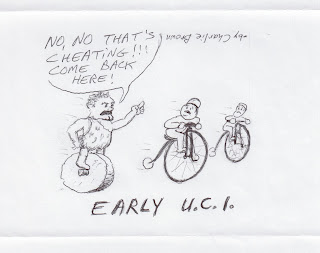
    I found in my "Charles Brown" file two cartoons he drew, but I never used, so I added those.
—Mike Eliasohn, editor


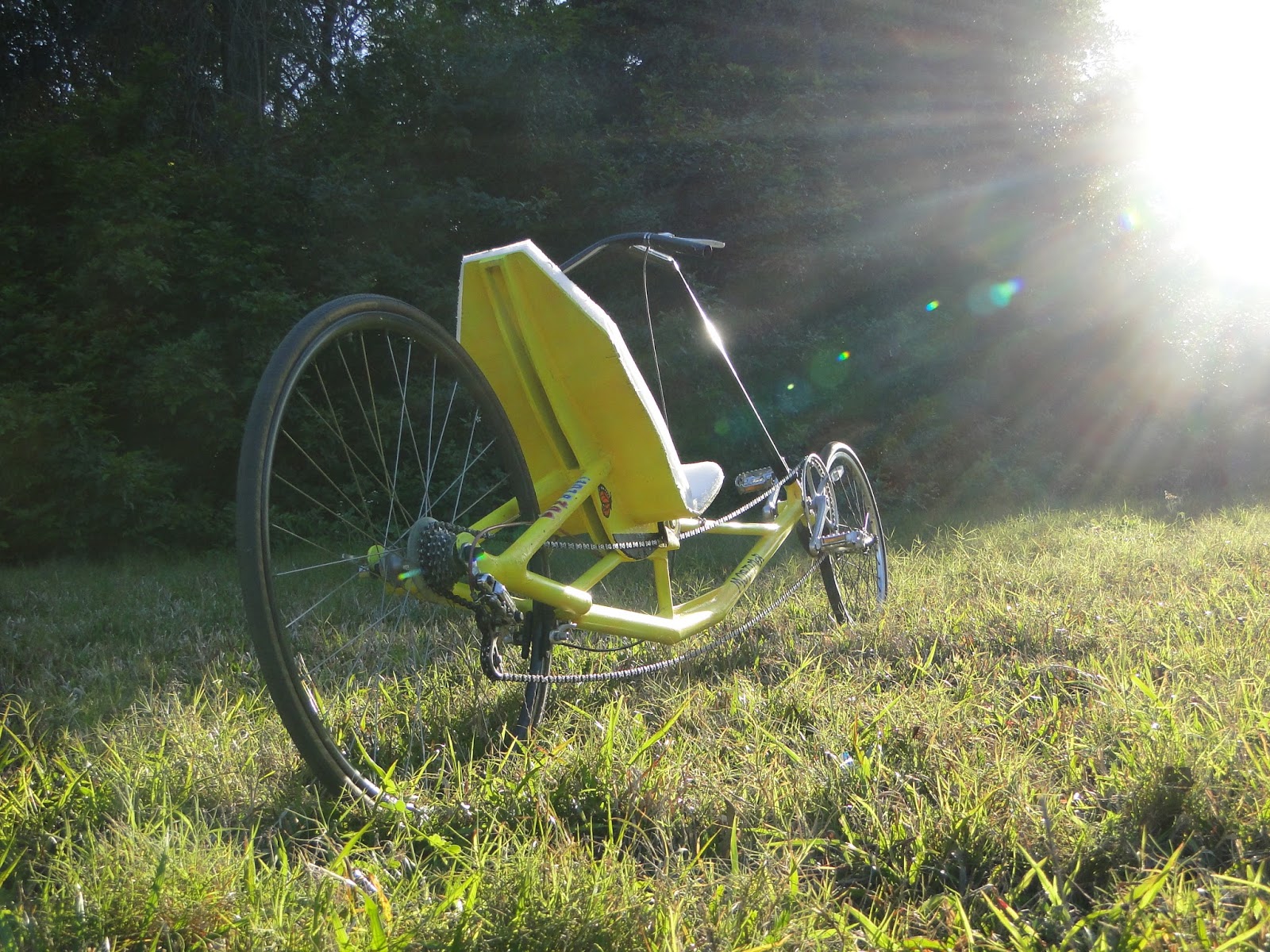
Mortimer, by Charles Meredith Brown

This is the most recent bicycle I've constructed, in 2014. Mike E. has been asking me for a while to write something about this bike for the blog. This one? It is not technically very innovative, just a long wheelbase bike with the seat lowered to 13" above the ground.
Other people tell me this is the best- looking bicycle I've built in a while. I agree. The triangulation is pretty good. If you look carefully, the idler is well- braced by the trusswork. I think many other people's idler mounts should be more solidly constructed - even some big-name manufacturers. More on my reasoning behind it can be found on "recumbents.com".
It's fun and comfortable to ride. I've found the air drag could be made lower by raising the feet and laying the seat back, which is where my thinking is now days.


The 'Moonlight' series of bicycles
by Charles Meredith Brown


I like long wheelbase bikes a lot. I think short wheelbase bikes, when equipped with light, high-performance tires, have too rough a ride.

Disadvantages with traditional long wheelbase bikes, as I see it, are the air drag is too high, and there isn't enough weight on the front wheel, so it slides out more easily than it should.
I started to think, if the whole rider position were rotated back to reduce air drag, space opens up under the cranks so you can push the front wheel back. Leaning back the seat means the back wheel has to move back to make room for it, so moving both wheels backwards relative to the rider puts more weight on the front wheel. The result would have speed, sharp cornering, and the smooth long wheelbase ride.

I've been futzing around on this design since 1994, trying different variations, wheel sizes, indirect steering systems, etc.

Here are pictures of several of the bikes. Almost all used the monotube frame design. The reason for this is that most of the frames are made of wood! Wood has an Achilles' heel of being flexible in torsion, so most successful wooden recumbent frames are monotubes of large diameter, hollow construction to cure this. 
 I did not own a camera for a long time, so many interesting bikes are not shown here.  Several used indirect steering.  I learned good-quality ball joints purchased from Wicks Aircraft (www.wicksaircraft.com) made a hugh difference, with much less lost motion in the steering.

This is Charles during the last Michigan HPV Rally he competed at, in June 1994.  The frame is a box structure, with thin plywood sides and half-inch thick wood top and bottom. Except for the tapers at the ends, the "box" measures 3 inches wide and 5 inches deep. The box runs to the right side of the rear wheel  and tapers to a solid fiberglass dropout. The left side stays were made of solid white pine.  The bike weighed only 26 pounds.   It was designed for a 16-inch front wheel, but there's a 20-inch wheel in the picture to squeeze a little more speed out of it for the race, which was okay as long as Charles was careful in tight turns.  


This one has a varnished wood frame and tailcone and was designed around a light, high-performance 16 x 1 front wheel produced for racing wheelchairs, using a Primo tire and Sun Metal rim.  The wheel was surprisingly durable in this use.  The hole  in the back of the seat was the storage compartment - just stuff in your things and go!  My bikes were used for commuting, so I had to be able to carry a few things.  The seat back was some stiff cloth webbing wrapped tightly in a one-piece spiral around two uprights.  This was uncomfortable at first, but slowly it shaped itself to my back and became quite nice, while still providing something stiff to press against.  The bike accelerated and climbed hills well, helped by minimizing how much the chain changed direction at the idler and a light, stiff frame.

This is OLYMA  (stands for On Your Left, Mr. [Lance] Armstrong!). The front wheel is unusually far back in the picture.  Many of my bikes ended up with a series of headset holes running down the frame as I tested different steering geometries, handlebar setups, and the like.


If you’re using almost any construction material other than wood, I recommend a truss structure as the design puts considerable vertical loads on the frame. This drawing shows how I’d build it if I were using metal tubes.


This bike's frame consists of a giant steel tube.  I had more steering tests to do on it, and this construction virtually eliminates torsional flex.


 I didn't write anything about this lime green bike 'cause I couldn't think of anything that really stood out about it.  


Monday, December 21, 2015

Dates set for annual meeting, HPV Rally

      The Michigan Human Powered Vehicle Association annual meeting will take place Saturday, March 5, on the Michigan State University campus.
      The 32nd annual Michigan Human Powered Vehicle Rally will be Saturday and Sunday, June 18-19, at the Waterford Hills sports car racing track in Clarkston.
      The meeting will be in the Erickson Hall Kiva Room, 620 Farm Lane. (Thanks to Tim Potter of MSU Bikes for making the arrangments.) We last met there on Feb. 21, 2009. The meeting will start at 1 p.m., beginning with show-and-tell, so if you have anything pedal-powered to show, please bring it.
     The meeting date was set, in part, because the 21st annual Quiet Water Symposium (www.quietwatersymposium.org) takes place that day in the MSU Pavilion, likely from 9-5:30, so there will be time to attend that event, plus the MHPVA meeting.
     Despite the "water" in the name, some bicycle organizations will be exhibiting at the symposium, so it might be worth attending, even if you are not a canoeist/kayaker/sailor, etc. Show-and-tell usually lasts at least a half-hour, so if you stay too long at the QWS, please still come to the meeting.
     The Kiva Room is on the ground floor, which will make it easy to bring bikes/trikes in and out for show-and-tell. 
     The International Center Foodcourt is a short walk away (less than 5 minutes). There's a coffee shop that also sells donuts, bagels and pastries. Board members and anyone else who want to meet beforehand for lunch should be there about 11:30-11:45. (But if you prefer to go to the QWS, please do, rather than meeting for lunch.) There’s also a Starbucks in Wells Hall, about the same distance away from Erickson Hall.
     Here’s a map link to Erickson Hall: http://maps.msu.edu/interactive/index.phplocation=eh Car and bicycle parking is available outside and is free on Saturdays.
     As we discussed at the 2015 annual meeting and HPV rally, the March 5 meeting will likely be the last for the MHPVA, that is, we will dissolve, unless some new people are willing to take over the organization.
     Both I and Bill Frey, our treasurer, are in our early 70s and have been involved with the MHPVA since the early days. At the last meeting, we volunteered to become president and treasurer again because no one else wanted the jobs, but did so with the understanding we would only do it for a year.
     If you want to read about our discussions regarding the future of the MHPVA – and please do – see the reports on the blog about the last annual meeting, posted March 9, 2015, and the Michigan HPV Rally, posted June 18, 2015.
     Bill Frey reminds us that the MHPVA is incorporated, so if it dissolves, the money in our treasury legally must be donated to non-profit organizations, so that will be a topic of discussion. It cannot be divided among the members, nor can we blow the money on a wild (or not-so-wild) party.
     An option would be for the MHPVA to continue as a less-formal club, but that would still require someone to be the leader, and we might also need a treasurer.
     For now, the MHPVA officers are: President, Mike Eliasohn, St. Joseph; vice president, Mike Mowett, St. Clair Shores; secretary, Paul Pancella, Kalamazoo, treasurer, Bill Frey, Grosse Pointe Farms; and members at-large, Wally Kiehler, Grosse Pointe Woods, and Bob Krzewinski, Ypsilanti.
     If anyone reading this has thoughts about the future of the MHPVA, please e-mail me at mikethebike2325@comcast.net. 
     Even though the MHPVA may come to an end, the Michigan HPV Rally will continue as long as someone is willing to be in charge (thank you, Mike Mowett) and people want to compete. We will discuss the rally at our meeting, but chances are there will be few if any changes from past events. All the details will be published on this blog after the meeting.
     At the meeting, we also will be discussing ex-Michiganian Charles Brown's proposal for creation of a sport subclass to the stock class. You can read previous discussion on the blog, "A sport subclass?," posted July 11, 2015. 
     To qualify for the sport subclass, a riders' eyes would have to be at least 42 inches from the ground. Charles' thinking is that such riders are safer when riding in traffic, since they are more visible to motorists than lower bikes/riders, but have an unfair disadvantage when racing when compared to the low racers.
    And speaking of Charles, he spent a lot of time researching, writing and making drawings for his thesis on recumbent design, which was recently posted on www.recumbents.com. It's divided into three parts: Frame design, steering and ride and air drag. It's somewhat technical, but worth reading, or at least looking at. – 

– Mike Eliasohn, MHPVA president

HPV racing in Britain

A variety of vehicles raced at Fowlmead.  From left are Ian Perry in a DF velomobile; Mark Vowells on a Ken Rogers tricycle; and Magdalena Williams on a Challenge Fujin Tour.

Text by Mike Eliasohn; photos by Martin Purser

My friend, Martin Purser, who lives in England, sent me some photos he took at the British Human Power Club races Aug 8-9, 2015, at Fowlmead.
The BHPC is a very active organization, with 11 racing events in 2015, most at auto road racing tracks. Fowlmead was the only two-day event, the rest being one day.
At Fowlmead, several Tricycle Association members participated, including Martin and his wife, Alison, on their tandem trike. Most TA members ride upright trikes – think of a "10-speed" road bike, with two wheels in the rear (or just look at the photos). The Pursers, whom I've known since at least 1980, are both very active in the TA.
I found most of the information for the captions in issues of LaidBack Cyclist, the BHPC magazine. I (Mike) am a member of the BHPC and the TA, both of which publish quarterly magazines (unlike a California-based HPV organization I could name).  The winter 2015-16 issue of LaidBack Cyclist totals 54 pages, including an 18-page report on the World Human Powered Speed Challenge at Battle Mountain, Nev. The autumn 2015 issue of the TA Gazette is 56 pages.
I have some issues of both magazines I don't need to keep. If interested, please e-mail me at mikethebike2325@comcast.net.
The websites for the two organizations are www.bhpc.org.uk and www.tricycleassociation.org.uk.

Racers await the one-at-a-time start of the five-lap time trial on the short course (total of 4.05 miles) on Saturday. The longest race at Fowlmead, on Sunday, was 2 hours plus one lap of the long course (1.99 miles).

Tricycle Association President Geoff Booker (standing, wearing yellow jersey) sorts  out the teams for the mixed relay (upright tricycles and various HPVs) at Fowlmead. The teams were selected from aggregate times achieved by competitors in the time trial.


Well-known cycle designer, builder and author Mike Burrows on one of his carbon fiber creations.  He finished 4th overall on Saturday and 13th on Sunday.  The single blade fork is on the left side. The fourth edition of his book, Bicycle Design, was published this year.


Steve "Slash" Spade in Beano finished first overall on Saturday and Sunday at Fowlmead. He won the 2-hour + 1 lap race Sunday (63.7 miles) at an average speed of 31.3 mph. He also was BHPC 2015 season champion in the open class.  The other classes are partial-faired, unfaired, ladies, ladies partial-faired, street, sports, multi-track, faired multi-track and junior.

Brian Robertson in a Go-One Evo KS, made in Germany.  At Fowlmead, he was third overall on Saturday and Sunday.  He was BHPC season champion in the faired multi-track class.

John Lucian in Blue Wave finished 9th overall on Saturday and 8th on Sunday at Fowlmead.  He was second in the faired multi-track class for the season. The fairing appears to be "shrink wrap" aircraft fabric over a tubular (presumably) framework.  Rick Gritters of Iowa used the same technique for building a fairing for his two-wheel low racer.

Lez Young (Trykit) leads Sid Charlton (Ken Rogers), Geoff Booker (Trykit)  and Ian Mathews (in rear, Higgins) in this criterium, eventually won by Booker. In addition to being Tricycle Association president, Booker operates Trykit Conversions Ltd., making upright tricycles and conversion axles for mounting to two-wheeler frames. The other current manufacturers of high quality trikes in the U.K. are Longstaff Cycles (two wheels in the rear) and Roman Road Cycles (two wheels in front). The vast majority of TA members ride upright trikes with the two wheels in the rear.  


Ian Perry in a DF velomobile finished second overall on both days at Fowlmead.  He's also in the photo at the top of this story.  


Sunday, August 2, 2015

Northbrook, Ill., HPV races - July 25-26, 2015

Words and photos by Mike Eliasohn


The annual human powered vehicle races took place July 25-26 at the velodrome in Northbrook, Ill.
In past years, Saturday racing was usually at Northbrook, then on Sunday, on the velodrome in Kenosha, Wis.  (A few times, it was the reverse.) However, the Kenosha oval is being repaved this year, so both days were at Northbrook.
It was hot and humid, so kudos to the racers who endured, especially those in the streamliners and velomobiles.
Complete results and photos can be seen at www.recumbents.com, then click on "recumbent racing," then "HPRA racing results and pictures."

Tim Wright came all the way from Peach Tree City, Ga., with his front-wheel-drive low racer that he finished about a year ago. It was the first time he raced it. Of the 14 entries in the stock class, he finished 7th, with a best of 4th in the standing start kilometer. The frame is made of .060 inch aluminum sheet, cut to shape using a CNC water cutting jet at work. (Something you can't do if you work in a bank or law office.)  The pieces were then welded together. Wright said he should have used thicker aluminum, to reduce stress cracks. He also made the fork.

Both wheels are the larger 20-inch size (451mm).  There's a single chainring, so only seven speeds, with a crossover at the top of the front wheel. Wright said for his next bike, he's planning a more laid-back, hence more aerodynamic, seating position.


The slender rear stays can be seen in this photo.  The slot in the seat foam holds a cell phone. Wright hasn't weighed his low racer, but figures it's no more than 30 pounds.


Thom (standing) and Charlie Ollinger, from Dayton, Ohio,  with their latest creation, a front-wheel-drive moving bottom bracket design  (similar to a Cruzbike). Thom did the machining and his son did the welding.  The frame is made from 6061 aluminum aero shaped tubing, intended for airplane wing struts.  Both wheels are 700c. Charlie said weight is in the low 20s.   Charlie only competed on Sunday, finishing 4th in the stock class in the standing start kilometer and 6th in the 1-hour time trial.

The Ollingers' bike, with its aero-shaped tubing, lies next to Mike Mowett's John Morciglio-built M1.  Mike, of St. Clair Shores and MHPVA vice president, won the stock class class over 13 other competitors.


Sean Costin of Arlington Heights, Ill., immediately after winning the 100-lap race Saturday afternoon for the streamliner and streetliner classes. It was extremely hot and humid. which felt even worse for the eight  competitors in their fully enclosed vehicles. "I was ready to throw up," Sean said. "I was just exhausted." During the race, he said he was thinking, "It was these laps can't come fast enough."  Sean's son, Jonathan, 12, who competed in the junior class, holds the top half of the fairing.


Husband Dan Zolyniak attaches the drinking tube for wife Amanda before the start of the 50-lap race Saturday afternoon.  She was the only competitor in the women's class.  The Toronto, Ontario, couple built this carbon fiber low racer and the streamliner in which Dan won that class over four other competitors.  In the 50-lap race for stock class entries, Amanda finished 10th overall, completing 43 laps at an average speed of 23.621 mph. (When the first place competitor finishes his 50th lap, all other competitors finish the laps they are on and are done.)


Clifford Lofgren (shown here during the 25-lap race) and Adrian Kowalik, both age 6 and riding KMX trikes, were the youngest competitors. Clifford is the son of Eric and Charlotte Lofgren and grandson of Bruce and Linda Gordon, all of Buchanan, Mich. Clifford's father, on a Cannondale upright bike and grandfather, in his Greenspeed velomobile, also completed.  The oldest competitor, in his Mini Moby streamliner, was Rich Myers, 79,  of Xenia, Ohio.

Riders get ready for the start of the 50-lap race Saturday afternoon for stock class entries.  Eric Lofgren, standing by his upright Cannondale, is eye-level with the still-standing riders on their high racers – until they get started and are almost horizontal.


Wednesday, July 15, 2015

Bicycle Museum of America

1959 BOWDEN SPACELANDER – The placard correctly says "Bomard Industries, Kansas City, Mo.," but it was manufactured for Bomard by the George Morrell Corp. in Grand Haven, Mich., and then in Muskegon. The bicycle was designed by Benjamin Bowden ("bow" as in "bow-wow."). About 1,200 were made before Bomard went backrupt (not because of the bicycle). What is now GMI Composites Inc. is still in business in Muskegon.

 Text and photos by Mike Eliasohn

The Bicycle Museum of America, 7 W. Monroe St. (corner of Routes 66 and 274), New Bremen, Ohio.  June through August, open Monday through Friday, 9 a.m.-7 p.m.; Saturdays, 10-2. September through May, open Monday through Friday, 9-5; Saturdays, 10-2.  www.bicyclemuseum.com.

     If you're interested in all types of bicycles, not just recumbents, a trip to The Bicycle Museum of America in New Bremen, Ohio, is worth the drive.
     Or pedaling there, if you like long-distance cycling.
     The museum got its start in 1997, when Jim Dicke II, chief executive officer of family-owned Crown Equipment Corp. in New Bremen, which manufactures electric lift trucks, bought the Schwinn collection of bicycles and memorabilia in Chicago and moved it to the west central Ohio community.
     Ohio is an appropriate place for such a museum, since many bicycle manufacturers were located in that state.
     Huffy manufactured its last bicycle in nearby Celina before moving production eventually to China. There's also been Shelby Bicycles in Shelby; Colson in Elyria; Cleveland Welding, which made the Roadmaster; Davis Sewing Machine Co. in Dayton, which made the Dayton bicycle; and Murray, which started in Cleveland.


1998 HUFFY GOOD VIBRATIONS – This was literally the last bicycle Huffy made at its factory in Celina, Ohio (near New Bremen) before briefly moving production to Missouri and Mississippi. By 1999, Huffy bikes were being made in Mexico, and finally in China.  When it was built in 1955, the Celina facility was the world's largest bicycle factory.

     And, of course, Orville and Wilbur Wright operated their bicycle shop in Dayton while inventing/designing/building the world's first successful airplane.
      According to staff member Jim Elking, there are close to 1,000 bikes in the BMA collection, of which about 200 are on display. Some of the display changes periodically, so repeat visitors won't see all the same bikes every time (provided their visits aren't too close together). There are some modern bikes in the collection; not all are antiques
      When I was there on July 6, there was a special display of military bicycles. However, there weren't any recumbents on display.
      But Jim showed me the storage spaces in the museum building (three stories plus basement), so I got to see some recumbents in the collection, along with LOTS of other interesting bikes.  Many other bikes are stored elsewhere.


1910 DURSLEY PETERSEN – Mikael Pedersen of Denmark invented his bicycle with its unique truss frame in order to support the hammock seat.  This rare women's model was on display, while the men's model (below) was spotted in the basement storage area.  There are at least two manufacturers of Pedersen bicycles today, using modern components, in Germany and Denmark, and an American importer (www.pedersenbicycles.com). 


      From Lansing, according to Mapquest, it's about 175 miles to New Bremen via U.S. 127 and 200 miles via I-69, but travel times are about the same. Although I live in St. Joseph, I left from Okemos/Lansing after a family visit, so took U.S. 127, which takes motorists through lots of farm country and interesting small towns in Ohio.  It's nice to know there are still small county seats with the courthouse on a block in the middle of  downtown, bordered by stores on all four sides. There was little traffic, at least on Sunday, July 5.
      I spent Sunday night at a motel in nearby St. Mary's, then was at the museum shortly after it opened at 9.
      I was at the BMA about two hours, but obviously could have spent more time there. I mention that because if you don't mind doing a lot of driving – and depending on where your home is – it might be possible to drive to New Bremen, tour the museum and then drive home, all in one day.


The Bicycle Museum of America started in 1997 with the purchase of the Schwinn collection, but even if it didn't, no history of the bicycle could be told without Schwinns, including these Stingrays.  Chicago-based Schwinn made the original Stingrays (or Sting-rays) from 1963-81.


1898 CYGNET – This bike, intended for women, featured a looped rear frame, which supposedly absorbed shock better than a conventional diamond frame. A modern bike on display at the museum revives the concept of the looped rear frame for shock absorption.

      When you're done with your visit, kitty-corner across the parking lot is a remnant of the Miami and Erie Canal, which ran 249 miles between Lake Erie at Toledo and the Ohio River at Cincinnati. Construction started in 1825 and was completed in 1845.
      Boats up to 80 feet long were towed along the canal by donkeys, horses or oxen walking on the adjacent towpath, at a speed of 4-to-5 miles per hour.
      But construction of railroads duplicating the canal's route started in the 1850s, offering faster service year-round. Traffic on the canal started to decline and 1913 was the last year it was open in its entirety.


2012 SPOKELESS BICYCLE – This bike with a hubless rear wheel was built by  engineering students at Yale University in New Haven, Conn. The wheel is supported by bearings in the housing at the top of the wheel. If you want to read and see more, do an Internet search of "yale university hubless bicycle wheel." Bicycles with hubless wheels, front and rear, are not a new idea.


Here's a view of some of the bicycles stored in the basement.  Of the almost 1,000 bikes in The Bicycle Museum of America's collection, only about 200 are on display.


Behind the current Dyno stretch cruiser/limo bike in the basement is an Avatar 2000 from around 1980, which was one of the first manufactured recumbent bicycles of the modern era. It had under-the-seat handlebars,  63-inch wheelbase, 27x1-1/8 inch rear wheel and 16x1-3/8 front wheel and weighed 29 pounds. It cost $1,500. FOMAC Inc., the manufacturer, was in Wilmington, Mass.  Sitting on top of the Avatar is a Breeze Eeze fairing, made in Big Rapids, Mich., in the mid 1980s. It had a stretched nylon cover over an aluminum frame and a Lexan windshield. There were versions for recumbents and upright bikes. It cost $79.


Painted on the frame of this moving bottom bracket recumbent is "Designed by Steve Robson" and "Welded by (I didn't write the name)." Steve, from Glencoe, Ontario, built numerous recumbents and wrote and illustrated The Home Builders Guide to Constructing a Recumbent Bicycle (first and second editions, 1998 and 2001) and The Illustrated Bicycle History Guide (1999). He still has a website, www.xcelco.on.ca/~stevebike, but apparently hasn't done anything bicycle-related in recent years.


2014 VANHULSTEIJN – Herman Van Hulsteijn builds his gorgeous stainless steel bicycles in the Netherlands (www.vanhulsteijn.com).  Notice the equally gorgeous wood frame bicycle behind it, not built by Van Hulsteijn.

Saturday, July 11, 2015

Urban Transportation Contest and other stuff


Urban Transportation Contest 2015


Wally Kiehler on/in his Lightning F-40 won the urban transportation contest. He's shown here during the flying start sprint, where his speed through the 200-foot timing trap was 34.01 mph, third best in the streetliner class.  (Jun Nogami photo)

   By Paul Pancella 

After missing the Michigan Human Powered Vehicle Rally for two years, I returned to Waterford to run the Urban Transportation Contest on June 13.
My thanks to Mike Eliasohn and others who kept the concept going in my absence.
I was happy to find enthusiastic participation this time around. We had nine official entries, along with a couple of others who tried their hand at some of the tasks without getting an official score. Here are the nine, by vehicle number:

140 – UTC veteran Wally Kiehler (Grosse Pointe Woods) competed once again with his fully-faired Lightning F-40.
157 – Bruce Gordon (Buchanan) with a 2010 Greenspeed Glyde, the only velomobile owner I could convince to participate.
313 – Brian George (Redford Township) on his upright GT Timberline touring bike, which he rode to the event from his home 30 miles away (and back home again on Sunday).
369 – Tom Zeller (Bloomington, Ind.) on another upright, a Specialized hybrid.
388 – Jim Iwaskow (Richmond Hill, Ont.), campaigning with a Challenge Jester low racer.
599 – Young Cecilia Kowalik, age 12, (Deerfield, Ill.) on her Sunset low racer
614 – Veronica Dang (Toronto),  riding a Hase Kettwiesel delta-format tricycle
945 – Daryl Hanger (Greenwood, Ind.) on a lower tadpole trike, a 2013 Catrike Trail.
981 – Linnae Hinterseher (Farmington Hills) with another tadpole trike, an HP Velotechnik Scorpion.

The winner once again was Wally Kiehler by a convincing margin. Wally’s F-40 did not place first in any single category (except tied with Bruce for best weather protection), but excels in this competition by scoring well in many. I believe that this shows the strength of the Lightning design as a good compromise for practical human power.
Second place was the upright touring rig entered by Brian George. This vehicle did better than the F-40 in some categories (smaller turn radius and better braking) but could not overcome poor aerodynamics (tested by coast-down distance) and the superior comfort of the recumbent seat. And as entered, Brian’s rig was actually heavier than the faired F-40! 
Jackrabbit Jim Iwaskow worked hard to pull his Challenge bike into third place, just beating out Tom Zeller on the other diamond-frame. Again, the coast-down helped (only the fully faired vehicles coasted farther, as expected) along with light weight and a fast grocery run.
Thanks once again to all the contestants, and we’ll see you next year.

The table below gives the final scores for each entry, in finishing order.
rank
entry
score


1
140
61.0
Wally Kiehler
2
313
57.7
Brian George
3
388
53.8
Jim Iwaskow
4
369
52.3
Tom Zellers
5
945
51.2
Daryl Hanger
6
599
48.7
Cecilia Kowalik
7
981
48.5
Linnae Hinterseher
8
614
47.6
Veronica Dang
9
157
43.6
Bruce Gordon


Brian George rode 30 miles from his home in Redford Township to the rally and despite the rain Sunday and the offer of a ride for him and his bike, chose to pedal home.  He finished second in the urban transportation contest on his GT Timberline mountain bike. As of the rally, he had ridden it about 4,000 miles this year, including a 1,157-mile two-week Easter trip to Florida. "It was 18 degrees when I left Michigan." (He and the bike got a ride home from Florida.)  In the bags are, "Everything you can think of to live," including a tent, sleeping bag and chair. Solar panels on top of the rear bags keep his phone, MP3 player and stereo charged. Weight of the bike and everything he carries totals about 115 pounds.  (Dave Mendrea photo)

                      A sport subclass?

                                 By Mike Eliasohn

At the MHPVA annual meeting Feb. 28, we discussed Charles Brown's suggestion for creation of a sport subclass to the stock class. To qualify, riders' eyes would have to be at least 42 inches from the ground.
His thinking is that such riders are safer when riding in traffic, since they are more visible to motorists than lower bikes/riders, but have an unfair disadvantage when racing when compared to the low racers.
We decided at the meeting to measure the eye height of riders at this year's rally, then decide whether it would be worthwhile to implement the sport subclass at the 2016 rally. Terry Gerweck, who did the technical inspections, measured the eye heights of all the riders. 
Since Charles' proposal only pertains to a sport subclass to the stock class, I only looked at the measurements for the stock class riders. Of the 15 stock class entries, six had an eye height of 42 or more inches. Of those, three were upright bikes, at 62 inches (two) and 57 inches. A Bachetta CA2 (I think that's a high racer) was at 47 inches and two Cruzbikes were at 42 inches. (The third Cruzbike was Larry Oslund at 40.5 inches, who finished fourth in the stock class.)
Of the top five in the stock class, only Daryl Hanger on a Cruzbike, who finished fifth, was at 42 inches or higher. Next in the sport subclass – had we had it – would have been Eric Winn (7th overall in the stock class) on a Cruzbike, and third would have been Alex Rankin (9th overall) on an upright.
The winner of the stock class was Mike Mowett on his Morciglio (very) low racer, who had the lowest eye height, 27.5 inches. Second was Florian Kowalik on an M5 M-Racer, 36 inches, and third was Dennis Grelk on his homebuilt low racer, 30 inches.
So at the 2016 winter meeting, we will have to decide whether to implement the sport subclass at that year's rally.
It should be noted that the HPRA race directors at their meeting in January 2015 rejected the sport subclass proposal. So if we implement it at the 2016 Michigan rally, it will only apply to the rally. HPRA stock class points would be compiled and prize money paid as normal, but we also could award prize money to the top finishers in the sport subclass.

       Congratulations, Bob Krzewinski

To those of us in the recumbent community, Bob Krzewinski is a recumbent cycle rider, racer and advocate; founder/editor/everything of the Wolver-Bents Recumbent Cyclists (www.wolverbents.homestead.com), organizer of recumbent cycle rallies and rides and the MHPVA's webmaster.
But he's also very active in the cycling community at large, for which he received the League of Michigan Bicyclists' Bicycle Advocate Award on May 20 in Lansing.  Our apologies for not reporting this until now.  (And if you are not an LMB member, please consider joining to support cycling in Michigan – www.LMB.org.)
The following is from the LMB website and magazine, Michigan Bicyclist.


DSCN6684

Bob Krzewinski holds the Bicycle Advocate Award, presented by League of Michigan Bicyclists Executive Director John Lindenmayer. (LMB photo)
Bob is a dedicated advocate for equitable transportation options. Bob, 61, has been a Ypsilanti resident since 1985, a US Navy veteran (1973-79) and is a retired 30-year airline captain. 
He has a legacy of organizations that he has either founded or helped them increase bicycling access and safety in Michigan: board member and secretary of the Washtenaw Biking and Walking Coalition (he co-founded the organization), founder of the Wolver-Bent Recumbent Cyclists, founder and current board member and chair of Friends of the Border To Border Trail, member of the Washtenaw County Parks and Recreation Commission, Greenways Advisory Committee, chair of the City of Ypsilanti Non-Motorized Advisory Committee, secretary to City of Ypsilanti Parks and Recreation Commission and coordinator of Ypsilanti Bike-Bus-Walk Week.
He also is a member of various bicycle-related groups, including: League of Michigan Bicyclists, Michigan Trails and Greenway Alliance, Rails To Trails Conservancy, League of American Bicyclists and Bike Ypsi. He is also working to garner a bicycle-friendly city award for the City of Ypsilanti. 
If that wasn’t enough, this year, Bob became a volunteer for Programs to Educate All Cyclists (PEAC), and regularly attends mechanic nights. The staff at PEAC say his expertise and dedication have been irreplaceable to the mechanic team!  

Thursday, June 18, 2015

31st annual Michigan Human Powered Vehicle Rally


MHPVA vice-president and rally organizer Mike Mowett of St. Clair Shores on his John Morciglio-built M1 finished first of the 16 stock class entries.  He's shown here during the flying start sprint. His speed was 40.11 mph.

Note: Complete results and more photos can be seen at www.recumbents.com, then under "recumbent racing," click on "HPRA racing results and pictures."

By MIKE ELIASOHN, MHPVA president (photos by the author unless otherwise noted)

The 31st annual Michigan HPV Rally drew an excellent turnout of 42 competitors, coming from as far as Iowa, Tennessee, North Carolina and Toronto, and ranging in age from 8 to 78.
It also was notable for the presence of three Cruzbikes (front wheel drive, moving bottom bracket and fast!) and five velomobiles (for the unknowing, fully faired three-wheelers intended for street use, as well as competition).
The rally was scheduled June 13 and 14, but with rain forecast for Sunday, we moved the flying start sprints through the 200-foot timing trap (the top speed event) from Sunday morning to late Saturday afternoon.  Also that day were the two one-hour time trials, hill climb/coast down and the urban transportation contest.


Amanda and Dan Zolyniak of Toronto competed at the 2014 rally with the streamliner they built.  Since then, they built this carbon fiber low racer, on which Amanda won the women's class.  (There was only one other competitor, but Amanda likely would have won had there been several competitors.) Her speed in the flying start sprint was 32.78 mph.  (Dave Mendrea photo)

The rain came on Sunday, so the scheduled two road races and tricycle race were not conducted. At about 9 a.m., we conducted the awards ceremony and everyone then went home. It was the first time in the 31 years of the rally that a full-day's events were washed out.
Cash prizes were presented to the top three in each class except for the stock class, which because of the large number of competitors, the top five took home some money. Here's the top three or five:
Streamliner (5 entries):  1) Dan Zolyniak, Toronto, Ont., Mistral built by him and his wife, Amanda, 225 points, 2 -tie) Dennis Grelk, Donnellson, Iowa, Barracuda built by Warren Beauchamp, and Calvin Moes, University of Toronto Vortex, 220.
Streetliner (6 entries):  1) Michael Hinterseher, Farmington Hills, Milan SL velomobile, 230; 2) Wally Kiehler, Grosse Point Woods, Lightning F-40 (the only non-velomobile in the class), 205; 3) Bruce Gordon, Buchanan, Greenspeed Glyde, 189.

Florian Kowalik, 16, of Deerfield, Ill., in his first year competing against adults, finished a close second in the stock class on his M5 M-Racer. In the flying start sprint, he went 38.96 mph.

Stock (16 entries):  1) Mike Mowett, St. Clair Shores, Morciglio M1, 215; 2) Florian Kowalik, Deerfield, Ill., M-5 M-Racer, 212; 3) Dennis Grelk, homebuilt carbon fiber low racer, 207; 4) Larry Oslund, Hendersonville, N.C., Cruzbike Vendetta, 194; 5) Daryl Hanger, Greenwood, Ind., Cruzbike; 165.
Women (2 entries):  1) Amanda Zolyniak, Toronto, Ont. Raptor carbon fiber low racer built by her and husband Dan, 240; 2) Veronica Pang, Toronto, Hase tricycle (two wheels in rear).
Tricycle (4 entries):  1) Jeff Hunn, North Manchester, Ind., BlackMax tilting tricycle built by Tim Hicks, 235; 2) Daryl Hanger, Catrike, 225; 3) Linanne Hinerseher, Farmington Hills, Scorpion HP, 100.

Genevieve Kowalik, 10, on her Rick Gritters-built low racer bested three of her siblings and one non-Kowalik to win the junior class. Her speed in the flying start sprint, 29.45 mph.

Junior (5 entries):  1) Genevieve Kowalik, age 10, Deerfield, Ill., Gritters low racer, 220; 2) Cecelia Kowalik, 12, Earth Cycles Sunset, 215; 3) Mathias Kowalik, 14, M5 low racer, 210. 
                          Discussion about future of MHPVA
Following the dinner break, the scheduled informal meeting was held to discuss the future of the Michigan HPV Association and the Michigan HPV Rally.
I (Mike E.) started  by saying I, as president, and Bill Frey, as treasurer, accepted our positions at the annual meeting in February with reluctance. We both held those jobs previously for many years and now in our early 70s, feel it's time for others to take over.
I also mentioned  that it's possible for the Michigan HPV Rally to continue without the MHPVA, provided at least one person is willing to be the organizer. All of the other Human Powered Race - America events are organized by individuals, not by groups similar to the MHPVA.


Michael Hinterseher of Farmington Hills in his Milan SL won the streetliner class despite finishing third in the one-hour time trial after crashing late in the event.  The rear inner tube blew, he lost control and the Milan flipped onto its right side. "I was skidding quite a while on my side," he said, which left "skid marks" on the fairing. A new inner tube was installed and Michael won the hill climb, coast-down and flying start sprint at 40.11 mph. (Dave Mendrea photo taken before the crash)

Some comment or  answers to questions:  Bill Frey: The MHPVA is incorporated, which requires a $20 annual payment to the state. If the MHPVA dissolves, the money in the treasury must be donated to non-profit organizations. It cannot be divided among the members. However, it isn't necessary for the MHPVA to remain a non-profit organization to continue. We pay $600 over two days to the Waterford Hills organization for use of the track.
Garrie Hill: Insurance for the rally costs us $53 per day. There have been zero claims from any of the HPRA events. The cost per event will increase if there are fewer events to insure. The individuals who organize the other HPRA events are usually reimbursed for their expenses from entry fees after the event is over.
Bruce Gordon:  $10 of the rally entry fee goes to the League of Michigan Bicyclists. Part of the "problem" is many of the competitors at the rally don't come to the MHPVA annual meeting each winter and many people who come to the meeting don't participate in the rally.
Terry Gerweck:  Wait until the next annual meeting. Then if some new people don't step forward to assume leadership roles, dissolve the MHPVA.
And that likely is what we will do. If others don't want to "take over the ship," we will dissolve. If the MHPVA continues in some form, we may need to revise the bylaws.
Regardless, the consensus seemed to be the Michigan HPV Rally should continue for the foreseeable future, with or without the MHPVA.  Everyone seemed to be having such a good time that it would a shame to let the rally die.


Larry Oslund came from Hendersonville, N.C., to compete on his Cruzbike Vendetta. He finished fourth in the stock class. In May, he won the men's division of Calvin's Challenge in Ohio, pedaling 264 miles in 12 hours.

                                           Event results
Following are the top two in each class in the events that were held:
1-hour time trial:  Streamliner – 1) Dennis Grelk, 22 laps, average speed 30.477 mph ; 2) Calvin Moes.  Streetliner – 1) Wally Kiehler, 15 laps/19.736 mph; 2) Tedd Wheeler, Reed City, Alleweder velomobile. Stock – 1) Larry Oslund, Hendersonville, N.C., Cruzbike Vendetta, 19 laps/25.958 mph; 2) Dennis Grelk.  Women – 1) Amanda Zolyniak,  16 laps/21.053 mph; 2) Veronica Pang.  Tricycles – 1) Jeff Hunn, 15 laps, 19.162 mph; 2) Daryl Hanger. Junior – Genevieve Kowalik, 12 laps, 15.774 mph; 2) Cecilia Kowalik.
Hill climb:  Streamliner – 1) Dan Zolyniak, 2) Dennis Grelk.  Streetliner – 1) Michael Hinterseher, 2) Tedd Wheeler.  Stock – 1) Florian Kowalik, 2) Mike Mowett.  Women – 1) Amanda Zolyniak, 2) Veronica Pang.  Tricycle – 1) Daryl Hanger, 2) Jeff Hunn.  Junior – 1) Cecilia Kowalik, 2) Ishtey Amminger, Memphis, Tenn., Hypercycle.
Coast-down:  Streamliner – 1) Calvin Moes, 2) Dan Zolyniak. Streetliner – 1) Michael Hinterseher, 2) Jeff Hunn.  Stock – 1) Dennis Grelk, 2) Florian Kowalik. Women – Amanda Zolyniak, 2) Veronica Pang. Tricycle – 1) Jeff Hunn, 2) Daryl Hanger. Junior – 1) Matthias Kowalik, M5 low racer, 2) Genevieve Kowalik.
Flying start sprint: Streamliner – 1) Dan Zolyniak, 45.76 mph, 2) tie; Dennis Grelk and Calvin Moes, 39.99 mph. Streetliner – 1) Michael Hinterseher, 40.11 mph, 2) Bruce Gordon, 34.09 mph.  Stock – 1) Mike Mowett, 40.11 mph, 2) Florian Kowalik, 38.96 mph.  Women – 1) Amanda Zolyniak, 32.78 mph, 2) Veronica Pang, 21.27 mph.  Tricycle – 1) Jeff Hunn, 30.37 mph, 2) Daryl Hanger, 30.10 mph.  Junior – 1) Mathias Kowalik, 33.02 mph, 2) Genevieve Kowalik, 29.45 mph.  (Note:  Due to the electronic timing equipment not functioning properly, timing was done with manually-operated stop watches, started when observer dropped his arm to signal when vehicle entered 200-foot timing trap.)

One on Sunday: Tom Buzzinett of Brighton came to the MHPVA winter meeting with the Baron low racer he bought in fall 2014.  Family obligations kept him away on Saturday, but he came to the rally Sunday, hoping to compete on the Baron. Despite the rain and no competition, he did get on the track, long enough to get wet and verify that canceling Sunday's events was a wise decision. Canceled were two road races and the tricycle race.

Peter Amminger and his son, Ishtey, work on Ishtey's Hypercycle. They came from Memphis, Tenn.  Peter bought the Hypercycle in the 1980s.  Ishtey, 12, finished fourth in the junior class. Hypercycles were entry-level recumbents in the early 1980s. Complete bikes sold in 1981 for $390 and frame kits for $180. (Car nuts: Notice the Jaguar F-Type in the background.)


Eric Winn of Brighton competed in the stock class on a Cruzbike Vendetta and in this Blue Velo Strada  in the streetliner class.  He said he bought the used Strada, made in 2010, last August in Whitehouse, Ohio, then pedaled it 85 miles home. He sometimes rides it 25 miles to work. He finished fifth of six entries in the streetliner class. His speed in the flying start sprint was 33.59 mph.