Friday, June 3, 2022

37th annual Michigan Human Powered Vehicle Rally

Text and photos by Mike Eliasohn

Neither rain, even a downpour, and "wear every layer you have" temperatures on Sunday morning, were enough to deter dedicated HPVers from making the rounds of the Waterford Hills sports car racing track in Clarkston on May 21-22, 2022.

The 37th annual rally attracted 20 competitors or vehicles, apparently the same number as at the 2021 rally. (Riders competing on more than one bike, and college teams with multiple riders using the same bike make competitor/vehicle counts less than perfect.)

I (Mike E.) suspect high gas prices and the forecast of possible rain and thunderstorms all day Saturday, then rain overnight Saturday into Sunday, kept some people away.

But competitors did come from as far as Iowa, Tennessee and Wisconsin, and places closer, of course, and one spectator came from Minneapolis.

Our special thanks to Dennis Grelk. He and his mother, Marge, drove all the way from Donnellson, Iowa (over 1,000 miles round-trip) bringing three HPVs. In addition to competing, he ran the transponder timing system, helped get people to the starting line, and compilled the results.

Rain Saturday morning delayed the start of the combined one-hour time trial to 12:30. That is, the one-hour time trial for streamliner, streetliner and tricycle classes was supposed to start at 9:30 and the one-hour for all other classes at 11, but we combined all classes into one, which hurt Dennis (any others?) who had a streamliner and his stock-class low racer, so only raced the latter (finishing 1st in class).

A dry afternoon enabled us to get in all the other scheduled events – hill climb/coast down, hot laps and urban transportation contest. There were no tricycles, so no tricycle race. 


In addition to competing on his Morciglio M1, Mike Mowett of Detroit was co-organizer of the rally (along with Mike Eliasohn), set up and took down the timing equipment (some of which he made), handled the insurance and did anything else that needed doing.

Also among the missing were any junior class competitors (age 15 and younger on stock class vehicles) and no official women’s entries. I (Mike E.) believe two University of Toronto women did compete in some events, but due to UT team members switching vehicles, sometimes during individual events, it wasn’t possible for those doing the scoring to keep track of who was riding.

Hence the results list “UT one,” “UT two,” etc., not individual riders.

We also got a late start on Sunday as we waited for the track to dry from overnight rain. But we got all events in – the flying start 200-foot sprints and combined the two short-course (no hill) road races into one.

We made enough from entry fees and donations to break even financially (expenses were the track rental fee and insurance), but unfortunately, there was no “excess” to use for prize money.


Katodi Kabwana, 21, drove from his home in Cedar Rapids, Iowa, to compete, but what a journey in life he has taken. He was born in the Democratic Republic of the Congo, traveled with his family to Rwanda and then Uganda (all three countries are in central Africa), before coming to the United States with his mother when he was 15. (His sister came later.) They settled in Memphis, where Katodi’s interest in bicycles led to his meeting HPV competitors Peter and Ishtey Amminger (father and son). Then Katodi’s mom, Bridget, got a job in Cedar Rapids in 2020, so the moved there and the Ammingers arranged for him to compete in Dennis Grelk’s HPV races there last September. Then, since the Ammingers were planning to come to the Michigan rally from Memphis, they encouraged him to also come. Kadtodi raced a Rotator Tiger owned by Peter. Back in Cedar Rapids, he is attending a community college to improve his English language skills, with the ultimate goal of graduating from college and becoming an airline pilot.

Members of the University of Toronto Human Powered Vehicle Design Team (hpvdt.skule.ca) took advantage of the Saturday morning rain delay to work on two bikes. From left, Bill Kong, Calvin Moes and Zack Fine. The team came with 10 students, two student-built streamliners, the low racer on the table and a carbon fiber upright bike and and two manufactured recumbents. The team last competed at the Michigan rally in 2018.

Here's the link to all the results, thanks to Dennis Grelk and Mike Mowett:

https://docs.google.com/spreadsheets/d/1fAMSCM4k9bCaUHfXS7als5Bxi_UYZaVp13qJIds1C7I/edit?fbclid=IwAR2yRSPTmNlMD651z1wdzP2-gOYpYoP5RToxFdp12lLIfol50CkMKHFyrBk#gid=1089521376

Here’s the top three in each class:

Stock (12 entries) – 1) Darryl Hanger, Greenwood, Ind., Velokraft NoCom. 315 points; 2) Ishtey Amminger, Memphis, Tenn., Cruzbike, 281; 3) Dennis Grelk, Donnellson, Iowa, homebuilt low racer, 280.

Streamllner (5 entries) – 1) John Simon, Portland, Mich., Moby streamliner, 315; 2) University of Toronto, 280; 3) Dan Glatch. Waterford, Wis., Milwaukee Flyer streamliner, 271.

Streetliner (3 entries) – 1) Jeff Hunn, North Manchester, Ind., DF XL velomobile, 345; 2) Tony Levand, Lemont, Ill., homebuilt two-wheeler, 335; 3) Eric Winn, Brighton, Blue Velo Strada velomobile, 260.

At 85, Richard Myers of Xenia, Ohio, was the oldest competitor – and it’s safe to say he’s our oldest ever. He only rode his Bacchetta Strada in the one-hour time trial (shown here) and hot laps on Saturday. ”I’m not competing. I’m here to ride,” he said prior to one-hour. 


Getting ready for the start of the combined one-hour early Saturday afternoon. Due to Saturday morning’s rain delay, the scheduled two one-hour time trials that morning were combined into a single race for all 20 competitors, which started at 12:30 that afternoon.
Front row, from left, Jeff Hunn, University of Toronto, Tony Levand and Mike Mowett.

Here's the top two in each class in each event:

Saturday: One-hour time trial – Stock: 1) Dennis Grelk, 19 laps at average speed of 26.154 mph/42.09 kph, 2) Mike Mowett.  Streamliner: 1) John Simon, 19 laps at average speed of 26.059 mph/41.94kph, 2) Dan Glatch.  Streetliner: 1) Jeff Hunn, 19 laps at average speed of 25.744 mph/41.43 kph, 2) Tony Levand.


John Simon of Portland, won the streamliner class in his Moby streamliner. Terry Hreno of Indiana built it in 1984 and sold it to John in 1988, He's been racing it ever since.

Hill climb – Stock: 1) Zach Fine, University of Toronto, UT upright carbon fiber Zephyr, 20.262 seconds,(1st overall);  2) Daryl Hanger, 22.890. Streamliner: 1) Bill Kong, UT, UT Vortex streamliner, 24.285 sec., 2) Calvin Moes, UT, Vortex, 25.573. Streetliner: 1) Eric Winn, 27.416 sec., 2) Jeff Hunn, 28.174.

From a standing start, competitors race up the hill (the hill climb time), stop pedaling and then coast as far as they can without pedaling. They mark where they stopped with chalk on the pavement.

Coast down –  Stock: 1) Dennis Grelk, homebuilt low racer, 2) Mike Mowett. Streamliner: Dennis Grelk, Baracuda streamliner (1st overall), 2) Bill Kong (2nd overall).  Streetliner: 1) Jeff Hunn (3rd overall), 2) Tony Levand.

Hot laps – Stock: 1) Ishtey Amminger, fastest lap, 28.50 mph/45.87 kph, 2) Daryl Hanger.  Streamliner: 1) Dennis Grelk, 29.43 mph/47.36 kph (fastest overall). Streetliner: 1) Tony Levand, 28.62 mph/46.06 mph, 2) Jeff Hunn.


When it comes to practicality, conventional upright bikes can have their advantages.  Dave Johnson of Olivet, shown here starting the hillclimb, won the urban transportation contest on his Specialized Stumpjumper.

Urban transportation contest –  The four competitors were scored on their time and ranking in the hill climb, ranking in the coast down, obstacle course time (a simple test of acceleration, maneuverability and braking) and points and ranking in the evaluation of the practicality of their vehicle. Points were awarded for lights (front and rear), fenders (front and rear), reflectors, daytime visibility, cargo carrying (minimal, one grocery bag or two), horn or bell, brakes, rearview mirrors, security against theft, convenience (getting on or in and off or out), weather protection, and carrying tools and tire pump or inflator and spare inner tube or tube repair kit.
For instance, the fastest of the four on the hill climb received 4 points; next, 3 points, etc. The rider scoring the most "practicality points" for lights, cargo carrying, etc., received 4 point; second most practicality points, 3; etc.
When the points for hill climb, coast down, obstacles course and practicality evaluation were added up, high score won. 
The winner was Dave Johnson of Olivet on his upright Specialized Stumpjumper mountain bike, 13 points; 2) Dennis Grelk on his homebuilt long wheelbase recumbent  and 3) tie between Daryl Hanger and Calvin Rieder  8 points. Darryl rode a Cruzbike S40 towing a trailer, handy for transporting his 22-month old daughter (back home in Greenwood, Ind., he usually tows the trailer with his Catrike recumbent tricycle, and sometimes also uses the trailer for hauling groceries.
Calvin, from the University of Toronto, rode a manufactured SpeedMachine medium wheelbase recumbent with front and rear suspension.  He didn't ride it in the hillclimb, so teammate Lincoln MacDonald's time was used.


Dennis Grelk on his latest homebuilt finished second in the urban transportation contest. It's designed for riding on any type of road, including gravel, but not offroad. Steering is by two rods with pivots at the handlebar and fork ends.

Sunday – Flying start 200-foot sprints (top speed event): Stock 1) Mike Mowett, 40.38 mph/64.99 kph, 2) Dennis Grelk, 38.74 mph/62.35 kph. Streamliner – 1) Calvin Moes, University of Toronto, Vortex, 43.32 mph/69.72 kph, 2) Bill Kong, UT, Vortex, 42.4 mph/68.30 kph. Streetliner – 1) Jeff Hunn, 39.37 mph/63.36 kph, 2) Tony Levand, 38.03 mph/61.20 kph.

20-lap short course road race: Stock - 1) Daryl Hanger, average speed 22.442 mph, 18 laps, 2) Ishtey Amminger.  Streamliner – 1) John Simon, 24.906 mph (2nd overall, 19 laps), 2) Univ. Toronto 1. Streetliner – 1) Tony Levand, 26.231 mph (1st overall, 20 laps), 2) Jeff Hunn (3rd overall, 19 laps). 


Ishtey Amminger of Memphis, Tenn., on his front-wheel-driver Cruzbike leads a  streamliner ridden by ? in Sunday morning's road race.  The short course eliminates the hill seen in the background.  Ishtey completed 16 laps, good for 2nd in the stock class.


Jeff Hunn in his DF XL velomobile is about to lap this University of Toronto rider on the student-built Zephyr carbon fiber frame bike. Jeff completed 19 laps at an average speed of 24.155 mph in the short course road race, good for 3rd place overall.


Eric Winn of Brighton prepares to unload his Blue Velo Strada from the roof of his motor vehicle prior to the start of Sunday morning's competition. Purchased used, he has owned it since 2014.


What looks unusual here is unusual.  It's Jim Northrup of Ypsilanti starting the hill climb on his Alenax lever drive bike. When the pedal attached to one lever arm is going up, the other is going down, so at one point in each pedal stroke, both feet will be next to each other.  Jim brought two of the three Alenax bikes he owns to the rally.  Alenax lever drive bikes were manufactured in Taiwan from about 1983-1993.  

Here's two YouTube videos from Daryl Hanger:

Photos and videos from John Johnston III of Minneapolis:

Michigan Human Powered Vehicle Rally 2022 (jalbum.net)

If you see any errors in this report, or anything else that needs clarification or changing, please email Mike Eliasohn at mikethebike2325@comcast.net


Sunday, May 8, 2022

New bikes coming to the Michigan HPV Rally

 Editor's note:  When this article was posted, I was expecting that three of the four HPVs profiled here would be at the Michigan rally; the only person very likely not coming was Ron Thompson, who lives in Maryland, and his latest G4 recumbent.

But in addition to Ron, Rob Lloyd and Thom Ollinger were no shows. Charles Brown did bring his new bike to the rally to show it, but raced last year's bike.

So my apologies.  Nevertheless, all four bike are interesting, so much so that they even attracted favorable attention from a recumbent enthusiast in Brazil.  (Read his comment and then look at his blog.)                  Mike E. 

The 37th annual Michigan Human Powered Vehicle Rally (May 21-22, 2022) is getting close and those attending will see some new homebuilt vehicles, raced by their builders.
Here's a look at the new vehicles your blog editor is aware of.


Rob Lloyd of Whitmore Lake has been detailing design and construction of his lowest-ever low racer on bentrideronline.com.  (On "Message board," go to "Specialty discussions," then "Homebuilders," then "Low racer build."  Here he is making its debut at the 13.2-mile time trial April 23 at Willow Metropark in New Boston.  Unfortunately, mechanical problems forced him to drop out after three of the six 2.2-mile laps, but with enough time to get everything fixed, plus a paint job, prior to the rally at Waterford Hills. (Paul Cyr photo)

Here's a side view of Rob's new bike, prior to the Willow Metropark time trial and painting. (Rob Lloyd photo)


Thom Ollinger of West Milton, Ohio, is a long-time HPV builder and competitor who has often competed at the Michigan rally.  Here he is on his latest creation, at the Willow Metropark time trial, which drew about 120 competitors (presumably most on upright bikes).  (Scott Kroske photo)


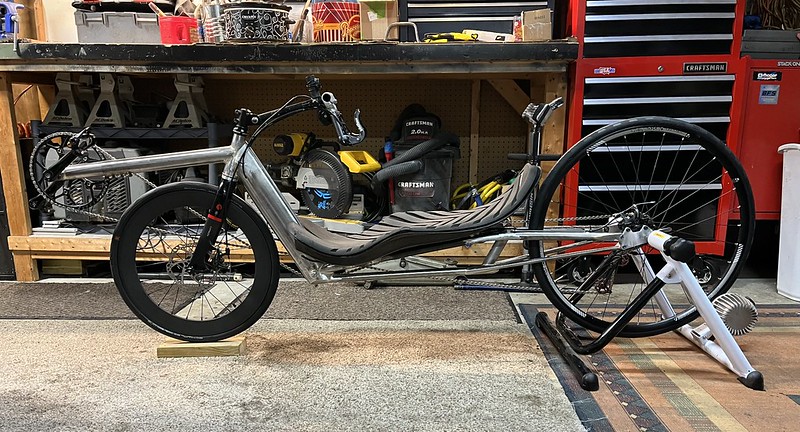
Charles Brown of Southfield has built many recumbents over the years, the goal of this one making it as light as possible. Here's his brief description: In top view (not shown), the frame is off center, placed pretty close to the chain line. This reduces the sideways forces on the frame, so a smaller diameter tube can handle the lateral and torsional loads. To manage the vertical loads, some light compression struts and thin rod are added to make a truss. The resulting frame is quite strong and stiff, and weighs only 2/3 as much as the usual single large diameter tube frame.

At the 2021 Michigan rally, Ron and Peggy Thompson of Bel Air, Md., attracted a lot of favorable attention with Ron's innovative G4 front-wheel-drive, front-wheel-steering recumbents. (See article below dated July 1, 2021 and report on the 2021 rally.)
Since then, Ron completed a racing version. Ron competed on the new bike and Peggy on her "old" G4 at a 100-mile race in Sebring, Fla., in February. Here's Ron's description in an email to the editor, sent May 1 (edited by Mike E.):


 The new bike (above left) though has come together nicely.  Well over a thousand miles on it.  Did a nice 100k this morning.  It is designed as a pure racer and is much faster than my "all purpose" concentric crank version of last year.

Peggy and I both did the 100 mile race at Sebring, Fla. in February; finishing 2nd and 3rd respectively in class.  And since winter riding in Maryland is limited, we were both badly undertrained!  My 4:36 total time though was a personal record –  the new bike is fast.  

  As with my red bikes, the new racer is designed to allow supplemental hand power input through pedal-steering interaction – analagous to standing to pedal an upright and tilting the bike against the descending pedal stroke.  The mechanism is optimized on the blue bike.  

  Notice that the crankset location pictured at Sebring is in the fork crown itself and is located on the steering axis.  That fork is painted blue.  (below)


This photo shows a new, unpainted fork, with the crankset located 7 inches forward of the steering axis.  This solved several problems.  The bike has now become a real joy to ride!  

 I am continuing to work on small fairings for the bike.  The bike seems to be responding well.  Will see how it goes.

Unfortunately, as of this report (May 8), it's uncertain whether Ron and Peggy will make it to this year's rally, high fuel prices being one factor. (It's more than 500 miles from Bel Air to Clarkston.)
If they don't make it, they will be with us in spirit.

Also, for the first time since 2018, the University of Toronto student HPV team will be at the Michigan rally. If they can get everything done in time, according to faculty adviser Jun Nogami, more than 10 students will be coming with three streamliners, a low racer and two manufactured recumbents.


Tuesday, May 3, 2022

Online registration for 2022 Michigan HPV Rally

To register to compete in the Michigan Human Powered Vehicle Rally, May 21-22, click on this link: 

 https://forms.gle/LkxuFS2xAKaNURyU9

Registering online in advance will save entrants and organizers time on Saturday morning. Payment still has to be paid then.


Saturday, December 25, 2021

37th annual Michigan HPV Rally May 21-22, 2022


 Rally co-organizer Mike Mowett at the 2021 Michigan HPV Rally

   The 37th annual Michigan Human Powered Vehicle Rally will be May 21-22, 2022, at the Waterford Hills sports car racing track in Clarkston, the location since 1986. 
     The oldest such event in North America is open to riders of all human powered vehicles – recumbents, streamliners, regular bicycles, tandems  and handcycles. There are classes for streamlined, unstreamlined cycles, tandems, women,  youth and tricycles. 
    The rally is conducted using Human Powered Race America rules (go to www.recumbents.com, then under “recumbent racing,” click on “Human Powered Race America,” then on “racing rules.” Note:  HPRA rules require all vehicles to have a mirroror or mirrors enabling rear  vision to both sides. 
    The track, on the grounds of the Oakland County Sportsmen’s Club, is  1.4 miles around, with nine turns and one hill. Sunday races use a shorter  course without the hill.
 
Entry fees: $25 for one day, $40 for two days. College and high school teams 
registering in advance, $35 for first vehicle and rider; $10 for each additional 
vehicle or rider. Spectators free.  (As of early-February, registration/payment will be at the rally; no online advance registration is planned, but that may change.)
Any entry fee money left after payment by organizers of track rental fee, insurance and expenses will be awarded as prize money to top finishers in each class. 
Free camping available at track Friday and Saturday nights, with indoor 
showers.

Even if you don’t want to compete, come and see some unusual 
and very fast cycles.

Tentative schedule:
SATURDAY, May 21
8 a.m. – Registration and technical inspection starts.
9:30 – One-hour time trial (streamliner, streetliner, tricycle classes).
11 – One-hour time trial (stock, junior, women, tandem classes).
Noon – lunch (as of late April, concession stand not expected to be open).
12:15 p.m. – Hot laps on short loop, all classes, ride as many laps as 
you want; your fastest lap counts, electronic timing.
1:30-2:30 – Hill climb/coast down. Race up the hill from a standing start,
then when you get to the top, start coasting. Coast as far as you can go, 
then mark your stopping point with chalk (provided). Separate scores/points 
for time up the hill and distance coasted.
After 2:30 – Tricycle race (no hill) and urban transportation contest.
Evening– eat at area restaurants or possible take-out pizza at trackside pavilion.
SUNDAY
8:30-9:30 a.m. – Flying start 200-foot sprints (all classes).
10 – Short course (no hill) road race (faired classes), about 12 miles.
11 – Short course (no hill) road race (unfaired classes), about 9 miles.
Awards ceremony after last race, expected by 12:30 p.m. Concession
stand not expected to be open.

Questions or suggestions: Contact Mike Eliasohn (mikethebike2325@comcast.net
269-281-0797) or Mike Mowett (mowett@aol.com, 586-863-3902)

TO GET TO THE RALLY:  From I-75, get off at exit 91. Take M-15 south 
to Dixie Hwy. (US-24). Turn left, continuing south about 1 mile and turn 
left onto Waterford Road, then proceed to track.If coming from the west, 
take U.S. 23 north (or south) to M-59 (Highland Road). Go east on M-59 
to Airport Road, then left (north) to US-24. Turn left, then immediately right
onto Waterford Road. Go about a half-mile to track.

PLACES TO STAY: 

CAMPING 
Free camping available overnight Friday and Saturday at the Waterford Hills  track, starting at 6 p.m. Friday. Restrooms, showers available and possibly electrical hookups.

STATE CAMPGROUNDS (www.michigan.gov/dnr)
Highland Recreation Area, 5200 E. Highland Road (M-59), White Lake,  248-889-3750. Two miles east of Highland. Holly Recreation Area, 8100 Grange Hall Road, Holly, 248-634-8811. Five miles  east of Holly. 
Pontiac Lake Recreation Area, 7800 Gale Road, Waterford, 248-666-1020.  Closest to Waterford Hills track, about 4 miles west. 

OAKLAND COUNTY:  Groveland Oaks County Park, 14555 Dixie Hwy., Holly,  northeast of Holly, 248-634-9811.

MOTELS  
Clarkston - Clarkston Motor Inn, 6853 Dixie Hwy. (US-10), 248-925-1522,  12 rooms, 2 miles northeast. 
Clarkston - Olde Mill Inn of Clarkston, 5835 Dixie Hwy., 248-623-0300.  Across Dixie Highway from Waterford Road leading to track. This is the  closest motel to the track.
Hartland - Best Western of Hartland, 10087 M-59 at US-23, 810-632-7177, 61 rooms. About 18 miles west. 
Waterford – Quality Inn and Suites, 7076 Highland Road (M-59),  248-666-8555, 111 rooms. About 3 miles southwest. 
Waterford – Holiday Inn Express, 4350 Pontiac Lake Road,  248-674-3434, 83 rooms. About 7 miles southwest. 
Whitmore Lake – Days Inn, 9897 Main St. (off US-23, exit 53), 734-550-0105, 61 rooms. About 33 miles southwest. 

  Note: The Michigan Human Powered Vehicle Association was formed in  July 1984 and officially came to an end Sept. 30, 2016, due to a lack of  active members willing to continue to run the organization. However, the  Michigan HPV Rally continues this year and hopefully in future years. 
   This blog, website (www.mhpva.org) and Facebook page  (www.facebook.com/mhpva) continue.

Thursday, December 23, 2021

Bicycle racing in the 1920s

By Mike Eliasohn

An online friend, Jim Miller, who lives in Burbank, Calif., and usually sends me vintage auto racing photos emailed me the top three photos of the velodrome in Newark, N.J., apparently all from the 1920s.


The photographs came from one of his grandfather's photo albums, which Jim recently received.  Photos in the albums range in vintage from 1914-38. The grandfather, Eddie Miller, apparently did not take the velodrome photos, though they may have been taken while he was living in Newark, where he met his wife.


I did some online searching and easily found the history of the Newark Velodrome on the website of Classic Cycle (classiccycleus.com) on Bainbridge Island, Washington. The website has a lot of interesting information on it, including views and descriptions of the many bikes in its museum, dating back to 1885 (but no recumbents).
The Newark board track, built in 1907, was 6 laps to the mile.
It hosted world championships in 1912 and Australian Reggie McNamara set world records for distances from 1 to 25 miles on the track in 1915, '16 and '17.
Notice the crowds in the photos.  Seating capacity was 12,500, but many races drew more than 20,000 spectators (meaning many were standing).


But the land the track was siting on became too valuable to continue to use for bicycle racing, so in 1930, it was demolished, to be replaced by an apartment building.
But there was still interest in bicycle racing, so about 10 mlles to the north, a wood velodrome was constructed in Nutley, N.J., which opened in 1933.  The track was smaller than the one in Newark – 7 laps to the mile.
In its first season, it drew an average of almost 8,500 spectators to each of its 35 races.
But interest in bicycle velodrome racing was declining and the track's last season for two-wheelers was in 1937.
Then in 1938 and 1939, the track was used for midget auto racing (small open wheel race cars). But in 60 races during those two years, three drivers were killed and controversy over the danger of racing cars on the tiny high-banked (45 degrees in the turns) track and the noise contributed to its closing.
Apparently in 1940, some final bicycle races were held. (Information is unclear whether races took place, or unsuccessful attempts were made to conduct races.)  The track was torn down in early 1942.


An internet search of "Newark velodrome historic photos" included two of the above photos that my friend had sent me that were in his grandfather's photo album and this one, too good to ignore. No helmets back in the "good old days," but notice the attire of rider of the pacing motorcycle, including a tie. No information or photo credit, but the sign at upper right does say "Newark," so it is the correct track.  (The "Eddie Madden leading" photo is the one that wasn't among the historic photos posted on the internet.)


Here's a view of the entire velodrome. As it says in the caption, the venue also hosted boxing matches. (Photo from old newark.com)

Additional sources:  www.nutleyhistoricalsociety.org
www.speedwayandroadracehistory.com
The History of America's Speedways, Past and Present, by Allan E. Brown, published 1994.
old newark.com


Saturday, August 28, 2021

36th annual Michigan Human Powered Vehicle Rally

By Mike Eliasohn
Photos by Mike Eliasohn and Kevin Shaw


Rick Toler of Dayton, Ohio, on his Hooker TT pursues (or drafts?) Ron Thompson of Bel Air, Md., on his innovative G4 front-wheel-drive bike.  Not sure which race. (Kevin Shaw photo)

Complete results are posted on recumbents.com, along with all of Kevin Shaw's photos. Go to "recumbent racing," then "HPRA racing results and pictures."

After a year of no events for human powered vehicle racers and enthusiasts, HPV racing resumed Aug. 21-22, 2021, with the Michigan HPV Rally at the Waterford Hills sports car racing track in Clarkston, the location since 1986.  

The rally drew 20 competitors and 23 vehicles (Dennis Grelk and Daryl Hanger were the multi-vehicle competitors). Checking turnout since 2007 (from all the rallies reported on this blog), it was the lowest count since then; the next lowest was 24 in 2019.


Jonathan Walters of Cincinnati on his Velokraft NoCom won the stock class. There were 13 competitors in the class. (Mike Eliasohn photo)

Was the low count because of continuing concern over COVID, the hot and humid weather during the weekend, a weekend with too many people having conflicts and/or  continuing declining interest in HPV racing?.  We will have to wait until the 37th annual Michigan HPV Rally in 2022 to find out

The announcement of the rally published on this blog in January said prize money would be awarded to the top finishers in each class. Unfortunately, because of the low turnout, there wasn't enough entry fee money collected to pay the track rental fee and for insurance and have money left over to pay prize money. That is, we lost money on renting the track and paying the insurance, so the organizers paid the difference.


After a year of no HPV events, racing resumed with the start of the one-hour time trial on Saturday morning,  Two one-hour time trials were scheduled, with streamliners, streetliners and  tricycles scheduled in the first one and stock, junior, women and tandem classes scheduled in there other. But due to the low turnout, only one time trial was held for all classes. (ME photo)

Special mention needs to be made of the Grove City College HPV team, which came from Grove City, Pa., with five students (four of whom raced) and faculty adviser Kevin Shaw. 


The Grove City College HPV team, standing with their only vehicle built by current students, were, from left, Shawn Cook, Gina Kim, Alex Heisey, Connor Sees and Nathaniel Stuyck, plus faculty adviser Kevin Shaw (chemistry professor and former BMX racer). Four are mechanical engineering students; the fifth started in m.e., but is now majoring in management.  (ME photo)


Due to a mechanical problem, the bicycle built by current Grove City College students was only used in the urban transportation contest, ridden by Alex Heisey.  Gina Kim welded the frame.  It used a Rohloff 14-speed hub, previously used on another vehicle. The GCC team also raced a recumbent tricycle built by prior students, a Tour Easy recumbent and two manufactured upright bikes.  (ME photo)

The reduced turnout also resulted in cancellation of the noontime hot laps and tricycle race on Saturday (it was hot enough without doing any "hot" laps) and the two no-hill road races scheduled Sunday morning (faired classes in one and unpaired in the other) were condensed into one race.

Special thanks to Mike Mowett and Dennis Grelk, who in addition to competing, handled most of the the scoring, timing and results.
Here's a note from Mike M., co-organizer of the rally along with Mike Eliasohn:

Thank you all for coming to this event, which we believe is the longest running human powered vehicle event in the world.

Special thanks to all who volunteered their time to help during the event, whether it was setting up something, taping something down, running the stopwatch, calling out stuff over the radio, flipping lap counter cards, waving a flag, or moving a table and chairs..  It takes a village.  
Thank you for your patience as we worked through some glitches with our timing system for the Saturday morning one-hour.  Special thanks to Dennis Grelk for getting it running with a little bit of phone help from Warren Beauchamp, our long-time recumbents webmaster.  We didn't have the usual suspects there to run it.  
All told, the one-hour will never be fully accurate. I did the best we could given our recollections, speedo distances, Strava GPS speeds, and "who was in front of whom" statements, etc.

Charles Brown of Southfield completed his latest creation shortly before the rally.  In contrast to his previous wood frame bike, this one, made from steel tubing, had a higher bottom bracket and more laid-back seat for better aerodynamics. (ME photo)

Top finishers in each class were:

Streamliner (3 entries) – 1) Tony Levand, Lemond, Ill., homebuilt streamliner, 335 points, 2) Dan Glatch, Waterford, Wis., Milwaukee Flyer, 315, 3) Dennis Grelk, Donnellson, Iowa, Barracuda. 240. 


Jeff Hunn of North Manchester, Ind., in a Quest velomobile, waits to start the hillclimb. Jeff was the lone competitor in the streetliner class, which requires riders to be able to start and stop without assistance.  (ME photo)

Superstreet (only entry) – Jeff Hunn, North Manchester, Ind., Quest velomobile, 360.
Stock (13 entries) – 1) Jonathan Walters, Cincinnati, Ohio, Velokraft NoCom, 345, 2) Dennis Grelk, Donnellson, Iowa, homebuilt mid racer, 317, 3) Rob Lloyd, Whitmore Lake, homebuilt low racer, 282.
Junior (only entry) – Cameron Lloyd, age 14, Whitmore Lake, homebuilt by his father, 240.


Gina Kim competed on this Huffy mountain bike – with steel wheels and crank and off-road tires – because it was the only bike in the Grove City College stable small enough to fit her. Definitely not a bike made for racing, but she averaged 15.4 mph in the one-hour time trial (faster than two of her GCC classmates), reached 23.62 mph in the 200-foot sprint, averaged 15.5 mph in the 25-lap road race and won the women's class.  (KS photo)

Women (2 entries) – 1) Gina Kim, Grove City College, Huffy mountain bike, 335, 2) Peggy Thompson, Bel Air, Md., G4 front-wheel-drive recumbent, 300.
Tricycles (2 entries) – 1) Daryl Hanger, Greenwood, Ind., Catrike 700, 240, 2) Connor Seese, Grove City College, student-built tricycle, 60.


Despite the heat and humidity, Tony Levand of Lemont, Ill., kept the top on his homebuilt streamliner in all events.  He won the streamliner class. (KS photo)

Following are the class winners in each event:

SATURDAY
One-hour time trial:  Stock – 1) Jonathan Walters, average 26.9 mph, 2) Dennis Grelk, 26.1 mph.  Streamliner – 1) Tony Levand, 24.0 mph, 2) Dan Glatch, 22.4 mph. Superstreet – 1) Jeff Hunn, 23.3 mph.  Women – 1) Peggy Thompson, 20.1 mph, 2) Gina Kim, 15.4 mph.  Tricycle – 1) Connor Seese, 11.2 mph.
Hill climb:  Stock – 1) Rick Toler, 18.861 sec., 2) Daryl Hanger, Velokraft NoCom, 20.381. Tricycles – 1) Daryl Hanger, 22.940. Streamliner – 1) Dennis Grelk, 27.795, 2) Dan Glatch, 32.301. Superstreet – 1) Jeff Hunn, 30.252.  Women – 1) Peggy Thompson, 34.793. Junior – 1) Cameron Lloyd, 37.201.
Competitors pedal to the top of the hill (that's the hill climb time), then stop pedaling and coast as far as they can go. For instance, Rick Toler was fastest overall in the hill climb, then in the coast-down was 11th overall and 7th in the stock class.


Dennis Grelk on this homebuilt bike finished second overall in the stock class. He also raced a streamliner and his homebuilt off-road recumbent. (KS photo)

Coast-down: Streamliner – 1) Dennis Grelk, 2) Tony Levand.  Stock – 1) Dennis Grelk, 2) Jonathan Walters. Superstreet – 1) Jeff Hunn.  Tricycle – 1) Daryl Hanger. Women – 1) Peggy Thompson. Junior – 1) Cameron Lloyd.
Standing start kilometer: Stock – 1) Jonathan Walters, 77.061 sec., 2) Dennis Grelk, 79.416 sec.  Streamliner – 1) Dennis Grelk, 80.063 sec., 2) Tony Levand,, 85.973 sec. Superstreet – 1) Jeff Hunn, 93.623 sec.  Tricycle – 1) Daryl Hanger, 104.746 sec. Junior – 1) Cameron Lloyd, 107.786 sec.  Women – 1) Gina Kim, 136.719 sec.


Dennis Grelk made hill climb runs in/on his streamliner, stock class bike and this off-roader/gravel bike he built. He only made one run on this bike to get a required time for the urban transportation contest. It has a lot of adjustability (for instance, front fork angle), which adds weight, so his goal for the next gravel bike he builds is to make it lighter.  (ME photo)


"How much groceries can you carry in that backpack?" Mike Eliasohn, judge and jury of the urban transportation contest, evaluates the practicality of the bicycle ridden by Alex Heisey and built by Grove City College students. (KS photo)

Urban transportation contest – The five competitors were scored on their time and ranking in the hill climb, ranking in the coast down, obstacle course time (a simple test of acceleration, maneuverability and braking) and points and ranking in the evaluation of the practicality of their vehicle. Points were awarded for lights (front and rear), fenders (front and rear), reflectors, daytime visibility, cargo carrying (minimal, one grocery bag or two), horn or bell, brakes, rearview mirrors, security against theft, convenience (getting on or in and off or out), weather protection, and carrying tools and tire pump or inflator and spare inner tube or tube repair kit.
For instance, the fastest of the five on the hill climb received 1 point; next, 2 points, etc. The rider scoring the most "practicality points" for lights, cargo carrying, etc., received 1 point; second most practicality points, 2; etc.
When the points for hill climb, coast down, obstacles course and practicality evaluation were added up, low score won. The result was a tie between Rick Toler on his upright bikes and Ron Thompson on his G4 front-wheel-drive recumbent, each with 9 points. Rick's bike had fewer practical features, but he did better in the performance categories; with Ron, it was the opposite. Third was Daryl Hanger, 10 points, on his Catrike 700; fourth was Denis Grelk, 14 points, on his homemade recumbent gravel bike, and fifth was Alex Heisey, 18 points, on the Grove City College student built bike.


Ron Thompson and his wife, Peggy, drove more than 500 miles from Bel Air, Maryland, to show and race the innovative G4 bikes Ron designed and built. Others tried and complimented the bikes. Ron said his hope is to eventually find a manufacturer who will put his design into production.  For more information, see article below and go to g4bikes.com. (ME photo)

SUNDAY  
200-foot sprints (top speed event): Streamliners – 1) Dennis Grelk, 42.04 mph, 2) Tony Levand, 38.56 mph. Stock – 1) Jonathon Walters, 41.20 mph, 2) Mike Mowett, Morciglio M1 low racer, 40.45 mph. Superstreet – 1) Jeff Hunn, 36.71 mph. Tricycle – 1) Daryl Hanger, 30.87 mph.  Junior – 1) Cameron Lloyd, 29.16 mph.  Women – 1) Peggy Thompson, 29.05 mph, 2) Gina Kim, 23.62 mph.

25-lap road race (approximately 15 miles, no hill, race ends when first competitors complete 25 laps):  Stock – 1) Jonathan Walters, 25 laps, 27.14 mph, 2) Dennis Grelk, 24 laps, 25.57 mph.  Streamliner – 1) Tony Levand, 25 laps, 26.70 mph, 2) Dan Glatch, 19 laps, 20.05 mph. Superstreet – 1) Jeff Hunn, 21 laps, 22,79 mph.  Women – 1) Peggy Thompson, 19 laps, 20.43 mph, 2) Gina Kim, 15 laps, 15.50 mph.

If you see any errors in this report, or anything else that needs clarification or changing, please email Mike Eliasohn at mikethebike2325@comcast.net


Mike Mowett of Detroit on his Morgiglio M1 finished 6th in the stock class, but he also was very busy organizing and running the rally, including compiling the results.  In the 200-foot sprint, he pedaled 40.45 mph, good for third place in the stock class. (ME photo)


Friday, August 27, 2021

An uncompleted recumbent – gone, but not forgotten

 Editor's note:  After posting this in August 2021, I finally emailed Doug to see if he found a buyer for his uncompleted Easy Racer clone project.  Here's his reply on Jan. 14, 2022:

I never got anyone interested so I just dropped it off at a metal recycler.  It was a project I started 15 years ago and never got around to finishing. Not a great loss. 

But I still thought the bike was interesting, so decided to leave the original article here, rather than delete this entry.  Mike E.

Doug Colby of Clarkston (where the Waterford Hills track is located) built this Easy Racer clone about 15 years ago, but never finished it, and finally decided it’s time to get it out of his house, so had it at the rally for sale.  No buyer then, so it’s still available.


For $100, you get everything you see in the photos, however, Doug says, the wheels aren't useable, so will need to be replaced.  

It appears the only fabrication and welding still needed would be to make and attach bridges or mounts for the front and rear brakes. Then some sanding and paint, assembly and go riding.

Doug MIG welded the frame from mild steel tubing. Wheelbase is 66 inches.


Over the years, Doug said he has built “probably six or seven” recumbents.
If interested, contact him at  (contact information deleted, since the bike is gone). The buyer will need to pick up the bike at Doug’s house.


Monday, August 16, 2021

Owosso Bike Fest – Aug. 7, 2021

SCROLL DOWN FOR INFORMATION ABOUT THE MICHIGAN HPV RALLY AUG. 21-22.  IT'S STILL HAPPENING.

By Mike Eliasohn 

Photos by Mike Eliasohn and Julie Turner

Having missed the first 15 Owosso Bike Fests, I wasn't about to miss the 16th, so on Sunday, Aug. 7, I was in downtown Owosso.

Actually, Bike Fest starts the day before, with a late afternoon/evening via the rail trail to nearby Ovid and return. Then from 9 to 3 on Sunday is the show and "swap meet," that is, people selling bikes and parts, which takes place in the block-long alley and parking area behind the sponsoring House of Wheels bicycle shop.

The event is, of course, a great opportunity for cycle nuts, as opposed to cycling nuts, to sit or stand around and talk about bikes.


I couldn't go to Owosso Bike Fest without a bike, so I created/assembled this rat rod Roadmaster. It and parts were scrounged from Cycle-Re-Cycle, the community bicycle shop in Benton Harbor, where I volunteer. The frame, fork, chainring, chain and front wheel are from the 1970s? Roadmaster, but there's parts from at least nine other bikes.  Here I'm attaching the information sign/price tag, for $25. I received some compliments, but no buyer. (JT photo)


A view of the alley/parking area behind the House of Wheels, where Owosso Bike Fest takes place. Bikes and parts for sale are intermixed with bikes entered in the people's choice judging. (JT photo)


My personal favorite, created by Randy Cates of nearby Chesaning. His son, Rod (if my notes are correct), seated in rear, said the frame, built by someone else, was found in Tawas Bay! and given to Randy, who turned it into the Rat Bastard.  Stand on your head and you can see that part  of the frame consists of an upside-down diamond frame. But that puts what was originally the head tube very close to the ground, making it a bike for very smooth pavement only. (ME photo)


Another homebuilt stretch cruiser, with a western theme. Ride 'em cowboy! (JT photo)


Terry Gerweck of Monroe on his 1959 Cushman scooter, which is in the process of restoration, though it obviously runs. "I had one when I was a kid," said Terry, which was his obvious rationale for buying this one.  It will be a resto-mod restoration, not intended to look like it was new from the factory. He also has bicycles at Bike Fest for sale. (ME photo)


A close-up view of Terry's 1959 Cushman. Behind it is one of the bicycles he brought to sell.  (JT photo)


Bikes with green tags, like this one at left, were entered in the judging. (ME photo)


Next to this delivery bike (notice the size of the basket!) was a Good Humor tricycle. On what turned out to be a hot, humid day, ice cream would have been perfect, but I never saw any being sold, so presumably the tricycle was there for show.  (JT photo)


This bike would be perfect for Friday night football games where the host team name is the "Tigers" (for instance, Benton Harbor High School). If my memory is correct, the tiger was created on flexible foam, so it doesn't interfere (too much) with the steering. (JT photo)


Another view, with a nice manufactured stretch cruiser behind the tricycle. (JT photo)


The 1960s Raleigh RSW 16 on the right was an interesting bike.  The seller was willing to negotiate, but the starting price was $400. The RSW 16 had 16-inch wheels and a Sturmey-Archer 3-speed hub. A folding version came later.  (JT photo)


A better view of the RSW 16, next to this Schwinn Racer.  (JT photo)


Your blog editor examines the head tube badge of this made-in-Pakistan 3-speed. (JT photo)