Wednesday, January 17, 2024

Building a recumbent cycle from plans

The TomaHawk, one of many recumbent designs for which plans are available from AtomicZombie

By Mike Eliasohn

There are various reasons to build your own recumbent cycle. Presumably one reason is because you like to "make stuff." Another is: why pedal something that looks like what other people ride, be it a recumbent or upright bike, when you can ride something unusual and attract attention?

Although most designs shown or discussed in this article are made of metal tubing welded together, if you don’t know how to weld (or have no place to weld), or don’t have a shop where you can do cutting and drilling, there are alternatives. Find a friendly (presumably small) welding and machine shop (or one of each) who can do that work for you, hopefully at a reasonable price. (Suggestion: If you're not in a rush to get something done, so can wait until the shop doesn't have much else to do, you might get a better price.) 

Or if you have work space, but don't know how to weld, there are designs out there made from wood, aluminum,carbon fiber, or even cut-up conventional bicycles, with the pieces bolted together (though some small pieces may need welding). 

I do have a special motive for writing this. As HPV old-timers like me know, there aren't as many builders out there as there used to be. Not only is attendance at HPV racing events declining, more of those who do participate bought what they ride. Building, riding and racing recumbent cycles would seem idea for high school students studying welding, machining and other trades. So if anyone reading this knows any such students, you might suggest, "Have you ever thought of building ..?" and use this article as a starting point.

Lastly, this article won't cover all the options for plans and designs that are out there. Do an online search of "how to build recumbent bicycles," "recumbent bicycle (or tricycle) plans," etc. and you will find more. 

Another source is texasrecumbents.wordpress.com, which is divided into numerous topics, including bamboo recumbents, no-weld recumbent trikes and bikes, front-wheel-drive moving bottom bracket recumbents, seats and Coroplast construction. Some items below also are on the texas recumbents site.

Also look on YouTube. If you know something I missed that's worth including, please email me at mikethebike2325@comcast.net

Atomic Zombie

If you're looking for ideas, a good place to start is atomiczombie.com. Brad Graham and Kathy McGowan offer 36 plans, for low racers, high racers, long wheelbase, short wheelbase, two-wheels-in-the-rear and two-wheels-in-front tricycles and a quad. There are also plans or tutorials for choppers, tall bikes and an upright two-wheels-in-front tricycle.

Atomic Zombie Warrior

Atomic Zombie charges for its plans, currently $16.95 for one set, four for $19 or six for $36.  The plans, actually step-by-step instructions, 60-220 pages with lots of photos, come as PDF downloads.

In 2004, Graham and McGowan published Atomic Zombie's Bicycle Builder's Bonanza (388 pages), with chapters on how to build various designs and general information about tools, welding, design, sources of materials, etc. Interesting reading, even if you don't build an AZ design. Copies, new or used, can be obtained from Amazon, alibris.com and likely other sellers.

Recycled Recumbents

A Recycled Recumbent Mach 2


If you like a traditional long wheelbase design, A.D. Carson (recycledrecumbent.com) has three plans available online for free. And if you like his designs, but don't want to build one, he builds and sells complete bikes (but not during the winter months.

Much of the steel tubing for his designs come from cut-up diamond frames. The Mach 1 (EZ Clone) and Mach 2 designs are similar – 26 inch rear wheel and 20-inch front, though the Mach 1 also can use a 16-inch. The Mach 3 uses 26-inch wheels at both ends. (700c wheels might fit in place of 26 inch.)


Wood 

In 1997-98, Steve Schmeck, who lives in/near Cooks in the Upper Peninsula, built two (mostly) wood frame recumbents, Woody (shown here) and then Treebike.


For construction details, go to www.manytracks.com, then click on "homestead," "recumbents," and then in the top of the text, "Woody and Treebike." (or click here)
In addition to information about Steve's two designs, you will see photos and information about various other homebuilt recumbents sent in by Many Tracks readers. Some of the designs are wood.

And if you think a website that also has information about chickens and other homesteading topics seems unusual as a recumbent bike building source, try www.littleloveliesbyallison.com. In addition to such topics as home decorating ideas and home improvement projects, scroll down (toward the bottom) to "DIY vehicle projects" then "bicycle projects" and finally "15 DIY recumbent bike projects you can build easily" (or click here). Included are two (mostly) wood frame recumbents and  one two-wheels-in-front tricycle, plus some other interesting designs (some from Atomic Zombie).


 An easy build
Keith Moss from Florida came up with this simple design for a long-wheelbase, made from cut-up steel bicycle frames, except possibly for the bottom tube.
For more information and photos, type "Keith Moss quick cheap easy LWB" in your search engine, and you should be able to find it.

F'lowroller


When I first saw images of Robert Horn's F'lowroller about 20 years ago, my reaction was "Wow!" It was truly a unique design.
In an article in online BikeRodnKustom, he described it as a cruiser / recumbent / lowrider and mentioned he quickly put 300 miles on it. It used a 3-speed coaster brake hub.
Bob later designed a second version, shown above, and then created "The F'lowroller Cookbook" (copyright 2005), with building instructions and photos.
He sent a pdf to anyone interested in building one.
I (Mike E.) have the "Cookbook" pdf, and with Bob's permission, can email it to anyone who asks. A printout can be made from the pdf.

Steve Robson's recumbent construction guide


In the late 1990s and early 2000s, Steve Robson was very active in HPV building and the Michigan HPV Association, including a stint as vice president, even though he lived in Glencoe, Ontario, Canada.
He also wrote and published two books about HPVs, including making all the drawings.
Steve went on to other interests, but occasionally would still get inquiries from people who wanted to build a recumbent. He would send them the text and some drawings. 
To make it easier for anyone to access his "The Home Builders Guide to Constructing a Recumbent Bicycle," he sent me (Mike Eliasohn) the text and some illustrations. I did some editing and added some photos, then Paul Bruneau did further editing and posted the link.
Remember, this book dates to 1998 / 2001, so some sources and references may be out of date, out of business or no longer available.  And one big change in bicycle technology since then is now common use of disk brakes on manufactured bikes, which could be a factor in selecting bikes to cut up to rebuild into a recumbent.


Front-wheel-drive


In addition to the F'lowroller, here are some other front-wheel-drive designs:

Python is a European low racer design, with front wheel drive and center-pivot steering, that is, the head tube is right behind the front wheel. "Standard" is two 26 inch wheels, but there are variations with smaller wheels and tricycles with two wheels in the rear.
Photo is from the website, www.python-lowracer.de, where there is lots of information for would-be builders.
If you’re familiar with the Cruzbike, but don't want to spend $2,650 (and that's for the cheapest model), or want to make sure you can ride a moving bottom bracket FWD before spending lots of money, go to www.instructables.com, then type in "recumbent bicycles." You will see several DIY recumbent designs (none sophisticated), so you may something else of interest. But here's what we are talking about:

The MBB bike shown on instructables.com is rather crude, so here's a more sophisticated, but still simple version. (I don't remember the source.)

Other stuff

Here's an interesting design from the Netherlands, with how-to-build instructions:


This is from the website, wind-water.nl, and the link is presented here with permission from Hanno Smits, the designer and webmaster. Also, go to the website, click on "Bicycles, bicycles" and you will see other interesting recumbents and ideas.

I (Mike E.) have an idea how to build a no-weld or minimal-weld recumbent from aluminum tubing and bars, but could not find any such design on the internet, other than this 2001 photo from Many Tracks, builder Bill Meacham.


If anyone knows of any such designs, preferably with some instructions, let me know.


Paul Elkins' website (elkinsdiy.com) has lots of interesting projects, including this simple recumbent made from one cut-up 20-inch wheel frame, plus additional tubing.  Go to "projects," then "transportation," "human powered" and then "DIY recumbent bicycle."
There's also a video: On Youtube, type in "diy recumbent bicycle" and you will find it.


This is obviously a stretch cruiser, made from two frames, not a recumbent, but it's interesting because it's entirely bolted together, no welding, As I recall, the rear triangle came from a mixte (step-through upright bike) frame. The bike was built by the operator of a website that I think is now defunct, which was mostly devoted to fixing/repairing bikes. Unfortunately, I don't have the website address in writing, so can't give proper credit.


Some information in this article comes from an article in the Autumn 2020 issue of Laidback Cyclist, the magazine of the British Human Power Club.

Monday, June 26, 2023

38th annual Michigan Human Powered Vehicle Rally


The picnic pavilion at the Waterford Hills sports car racing track also made a fine work area for the University of Toronto Human-Powered Vehicles Design Team, which came with 14 students and seven vehicles – five of them student built.  (Charles Brown photo)

By Mike Eliasohn

The 38th annual Michigan Human Powered Vehicle Rally June 17-18, 2023, was marked by good weather, good turnout and some records being set.

Complete results can be seen by clicking on:

https://docs.google.com/spreadsheets/d/1B2221AShyvPTBR3MS0w3P8PpT0O39ey6K8hmbl5o8us/edit?usp=drivesdk

Or go to recumbents.com, then HPRA racing results and photos, then 2023 Michigan HPRA Racing results.

About half the participants were from the University of Toronto Human-Powered Vehicles Design Team (www.hpvdt.ca), which came with 14 students (not all raced) and seven vehicles, three of them streamliners.  Of the 11 or so years the U-T has participated in our event, I (Mike E.) think that's the most students ever.

Due to lack of time, interest or entrants, three scheduled events on Saturday were not held – hot laps, tricycle race and the urban transportation contest. There were no junior class entrants (15 and younger).


Jonathan Walters of Cincinnati on his NoCom low racer waits for the start of the hill climb on Saturday afternoon. He won the stock class (18 entries) and set a record  for the stock class 1-hour, 28.2 miles. (Mike Eliasohn photo)

Here's the top finishers in each class:

Streamliners (5 entries) – 1) Dennis Grelk, Donnellson, Iowa, Cuda W streamliner, built by Warren Beauchamp, 337 points; 2) John Simon, Portland, Moby streamliner, 297; 3) Univ. of Toronto, various riders, 220.
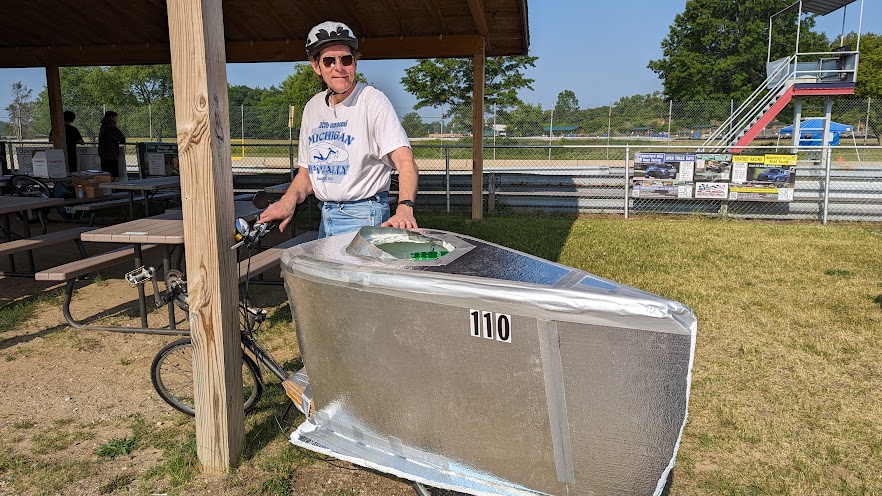
Streetliner (2 entries) – 1) Jeff Hunn, North Manchester, Ind., DF XL velomobile, 300; 2) Charles Brown, Southfield, homebuilt two wheeler with silver "torso" fairing, 110.
Stock (18 entries) – 1) Jonathan Walters, Cincinnati, Ohio, NoCom low racer, 340; 2) Dennis Grelk, homebuilt low racer, 700c wheels, 311; 3) Thom Ollinger, West Milton, Ohio, Morciglio Raptor, 286.
Women (1 entry) – 1) Claire Nolet, Univ. of Toronto, Speedmachine recumbent, 180.
Tricycles (1 entry) – 1) Marshall Randall, Rockford, GreenSpeed Aero, 60 points.


Marshall Randall on his GreenSpeed Aero only had time for the 1-hour time trial Saturday morning before having to leave. His average of 23.5 miles was a record for the tricycle class; the old mark of 20.5 miles was set in 2008. Marshall is director of sales and marketing for WizWheelz in Grand Rapids, maker of TerraTrike and GreenSpeed recumbent tricycles. (Marilyn Solomon photo)

Here's the top two in each class in each event (if only one is listed, that's all who competed):

One-hour time trials: Stock – 1) Dennis Grelk, 28.62 miles/46.06 km, 2) Jonathan Walters, 28.207/ 45.39. Streamliner – 1) Dennis Grelk, 31.8 miles/51.18 km, 2) John Simon, 27.51 / 44.27. Streetliner – 1) Jeff Hunn, 25.44 miles/40.85 km. Women – 1) Claire Nolet, 19.922 miles/32.06 km. Trike – 1) Marshall Randall, 23.47 miles / 37.77 km (record).
Dennis' bike fits the requirements of the now defunct super stock class and he exceeded the old super stock record of 26.7 miles, set in 2004. Meanwhile, Jonathan broke the old stock class record of 27.7 miles, set in 2005.  Both old marks were held by Frank Geyer, aka "Franknspeed."


Lining up for the start of the first 1-hour time trial on Saturday morning. Winner Dennis Grelk (28.62 miles) is on the low racer on the right (orange vertical stripe). (Mike E. photo)

Hill climb: Stock – 1) J. Walters, 19.522 seconds, 2) Mike Mowett, Detroit, Cervelo upright bike, 20.272 sec.  Streamliner – 1) Ethan Elba, U-T Tempest, 23.315, 2) Lincoln MacDonald, U-T, Tempest, 24.211. Streetliner – 1) J. Hunn, 29.778, dnf) Charles Brown, chain broke.  Women – 1) C. Nolet, 28.018 sec,
Coast down (when riders get to top of hill, they stop pedaling, the coast as far as they can go, then mark where they stopped with chalk mark on pavement. Finishing order recorded, but not how far they coasted.  Some U-T riders chose to keep pedaling back to the start line for another hill climb attempt or to the pits, so didn't compete in the coast down):  Streamliner – 1) D. Grelk, 2) L. MacDonald. Stock – 1) D. Grelk, 2) T. Ollinger. Streetliner – 1) J. Hunn.


Dennis Grelk has successfully raced his homebuilt low racer for many years, but has added fabric to cover any "gaps" for added streamlining, which is legal in the stock class. He finished second in the class. He also raced his streamliner, ran the timing system and drove with his mother, Mary, from Donnellson, Iowa – more than 1,000 miles round-trip. (Marilyn S. photo)

Standing start kilometer:  Stock – 1) G. Walters, 70.943 seconds, 2) Ron Wyatt, ?, Morciglio Raptor mid racer, 75.1. Streamliner – 1) D. Grelk, 81.1 sec., 2) J. Simon, 84.0 sec.  No streetliner, women's or tricycle entries.


Dennis Grelk won the streamliner class in his Cuda W streamliner, built by Warren Beauchamp. (Charles B. photo)

SUNDAY EVENTS

A new "non-hill" course was used for the road races, in place of the course used for the past several years. A lap was .624 mile, or just over 1 kilometer.

20-lap road race (12.5 miles/20 km): Stock – 1) D. Grelk, 27 minutes at an average speed of 27.7 mph/44.6 kph, 2) J. Walters.  Streamliner – 1) L. MacDonald, U-T Vortex, 17 laps completed, 22.25 mph/35.8 kph, 2) C. Nolet, U-T Tempest, 4 laps completed.


One of the three University of Toronto streamliners. (Marilyn S. photo)

25-lap road race (15,6 miles/25 km): Streamliners – 1) D. Grelk, 33.16 minutes at average speed of 28.13 mph / 45.26 kph, 2) J. Simon. Streetliner – 1) J. Hunn, 22 laps at average speed of 34.4 mph / 38.2 kph. Stock – 1) C. Nolet, Speedmachiner, 19 laps at average speed of 20.4 mph / 32.8 kph. 2) Ian Wu and Dylan Ngan (change of riders), U-T, Baron low racer, 16 laps.

200 foot sprints (top speed event): Streamliner – 1) Bill Kong, U-T Vortex, 44.22 mph / 71.16 kph. (Note: Final run of the day and Kong's only run), 2) D. Grelk, 41.99 mph /67.57 kph. Stock – 1) J. Walters, 41.51 mph / 66.81 kph, 2) D. Grelk, 39.61 mph / 63.74 kph. Streetliner –1) J. Hunn, 38.05 mph / 61.24 kph.  No women's or tricycle entries.


It's been a few years since Cyrus Furbush competed at the Michigan HPV Rally. He made his return by pedaling his M5 high racer 66.5 miles / 107 km from his home in Tecumseh to the track.  He said he started about 7 p.m. Friday and arrived at 4 a.m. Saturday. At the track, he had to remove the lights and rear carrier rack and everything he carried for two nights of camping, then Sunday afternoon, reverse the process. He then pedaled home, arriving about 1 a.m. Monday. He's shown here waiting to start the hill climb Saturday afternoon.


Jeff Hunn of North Manchester, Ind., had the only velomobile at this year's rally, a carbon fiber DF XL, and won the streetliner class over one other competitor. Vehicles in the class can have any number of wheels, any number of riders, wheel discs/covers and some type of fairing. (Mike E. photo)


It was not the best of Michigan HPV Rallies for Charles Brown of Southfield, the other streetliner competitor. He started Saturday morning with his wearable fairing made of 1-inch construction foam (that is, he puts the fairing on, then gets on the bike). (Marilyn S. photo) 


But he had problems with the fairing, so by Saturday afternoon's hill climb, his homebuilt bike was naked. But on one of three rides up the hill, the chain broke. (Mike E.)


Rally co-organizer Mike Mowett of Detroit gets an assist from Tedd Wheeler to stay upright before starting the hillclimb.  Mike also competed on his Morciglio M1 low racer. He and Dennis Grelk, in addition to handling timing and scoring and other duties, were the only solo (that is, non U-T) competitors to race their own two bikes. (Hannah Dempster photo)


Here's Mike on his Morciglio M1, waiting to start the hill climb.


Ishtey Amminger, who started competing in the Michigan rally in the junior class in 2015 at age 12, this year had to drive from his job at a summer camp in Arkansas to the home of his father, Peter, in Memphis, Tenn., and they then drove to Waterford Hills (and the reverse). On his Cruzbike Vendetta, Ishtey finished 6th in the stock class. (Hannah D. photo


Dan Glatch of Waterford, Wis., competed on the front-wheel-drive Milwaukee Flyer, minus its usual full fairing, which made transporting it much easier. It was designed and built by Mike Kramer of South Africa for Wimpie van den Merwe,also from S.A., who raced it at an HPV event in Minnesota in the early 1990s, then sold it to Dennis Northey, rather than taking it back home.  Dan and Bob Jung are now the owners. Dan said it was maybe only the second time he has raced the Flyer minus the fairing. (Hannah D. photo)


Mike Denninger of Bedford, Mass. (about 1,640 miles round-trip) first raced his homebuilt low racer at the 2017 Michigan rally, then returned this year.  For more information, see the article on this blog, "Two nice homebuilts at Michigan HPV Rally," posted July 16, 2017. (Mike E. photo)


John Simon of Portland, finished second in the streamliner class in his Moby streamliner. Terry Hreno of Connorsville, Ind., built it in 1984 and sold it to John in 1988, He's been racing it ever since. (Marilyn S. photo)


After the racing was over Sunday, the University of Toronto Human-Powered Vehicles Design Team posed for this photo. (Mike E. photo)


Gary and Marilyn Solomon of Laidback Bike Report were at the rally both days, recording and photographing the event and talking to people. Gary's report is part of the Laidback Bike Report broadcast on July 9, which can still be seen on the website (laidbackbikereport.com).  Some of the photos in this report were taken by Marilyn.

Note:  If you see anything in this report that needs correcting or should be added, please email me at mikethebike2325@comcast.net.               Mike E.

More photos and/or videos from:

Hannah Dempster, University of Toronto:  https://photos.app.goo.gl/gt92KeiXnQtn1C329


Friday, June 9, 2023

McKinley Thompson: Auto designer, HPV builder


McKinley Thompson Jr. and rider Brooke Linford, his then son-in-law, first showed up with this tricycle at the International Human Powered Speed Championships in Indianapolis in September 1985, but didn't race. The tricycle had suspension on each wheel. They next appeared, along with the Orca fairing, at the Maple City Metric ride in Adrian in May 1986.

By Mike Eliasohn


Us HPV old-timers remember McKinley Thompson Jr., who showed up at the Michigan HPV Rallies and other HPV events in the 1980s and early 1990s with some interesting vehicles he designed and built.

He likely is the only person to have created HPVs with two, three, four and five wheels.

I knew McKinley, who lived in Detroit, worked for Ford Motor Co., but I don’t remember if I knew what he did at Ford.

Then in February of this year, the Automotive Hall of Fame (automotivehalloffame.org) in Dearborn, announced six inductees for this year into its Hall of Fame, including:


McKinley Thompson is a 1956 graduate from Art Center College of Design and made history by becoming one of the first African American automotive designers. Upon graduation, he landed a dream job at Ford’s legendary Advanced Design Studio, and went on to spend the next 28-years of his career as a designer for Ford. He was pivotal in shaping some of the company’s most iconic consumer products ever– including the Thunderbird, Mustang and Bronco. His acumen and aesthetic left an indelible mark on the automotive world and his timeless designs have been studied by generations of automotive designers.


The other inductees will be Mary Barra, General Motors Corp. chairman and chief executive officer; five-time world Formula 1 champion Juan Manuel Fangio; Honda Motor Co. co-founder Takeo Fujisawa; Larry R. Wood, who designed Hot Wheels cars for 50 years; and Fred Bauer, founder of Gentex, manufacturer of auto-dimming rearview mirrors and automotive electronics.

The induction ceremony will be July 20 at the Fillmore in Detroit.


Here's Brooke racing Orca at the 4th annual Michigan HPV Rally on Aug. 9,1986 at Waterford Hills, the first rally held at the track in Clarkston.  Brooke, from Northville, finished 6th overall and participants voted Orca "most popular" vehicle. There weren't different vehicle classes in 1986, so all 31 participants were, in essence, racing in the same class, regardless of age, sex or type of vehicle. Then from Aug. 26-29, he and McKinley were at the International Human Powered Speed Championships in Vancouver, British Columbia, Canada. Brooke and Orca finished 28th overall of 39 entries. He competed in the 200 meter flying start sprints (25.36 mph), 15-kilometer criterium and commuter vehicle event.  

McKinley was born in 1922, grew up in Queens, New York, and had a keen interest in cars from when he was young, according to a Ford news release. “He served in the Army Signal Corps during World War II, learning drafting and working as an engineering layout coordinator. After the war, that work provided for him and his growing family, but Thompson’s love of cars and his dream of being a designer persisted.” In 1953, he entered a design contest in Motor Trend magazine, submitting a design for a gas turbine car with a reinforced plastic body,

He won the contest, the prize for which was a scholarship to the ArtCenter College of Design in  Pasadena, Calif. After graduating with a degree in transportation design in 1956, he started working for Ford.

He retired from Ford in 1984 and eventually moved with his wife, Theresa, to Arizona, where he died in 2006 at age 83. (If you want to read more about McKinley and his automotive design career, type in “McKinley Thompson Jr.” in Google, Yahoo or other search engine and you will find several articles.)

Going through my photos and what I wrote on the backs and Michigan HPV Association newsletters, McKinley and one of his pedal-powered creations – a recumbent tricycle – first appeared at the 11th annual International Human Powered Speed Championships in Indianapolis in September 1985. (Photo at top of this article.)


This was Rolling Thunder at the Michigan HPV Rally at Waterford Hills in August 1987.  It had single wheels front and rear, which was the drive wheel, and two outrigger wheels midway. Frame was made of aluminum tubing. Body was made of Lexan polycarbonate plastic, pop riveted together. With any vibration, the body panels rattled, hence the vehicle name. Rolling Thunder was selected "most popular entry." 

The final time was at the Michigan HPV Rally at Waterford Hills in June 1993, where McKinley showed, but didn’t race his Eagle Duo, a side-by-side two rider tricycle (two wheels in front).


McKinley and International Human Powered Vehicle Association President Marti Daily on his Parallel at the International HP Speed Championships in September 1989. Photo was probably taken at Michigan International Speedway, where most events were held. The other events were in Adrian.


McKinley entered Alien at the IHPSC in 1989.  Hollis Harris pedaled it to 28th place, 34.92 mph, in the 200-meter speed trials; 19th in the one-hour time trial (24.58 miles); and 23rd in the 9.5 mile LeMans start road race.


This "open" view of Alien shows the layout of the short wheelbase streamliner.


The then Michigan Human Powered Vehicle Association took part in the Red Flannel Festival in Cedar Springs in October 1990, with McKinley's Gemenoid among the participating vehicles. (Notice the MHPVA banner on the front.) Gemenoid carried two riders, side by side. Originally a 3-wheeler with the single wheel in the rear, it was unstable. Rather than a complete rebuild to make it into a 4-wheeler, McKinley added two small outrigger wheels to add stability, making it a 5-wheeler. Body was made of ABS plastic, vacuum formed in a mold, then split vertically, with widening panels inserted.


How many people did it take to get two riders inside Gemenoid? Photo was taken prior to the start of the Red Flannel Festival parade in 1990. (Prior photo of Gemenoid apparently was taken in McKinley's driveway at his home in Detroit.)

According to his step-daughter, Trish Buzzone, Tom, as she called him, did most of the work on his HPVs himself, but when needed, had welders and  fiberglass/plastic specialists to help him.

“At the end of his journey, that (developing HPVs) was his greatest passion,” she said.

When he and his wife moved to Sun City, Arizona, Buzzone said, he took a couple of his creations with him that were best suited for pedaling around in a senior citizen community.

She said the rest he sold or gave away, but doesn’t know if any still exist or who has them.  (If anyone knows, please contact the author.)


In October 1992, the MHPVA returned to the Red Flannel Festival in Cedar Springs, with five vehicles in the parade, including McKinley's latest, Eagle Duo. Frame was welded aluminum tubing. Tires were 26x2.125. Each crank had a 42 tooth chainring, with the chains going to a jackshaft with three chainrings, with the center sprocket chain driving the rear wheel. Eagle Duo weighed about 100 pounds.


This was apparently McKinley's final racing entry at the Michigan HPV Rally, at Waterford Hills in June 1993. Unfortunately, I (Mike E.) didn't write the name of the rider on the back of the photo.


Thursday, January 26, 2023

38th annual Michigan Human Powered Vehicle Rally - June 17-18, 2023


 Action from the 2022 Michigan HPV Rally 

The 38th annual Michigan Human Powered Vehicle Rally will be Saturday and Sunday, June 17-18, 2023, at the Waterford Hills sports car racing track in Clarkston in southeastern Michigan, the location since 1986.

    The oldest such event in North America is open to riders of all human powered vehicles – recumbents, streamliners, regular bicycles, tandems  and handcycles. There are classes for streamlined, unstreamlined cycles, tandems, women,  youth and tricycles. 

    The rally is conducted using Human Powered Race America rules (go to www.recumbents.com, then under “recumbent racing,” click on “Human Powered Race America,” then on “racing rules.” Note:  HPRA rules require all vehicles to have a mirroror or mirrors enabling rear  vision to both sides. 
    The track, on the grounds of the Oakland County Sportsmen’s Club, is  1.4 miles around, with nine turns and one hill. Sunday races use a shorter  course without the hill.
 
Entry fees:$30 for one day, $45 for two days. College and high school teams, $40 for first vehicle and rider; $10 for each additional vehicle or rider. 


Pre-registering will save time when you arrive, but paying entry fees still made when checking in. Cash payment preferred, but checks will be accepted.
Any entry fee money left after payment by organizers of track rental fee, insurance and expenses will be awarded as prize money to top finishers in each class. 

Spectators admitted free. Even if you don’t want to compete, come and see some unusual and very fast cycles. Free camping available at track Friday and Saturday nights, with indoor showers.

Tentative schedule:
SATURDAY, June 17:
8 a.m. – Registration and technical inspection starts.
9:30 – One-hour time trial (streamliner, streetliner, tricycle classes).
11 – One-hour time trial (stock, junior, women, tandem classes).
Noon – lunch (concession stand open 11:30-1).
12:15 p.m. – Hot laps on short loop, all classes, ride as many laps as 
you want; your fastest lap counts, electronic timing.
1:30-2:30 – Hill climb/coast down. Race up the hill from a standing start,
then when you get to the top, start coasting. Coast as far as you can go, 
then mark your stopping point with chalk (provided). Separate scores/points 
for time up the hill and distance coasted.
After 2:30 – Tricycle race (no hill) and urban transportation contest.
Evening– (new @ June 14): trackside barbecue by Mark B., starting 5-6 p.m. – hamburgers hot dogs, pulled port crock pot, pasta salad bowl, watermelon slices, soft drinks, distilled water. Plates, napkins, utensils provided. $10 (additional donations accepted).
SUNDAY
8:30-9:30 a.m. – Flying start 200-foot sprints (all classes).
10 – Short course (no hill) road race (faired classes), about 12 miles.
11 – Short course (no hill) road race (unfaired classes), about 9 miles.
Concession stand open 11:30-12:30.
Awards ceremony after last race, expected by 12:30 p.m.

NOTE: There was some discussion about having the concession stand open for breakfast, but that won't happen. It will be open for lunch both days. 

Questions or suggestions: Contact Mike Eliasohn (mikethebike2325@comcast.net
269-281-0797) or Mike Mowett (mowett@aol.com, 586-863-3902)

TO GET TO THE RALLY:  From I-75, get off at exit 91. Take M-15 south 
to Dixie Hwy. (US-24). Turn left, continuing south about 1 mile and turn 
left onto Waterford Road, then proceed to track. If coming from the west, 
take U.S. 23 north (or south) to M-59 (Highland Road). Go east on M-59 
to Airport Road, then left (north) to US-24. Turn left, then immediately right
onto Waterford Road. Go about a half-mile to track.

PLACES TO STAY: 

CAMPING 
Free camping available overnight Friday and Saturday at the Waterford Hills  track, starting at 6 p.m. Friday. Restrooms, showers available and possibly electrical hookups.

STATE CAMPGROUNDS (www.michigan.gov/dnr)
Highland Recreation Area, 5200 E. Highland Road (M-59), White Lake,  248-889-3750. Two miles east of Highland. Holly Recreation Area, 8100 Grange Hall Road, Holly, 248-634-8811. Five miles  east of Holly. 
Pontiac Lake Recreation Area, 7800 Gale Road, Waterford, 248-666-1020.  Closest to Waterford Hills track, about 4 miles west. (Due to upgrades being made, modern campground will be closed until at least July 9, but other camping available.)

OAKLAND COUNTY:  Groveland Oaks County Park, 14555 Dixie Hwy., Holly,  northeast of Holly, 248-634-9811.

MOTELS  
Clarkston - Clarkston Motor Inn, 6853 Dixie Hwy. (US-10), 248-625-1522,  12 rooms, 2 miles northeast. 
Clarkston - Olde Mill Inn of Clarkston, 5835 Dixie Hwy., 248-623-0300.  Across Dixie Highway from Waterford Road leading to track. This is the  closest motel to the track.
Hartland - Best Western of Hartland, 10087 M-59 at US-23, 810-632-7177, 61 rooms. About 18 miles west. 
Waterford – American Inn, 7076 Highland Road (M-59),  248-666-8555, 111 rooms. About 3 miles southwest. 
Waterford – Holiday Inn Express, 4350 Pontiac Lake Road,  248-674-3434, 83 rooms. About 7 miles southwest. 
Whitmore Lake – Days Inn, 9897 Main St. (off US-23, exit 53), 734-550-0105, 61 rooms. About 33 miles southwest. 

  Note: The Michigan Human Powered Vehicle Association was formed in  July 1984 and officially came to an end Sept. 30, 2016, due to a lack of  active members willing to continue to run the organization. However, the  Michigan HPV Rally continues.
   This blog, website (www.mhpva.org) and Facebook page  (www.facebook.com/mhpva) continue.

Historical note (subject to Mike E's memory):  The first three rallies were held elsewhere before coming to Waterford Hills in 1986. Then in 1989, the Michigan HPV Association conducted the International Human Powered Speed Championships, with most events at Michigan International Speedway, and in 2009, the Michigan Human Powered Speed Challenge was held at the Ford Motor Co. proving grounds near Romeo. COVID canceled the scheduled 2020 rally.  Add it all together and this year's rally will be our 40th annual event.


Two recumbent bicycles from over 100 years ago


This fascinating photo – especially for recumbent enthusiasts – pops up occasionally on some Facebook page or blog or website. 

And if you would like to purchase a vintage postcard with the photo, type in "W.E. Warman H.B.See Orlando" and you will find a couple sellers.

A Facebook page devoted to Orlando, Florida, history, showed this photo, with this note:

W.E. Warman and H.B. See
Orlando, Fla
April 18, 1915

On the back, someone has penciled in "Ad for Warman bikes". I looked for info about the men, and/or the company, and didn't find much except for an ad; the company was based in Chicago. Perhaps they were in town on a promotional tour for their bikes.

I (Mike E.) did find on the internet two auction listings for Warman-Schub bicycles from Chicago, one manufactured in 1898 and the other undated, but likely of similar vintage, so possibly that was the same company mentioned on the back of the photo or postcard.
A question to which the answer is presumably lost to history is, if the recumbent cycles Warman and See were riding were made by the Chicago company, did they pedal them all the way from Chicago to Orlando as a promotional trip? Which would have been quite a feat, considering the primitive roads that existed in 1915 and the distance involved and presumably their bikes had only one speed.
And, notice the attire of Warman and See and the spectators – coats and ties worn by most, including the two cyclists.

– Mike Eliasohn