Monday, March 18, 2013

It IS about the bike: My 2012 racing season


MHPVA PRESIDENT MIKE MOWETT on his John Morciglio-built M1 during the 200-foot sprints at the Michigan HPV Rally in May 2012. In the stock class, he was second fastest in the top-speed event, 39.5 mph. (Mike Eliasohn photo)

By Mike Mowett, MHPVA president, St. Clair Shores

Last year was an exceptional racing season for me.  I set multiple stock recumbent records and won multiple races with my M1 carbon fiber lowracer built by John Morciglio of Waterford, Michigan.  In doing so I became perhaps the nation’s fastest-ever stock recumbent cyclist.  (Note: A stock class recumbent is one without an aerodynamic fairing. )
I was proud to race a homegrown product, be the 2012 state 20-kilometer time trial champion, and be faster than nearly all the “pro” Category 1 and 2 cyclists riding upright bikes that I raced last year.  My average speeds of 28- 30 mph on my M1 lowracer I could have only dreamed about in the past on any other bike.  Lance Armstrong’s book, “It's Not About the Bike,” is not correct when you have a bike as fast as a M1 – that is what I told people at the races last year.
I didn’t train any harder, but I went a lot faster due to what the M1 enabled me to do.  It was also a lot of fun to go fast and set speed records! 
John Morciglio has built a variety of carbon fiber recumbents over the past five years, but the M1 is his fastest – until he builds something faster!  He is a remarkably gifted craftsman with about 30 years of experience as a master woodworker building custom homes and other projects. He built a few carbon-fiber racing kayaks in the past,before building his first carbon bike.  John got into this sport about five years ago, after he was passed by Chris Evans, also of Michigan, riding a Velokraft NoCom lowracer at a local park.  John had no idea what type of bike had passed him, nor did he have a chance to catch up to Chris who was speeding along. 
John then found the recumbents.com website, and saw pictures of the NoCom.  So with little further input and working on his own, he designed and built the M1 lowracer.  He showed up at the Michigan HPV Rally in 2008, totally surprising everyone with his remarkable craftsmanship.  In his home workshop, he’s now built about 40 carbon fiber bikes, including the Apache dual 700 wheel highracer, the Arrowhead 650/700 midracer, the M2 ViperBlue midracer now raced by Brian Stevens of Grand Rapids, a swing-boom front-wheel-drive and a back-to-back tandem. He is currently building a three-wheeled tilting velomobile that will be convertible to a two-wheeler and has started making carbon fiber guitars.
The cost varies according to what the customer wants. The best way to reach John is by email: kmorciglio@comcast.netYou can see his latest builds, as well as photos of his past projects, at http://s363.beta.photobucket.com/user/JohnMorciglio/library

While the M1 may appear to be a NoCom lowracer bike, in my opinion it is better built with better design features.  The NoCom has been around for at least 10 years and most of the really fast guys have raced on one. 
The M1’s bottom bracket is adjustable fore-aft and integrated into the frame, whereas on the NoCom, the front boom has to slide with the bottom bracket in it.  I’ve heard that several NoCom owners have had problems with the booms cracking when they are clamping them in place.  Also it seems the wheel dropouts on some NoComs came misaligned, requiring straightening and reworking.  John’s frames have been perfectly aligned. 
The M1 frame is stronger and stiffer for more power transfer, according to some riders who have tried the NoCom and the M1.  The “pistol-grip” handlebars from John are more aerodynamic than the tiller bar on the NoCom.  The M1 has larger chainstays than the NoCom, which may help air flow behind the rider's shoulders, by acting like a small tailbox. 
It has carbon disk covers, also built by John, over its Velocity spoked wheels – 406 (small 20-inch) front and 700 (27 inch) rear.  John is now a Velocity wheel dealer so he can acquire wheelsets at a good price.  He uses TRP brakes, which are aerodynamic and sold for upright triathlon bikes.  He tucks them behind the fork for maximum aerodynamics.
 The M1 is a fast machine, at least 2 to 3  mph faster in average cruising speed compared to my previous “fast” Optima Baron and Challenge Fujin recumbents.  This is due primarily to its excellent aerodynamics, small frontal area and narrow “pistol-grip” handlebars that keep the hands and arms close to the body. 
It weighs just under 25 pounds with the components I have on it, including a lightweight 10-speed KMC chain, a huge 65 tooth chainring and custom 11-12-13-14-16-18-21-21-26-34 SRAM cassette that I built to give me a few big low gears for starting and lots of high gears for smooth shifts at high cruising speeds.  I’m a slow cadence pedaler (about 60 to 65 rpm) and I’ve found that going to bigger gears has allowed me more speed.  The high gear on the M1 is a rather large 154 gear inches; the low is 60.  To cruise at 30 mph requires pedaling at 65 rpm.  Yet at 60 rpm I can still climb some moderate-sized hills at 9 mph.
 I first test-rode the M1 at Stony Creek Metropark in the summer of 2011.  This is a course that I rode hundreds of times, so I knew all my personal bests on my other bikes at this site.  It previously took me about 27 minutes and 40 seconds to cover two laps, or 12 miles on my Challenge which is an average speed of 26 mph. 
I made a deal with John that if I could break my personal best riding the M1 I’d consider buying it.  Well I broke my personal best by an incredible 2 minutes on the M1 (averaging 28 mph) on that very first test ride.  Furthermore, I knew I could possibly win the state time trial championship on it, which I later did (see below).
 I’ve been racing for almost 25 years, primarily on an upright bicycle with a bodysock fairing.  I was 38 years old this past year. I finally switched to a recumbent about five years ago, but until this year, I was never as fast as the really “fast” racers who do our HPRA circuit and time trials.
My training usually consists of riding five laps or 30 miles at Stony Creek.  I  do this at a high intensity once or twice a week after work.  I also did some long rails-to-trails rides of about 40 to 50 miles on my upright hybrid bike, and found them more enjoyable than just going around in circles at the park! I paid attention to nutrition, but that’s it; nothing different compared to other years. 
To be successful in racing, you should race often, which is what I did, but sometimes too much racing and traveling affects your overall training schedule.
 I didn’t go to Battle Mountain in 2011, so used the saved money to purchase the M1 from John that fall. My first time racing it was in the last HPRA race of the year, on the half-mile Hawkeye Downs rspeedway in Iowa.  Sean Costin and I covered 27.9 miles finishing first and second respectively in the one-hour event, Sean sprinted by me to win by less than a second, but that was okay as I had let him draft me for much of the race, and I was really enjoying being out in front for once.  I looked forward to the 2012 season.
 For years, I have been noting records and the best performances at bicycle races, for uprights and recumbents. With the M1, I’ve become as fast as the fastest “professional” riders on uprights and faster than some of the fastest recumbent racers.  I went speeds and times that I could only dream about going on an upright, like a 30 mph average in a race or 40 kilometers in 52 minutes or 25 minute in a 20K.  Dreams can come true with the right bike. The following are my best accomplishments in races or time trials in 2012 – all with the M1.  I’ve described the courses, I was surprised that even on courses with a narrow turnaround on a two-lane road I was able to average the speeds I did.
 1) Northbrook, Ill., velodrome –  50-lap stock race record – I added 1 mph to the previous best by Sean Costin, and became the first to average nearly 30 mph in the U.S. for a 50-lap event.  I raced to the front at the start of the race.  Sean's chain derailed at the start, otherwise the race would have been even better.  I let a four-person paceline draft me throughout the race.  Thom Ollinger, Dennis Grelk, and Sean (when he caught up) were behind me enjoying the 30 to 32 mph speeds I was doing lap after lap. 
My race tactic was to just do a“time-trial,” meaning I wasn’t going to try to draft someone, then sprint around them at the end.  That is how most of these 50-lap races are won.  Since I led the whole time, I had no help from others to draft behind, but that is how I wanted to ride, at the front, doing essentially a time trial performance so the outcome would be all my own. 
This ranks as my most noteworthy performance of the year because it comes at the toughest and most contested recumbent event on the HPRA schedule.  Sean's previous record was 29.0 mph.  Now I’ve taken it to 29.9 mph.
2) Colavita Zipp 24.62 mile time trial in Celina , Ohio, a first-time challenge organized by Thom Ollinger – First overall amongst unfaired riders, second overall, 1 minute behind a streamlined Quest, 1 minute ahead of upright Gary.  Also bested the best recumbent riders.   I beat Thom, Dennis and Warren.  My time about equals Sean’s fastest time on a similar 40K course – the Double Bong.  If conditions had been a bit better, not so much wind and wider turns, I should have gone faster.  Time 52:22 for 24.62 miles, 28.20 mph average.
 3) Michigan state 20 kilometer time trial – First overall by more than a minute vs. a pro on an upright  bike, just off second and third  fastest speeds in history, and I did it in the rain.  Time 25:19, distance 12.42 miles, average 29.44 mph. 
4) 28.1 mph and 28.0 mph  New one-hour record averages at Stony Creek over 30.25 miles (5 laps), bested my 27.7 mph from last year. Stony Creek is my benchmark for performance and while a personal ride, setting a personal best here ranks on my list of best accomplishments.  Did best of 28.1 mph during the week of the Northbrook races, I think on Thursday night.  Time: 1:04, distance 30.25 miles, average 28.1 mph
 5) Defiance, Ohio – Overall winner by 2 seconds ahead of  Gary Painter on a upright bike.  First win in a major race overall. Distance about 12.69 miles, average 28.4 mph. Out and back course with a turnaround over rolling terrain and a couple of turns.
 6) 7-mile time trial (5 laps) at Waterford – overall record, first to break 15 minutes with a 14 minute 28+ mph average.  With over a thousand runs on that track by several hundred riders, including Category 1 and 2 riders, I’m the fastest ever by almost 30 seconds.  14:49 time record with a 2:54 first lap catching and passing a guy who later finished fourth overall in the state time trial on July 19, 2012.
 7) Setting one-mile record at over 30 mph in Florida in Maple Mile.  First to dip under 2 minutes.  We did three laps of a flat track with no banking and several left-hand turns that you had to navigate carefully at full speed.  Beat John Schlitter; we both ran twice.  Later he beat me in the lap races, I won the 200 meter race on the velodrome though, setting another record
 8) Cycling Saddlemen 10-mile time trial at Hines Park – I set the overall record and was the first to break 22 minutes, with a 21 minute something.  Out and back course with a turnaround over rolling terrain.
 9) St. Mary’s Ohio time trial – I was second overall by just 2 seconds behind a tandem team. We both had some difficulties (me at the turnaround by getting off my bike and the tandem with a van pulling out in the road at the end). Out and back course with a turnaround.
 10) Kenosha, Ill., velodrome – 50-laps, not as fast as at Northbrook, but still new record.  This performance might not be remembered as big, since it’s almost like second fiddle to Northbrook. 29 mph average.
 11) Michigan state 40 kilometer time trial– 12th overall. First time going out west to the Duck Lake course.  My first time officially breaking 1 hour in a 40K; I did a relatively good 55 minutes.  Course was two laps of a four-turn course with one good climb.
 12) 26 mph in the one-hour at the Michigan HPV Rally at Waterford, Hills Sean dropped out, though I was having trouble keeping up with him.  My best there, never even did 25 mph previously.  Completed 19 laps, which is a record for me.
 13) Calvin's Challenge – Riding a solo century in just over 5 hours, 12 minutes early in May on bumpy course, set recumbent class unfaired record, including a bathroom break, riding last 7 miles at 23+ mph average with John Schlitter, Kent Polk and Kurt Seagoval who all went on to ride 12 hours in records of 270, 269, 268 miles.
 And starting the 2013 season, I set more records at the Florida Challenge Feb. 23-24,. I set the 50-lap record there, again doing a time-trial tactic, so that’s my third venue on the circuit where I now own the records.  Last year I set the 200-meter sprint record, this year we had a shorter run-up, but still came very close to it.  And this year I set the kilometer record – all on the velodrome.
 My goal for the rest of the 2013 season is to at least go as fast as last year.  I hope to do BlackBear on either my M1 or in my streamliner. 
In the future I will give John’s Arrowhead, a 650/700 midracer a try to see if it faster.  If it is, then I will race it.  In the U.S., many racers are curious as to why the highracers in Europe are so fast, even though they should be less aerodynamic than a lowracer.  Part of the the answer may be that the bigger wheels have less rolling resistance. 

Monday, January 7, 2013

Doug Pertner builds a velomobile


THE STARTING POINT, Doug's made-in-England ICE Vortex

By Doug Pertner, St. Clair Shores

I was looking for a little more protection during upcoming cooler weather, so decided to build a fairing for my ICE Vortex tricycle, something that could be taken off without too much problem, if need be.
What you see here was the patterns made from cardboard for testing, which were held to the framework with wrapping tape..
The more-or-less finished fairing attaches the corrugated plastic side panels to some strips of aluminum bar stock with screws, nuts and rivets, covered with duct tape.
If the Vortex had center steering, my hands wouldn't have to stick out. But since it doesn't, a good pair of mittens has worked fine when the temperature was in the low 30s and the wind was blowing 10 mph.
I bought the 2011 Vortex used with about 100 miles on it. (Starting price new for the sub-29 pound Vortex is $3,860 – www.icetrikes.com).
I wondered why the guy sold it with so few miles and discovered he may have had the same problem I did. The crank geometry was off, so it hurt to pedal, that is, the cranks seemed to be too low for me. I experimented for three months and even thought of selling it, but finally found a position I could be comfortable with, which I achieved by folding a seat pad in half and putting it at the front of the seat, thus raising the front of the seat.
I still can't go fast with the Vortex. I am used to spinning about 90 rpm and higher. On the Vortex, the best I can do is about 70 to 84 rpm, so to compensate, I must push a higher gear to get into the 20 to 26 mph range, unlike on my Predator (an Optima Baron low racer with Doug's homemade fairing – see photo below).
But the more I ride the Vortex, the more I like it, because I don't have to put my feet down to stop. The fairing is an added bonus.
Doug with the more-or-less finished velomobile. The corrugated cardboard used for patterns is in the foreground.

I started turning the Vortex into a velomobile a year ago, but didn't start seriously working on it until September or October. It is an ongoing project, since I can only work on it outside. I have too much junk in my garage to work on it there and it's too wide to take it into my house. So when the weather permitted, if not at my job, the only hours I had to work on it were from 8 to 9 in the morning until 8 to 9 at night.
The windshield part of the fairing is a Windwrap GX , which sells for $224 plus $20 for tinting (mine is tinted), plus its One Point tilt mount, which clamps to the boom tube behind the bottom bracket, $375. Windwrap is owned by TerraCycle (www.t-cycle.com), which makes and sells all kinds of interesting accessories, mostly for recumbents. I also bought a light mount from them for $12. Add shipping and handling and the total was $660.96. Cha-ching.
The cover over the cockpit opening is Lycra stretch fabric.
I had been looking at trikes for a couple of years and finally bought the Vortex after an accident I had on the Predator at about 4:30 in the morning. I went about 3 feet and fell over. I had my small waist bag containing keys and phone on my side – which I usually don't do – and happened to fall on that side, cracking or breaking some ribs. That hurt for at least three months.

Unlike on a two-wheeler, not having to worry about stopping at stoplights, either trying to do track stands or unclip, has become great to me.
 The bad side is my average speed on the Vortex is 18 mph, and usually 16-17 mph in the city, with a maximum of 32 mph, compared to 36 mph on the flat in the Predator.
With my head exposed, I like being able to go out in the Vortex and not worry about the greenhouse effect. In the Predator, if the temperature and humidity were “wrong,” the inside would cloud up. Not being able to see where you are going is no fun and I've been there too many times.
Because of an operation this year, my training miles were down.(As of mid-December, Doug had pedaled 1,304.17 miles this year, compared to 2,000+ in a normal year. Maybe in 2013, riding more miles will improve my performance on the trike.

DOUG IN the almost finished velomobile. The cardboard (light brown) side panels were later replaced with corrugated plastic panels.
DOUG IN THE PREDATOR – an Optima Baron with homemade fairing – at the Michigan Human Powered Speed Challenge in 2009 at the Ford Motor Co. proving grounds near Romeo. On the 5-mile oval, he pedaled 100 miles in 4 hours, 3 minutes, 52 seconds for an average speed of 24.6 mph. He's gone as fast as 37.2 mph in the Predator, but not at the MHPSC.

Editor's note: Doug also wrote a review of his Louis Garneau Vorttice Black Knight aero helmet (www.louisgarneau.com): 
I have worn it a couple of times in cold weather, including Dec. 23, when it was 30-34 degrees. It looks like that was the last day I will wear it for a while.
European sizes run differently, it would seem, than in the U.S.A., which I should have learned by now. It seems their sizes run one or two smaller sizes than ours. I wish I had bought a small and a large size (there's no medium), then return the one that didn't fit right.
My head size fit in the small size range (20.5-22 inches), but the small size I bought fits really tight. I have a bit of a problem with the visor and my glasses. If I wear a balaclava, it helps pad my ears, but, did I say it fits tight?
The helmet design helps circulate the air, but I never got cold. The small vents on top and the funny looking slashes in the visor some way (so far) keep the visor and my glasses clear, that is, no fogging, which is the opposite of my experience with other helmets in past years.
When I first put the Black Knight on, my wife said, “Yep, your head looks like a golf ball.” It has dimples and a few other do-dads that I assume direct the air flow. Those dimples make me wonder if covering my bike with them would make me go faster.
Laugh if you want, but my grandson went to a Pinewood Derby some years ago and a kid showed up with a car that looked like someone beat it with a ball peen hammer... Guess who won?
I can't really say what kind of aero effect the Black Knight has, but with its short tail, I can get inside my partially enclosed trike with no problem. There's been no rubbing problems.
Despite the price (manufacturer's list price is $260), I bought the Vorttice Black Knight because I liked the name, it looks neat, especially with the visor down, it keeps my head warm and – a special, welcome treat – my glasses clear.
Also, the strap adjuster is easy to get to and requires only one hand to adjust the wheel on the back of helmet, Just turning it one way or another gives a good fit.
It will be interesting to see how the helmet operates in hot and humid air. The strange sticker warning on top says: "Do not expose the helmet to the sun or any other potential source of heat for a long time." Well, there goes my competing in the Ironman triathlon in Hawaii this year.

Saturday, October 13, 2012

Tour de Fat, Tempe, Ariz. – Oct. 6, 2012


By Mike Eliasohn

I had already purchased my airline tickets to (and from) Phoenix, Ariz., when I discovered that the Tour de Fat was taking place in Tempe, Ariz., on Saturday, Oct. 6, my day of arrival. The site, a park on the edge of downtown Tempe, was only a couple of miles off my usual route from the airport to my hotel and then my ultimate destination in Mesa, to see family, so how could I not go?
In 2012, there were 15 Tour de Fat events around the country, sponsored by employee-owned New Belgium Brewing (www.newbelgium.com) in Fort Collins, Colo., as part of its marketing efforts. The first was June 2 and the last will be/was Oct. 20. The only TdFs in the Midwest are in Chicago, Milwaukee and Minneapolis.
The "Fat" in Tour de Fat refers to fat-tired cruisers – one is pictured in New Belgium's logo – but presumably any type of bike is welcome. Though other than various types of cruisers, the only bikes I noticed were some skinny-tired "fixies" (fixed gear single speed road bikes). 

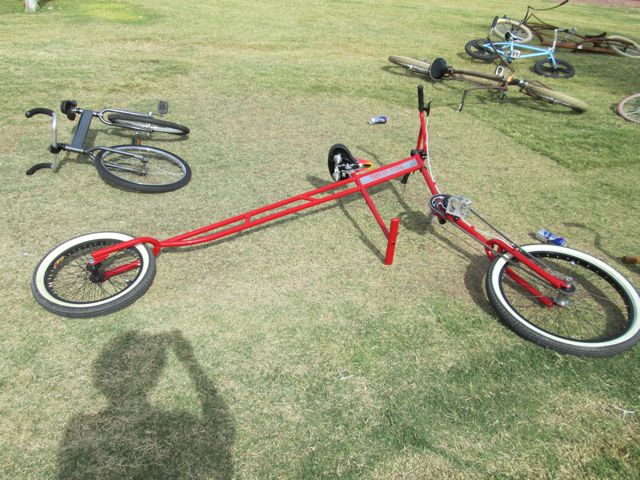
Two stretch cruisers.

The day's events in Tempe started with a morning parade – with wearing of costumes by riders encouraged – followed by music and other entertainment, bicycle contests and, of course, New Belgium beer, in the park.
In a preview article in the local College Times newspaper, Matt Kowal of New Belgium said, "We are a bike festival  first and beer festival second. We really want to make sure that people have the chance to taste our beers, but also come in lucid and be able to get inspired about bikes."
But I did observe a young lady, who may have had a few too many brews, pushing off on her bike with difficulty, to put it politely. A man sitting on a stretch cruiser also saw her and joked she was guilty of BUI (bicycling under the influence.)

Two more stretch cruisers, apparently homebuilt. The front "triangles" appear to be from regular road bikes.

It should be noted that Tempe is a college town (Arizona State University), and with temperatures ranging from warm to hot and flat terrain in the Phoenix area, is ideal for cruisers, which typically have only one or three speeds.
Unfortunately, by the time I got to the TdF in mid-afternoon, it was winding down. There were still plenty of bikes, but as I approached in my rental car, cyclists were leaving in droves, so I saw plenty of interesting bikes before I got there.
And by the time I got there, time was getting tight and I didn't want to be too late to my final destination. I found an empty parking space on the street, paid for 20 minutes of time on the meter, and made a quick tour. I took as many photos as I could, but didn't have time to talk to anyone, sit on any bikes or go on any test rides.

This rider is on a Driftwood Cruiser, with, as the name suggests, a wood frame. Driftwood Cruisers are made in nearby Mesa, Ariz., by Preston Brown and his helpers. If you want to buy one, and even if you don't, but want to see more, go to www.driftwoodcruisers.com.


How many bikes were at the Tour de Fat in Tempe? A safe guess is more than a thousand, and maybe thousands.

According to the College Times article, the TdF event in Temple is the second largest, behind only the one in New Belgium's home base in Fort Collins, Colo.
"We're just there to share in the celebration of the greatest invention of all time," Kowal said in the article. "It's not just a festival about beer and bicycles, but about people-powered transportation and people-powered fun."


Many low-racers seen at Human Powered Race - America events have front-wheel drive and front-wheel steering.  This bike also has FWD and FWS, but it's obviously not for racing. Presumably the pegs hanging below the seat are for the riders' feet, so he can coast. (Fixed gear, maybe?)  (Update: I later learned this bike, the swing bike below and some other interesting two-wheelers are made by Jon's Big Bikes in Peoria, Ariz., www.jonsbigbikes.com.)


This is what's known as a swing bike; both the front and rear wheels steer. The axle for the cranks runs through the rear wheel. Very nicely built, be it homemade or by a professional.


Tricycles were also seen at the Tour de Fat, but not of the recumbent variety.


Wednesday, October 10, 2012

Mich. Recumbent Rally - West, Sept. 8, 2012

THE MICHIGAN RECUMBENT RALLY - WEST, organized by Paul Pancella, took place Sept. 8 in the parking lot of the College of Engineering building on the Western Michigan University Parkview Campus in Kalamazoo. That's a WizWheelz (now TerraTrike) tandem in the foreground, which was for sale. There's been a recumbent rally in west Michigan every year since 1997, always on the day before the Vineyard Classic Bicycle Tour in the Paw Paw area. Photos and captions by Mike Eliasohn

JOHN MISHLER of Richland brought his ICE Sprint FS, which he bought in September 2011 from SPIN bicycle shop in Lansing. Custom-ordered from the factory in England, the rear wheel folds forward and the seat is easily removable, resulting in a compact package that fits in the rear of John's Ford Focus hatchback. There's suspension on all three wheels. According to the SPIN blog, it also sells Catrike recumbent tricycles and Rans recumbents and crank-forwards, as well as upright bikes. It's at 206 E. Grand River Ave.; phone 517-372-3000.


KEITH VANDERBERGH of Wayland (that's him, minus his head) had his Rans Rocket Saturn-V for sale for $400. It was purchased in 2000 and has Magura hydraulic rim brakes on both wheels. As of Oct. 10, he still had it for sale. E-mail keith@icebergh.us or call 269-792-6324.


DAN WILSON of Bridgman tries Mike Eliasohn's Sun EZ Classic compact long wheelbase recumbent. This is the current version of what was the EZ-1. John Mathieson of Breakaway Bicycles and Fitness in Portage came to the rally with two recumbents and the news that in addition to Bacchetta and Sun, it will be selling TerraTrike recumbent tricycles. Breakaway, which also sells upright bikes, also has shops in Muskegon and Grand Haven (www.breakawaybicycles.com). The Portage store is at 185 Romence Road, phone 269-324-5555.

Tuesday, October 2, 2012

Great Lakes Independence Ride 2012

Words and photos by Mike Eliasohn

The sixth annual Great Lakes Independence Ride, otherwise known as IRIDE (www.independenceride.org), started Aug. 2 in St. Joseph and ended four days and 240 miles later in Ann Arbor.
The ride is a project of the Center for Independent Living in Ann Arbor,  "a nonprofit organization dedicated to the success of children, youth and adults with disabilities at home, at school, at work and in the community," to quote from its website (www.annarborcil.org).
Glen Ashlock, the center's director of sports and recreation and a ride participant, said 52 riders pedaled  the entire distance, while another 10 to 12 rode at least one day. About eight riders were on hand cycles and two or three with visual impairments rode on the back of tandems.  The longest single day stretch was 63 miles.
The ride also was a fund raiser for the Disability Network/Michigan and the Centers for Independent Living in the state.
Prior to the start of the ride on Aug. 2 in St. Joseph, Jim Nieters (on ground) works on the Invacare Top End Force R handcycle of Bryan Wilkinson (in wheelchair) of Howell.  The Invacare Top End Force 2 handcycle of Brad Baumann of Zeeland is in the foreground. Jim was a rider and mechanic on IRIDE.

A closeup of the Invacare Top End Excelerator XLT Pro ridden by Tom Hoatlin of South Lyon. It has 27 speeds. Notice the upside down deraileurs for the triple chainrings and 9-speed cassette and two brakes on the front wheel.
This Invacare Force R, ridden by Bryan Wilkinson, also has 27 speeds, and a disk brake on the front wheel. No rear brakes.
Departing from the offices of the Area Agency on Aging and Disability Network/Southwest Michigan, these two handcycle riders show very different riding positions.  Above is Tom Hoatlin and below is Brad Baumann. Glen Ashlock said the riding position is determined partially by rider preference and partially by disability. For instance, the upright position enables the rider to use his or her trunk muscles more.

Tuesday, September 18, 2012

Some interesting bikes & people

Words and photos by Mike Eliasohn


In the March 1994 MHPVA newsletter (printed on paper) was a report on a new recumbent bicycle, the Brampton Bike, being manufactured by Tom Bell Jr. in Brampton, near Gladstone. Eighteen years later, I (Mike) finally traveled to the Upper Peninsula in August 2012 and met Tom, saw the bike and found out "whatever happened to ..."
The 1994 flier called it "a high quality, high performance recumbent bicycle at a low affordable price. Perfect for commuting." The price was $549.
After building some prototypes, including this final one shown in the photos, Tom built three bikes which he sold. But he started thinking, "I don't want to build the same bike over and over again," he said, so he stopped. He then started Brampton Bike & Ski in downtown Gladstone, which remains in business, although Tom no longer owns it. He now works as a paramedic.
Tom made the bikes in his garage. The only things he didn't do himself were the paint and upholstery. The main frame tube is 1x2-inch mild steel; the rear stays are 1x1-1/2; and the cross tubes connecting the stays are 1x1. Tom bought parts from J&B Importers/Sun Bicycles. The three bikes sold used Shimano Tourney components, had triple chainrings and seven-speed freewheels.  The bike shown here has some different components than on the production bikes, including the handlebars from Sun/J&B. Tom bent the handlebars on the production bikes from galvanized tubing.
The wheels are 26-inch in the rear, 20-inch in the front, with aluminum rims. Three frame sizes were to be available: 63, 66 and 69-inch wheelbase. Weight was about 45 pounds. A single quick release allowed easy adjustment of the seat position.
The Brampton Bike is obviously simple, but Tom's worksmanship is very nice. It makes me wonder if a small welding/machine/fabricating shop when its normal business is slow could produce similar bikes.
On my way to the Upper Peninsula, I stopped in Empire to see Reuben Chapman. Back in 1982, Reuben was living in Ann Arbor and publishing Getting There by Bicycle 10 times a year. The October 1982 issue had an article by Reuben about the first recumbent gathering in Michigan, on July 11 of that year, organized by me and Terry Gerweck in conjunction with the River Raisin Tour in the Monroe area. Six recumbents were there, which led to the creation of the Michigan Human Powered Vehicle Association and the annual Michigan HPV Rally. Reuben and his wife, Mary Ann, have lived in Empire, west of Traverse City, since 1999. He still rides his Lightning, shown here, and other bikes.


In the bicycle world, there are low racers and low riders – and tall bikes. At the Ann Arbor Classic Bicycle Show April 29, 2012, Joseph VanLoozen was showing and promoting his Very Big Bike, which he is manufacturing. A 7-speed bike costs $1,395; frame sets are $750. The website is www.verybigbike.com, which includes a video of how one gets on the thing to get started. On Sept. 15, VanLoozen and his brother, Pat, who make up VanLoozen Brothers Bicycles in Levering (south of Mackinaw City), each rode one of their bikes 31 miles in the Tour de Troit in Detroit. The frames are manufactured by BSM Technologies in Romulus, powder coated and then assembled by the brothers. Joseph built his first tall bike in 1978 in a school shop class. So far, he said, about 20 bikes have been completed and seven have been sold. A single-speed for the rental market and "twenty-niner" (mountain bike with 29-inch wheels) are now under development with BSM.


Also at the Ann Arbor Classic Bicycle show was this interesting bike owned by Brian Pikielek, owner of Bike Tech in Detroit. He told me in September the bike was built by Andy Toth, who operated Andy's Bike Shop in Melvindale from the 1940s to the mid 1990s. Brian also owns two other bikes Toth built, neither a recumbent.  The remote steering using a shaft resembles recumbents made in the 1930s in Europe, but they used a universal joint to link the shaft to the fork, rather than the bevel gear on this bike. Bike Tech, at 18401 E. Warren in Detroit, sells new and interesting/unique old bikes. In addition to the usual bicycle repairs, it also does frame repairs (that is, brazing). The website is www.biketech.us and the phone number is 313-884-2453.

This interesting stretch cruiser is owned by Jim Baney, owner of Jim's Vintage Bicycles, 6656 S. M-139, Berrien Springs, ph: 269-408-0430. He said he bought it at the Ann Arbor Classic Bicycle Show, but didn't know anything about the builder. Notice the use of a rear swing arm, presumably from a mountain bike. Jim sells and restores vintage bicycles, as well as more modern used bikes.

Thursday, July 5, 2012

28th annual Michigan HPV Rally May 19-20, 2012


THE START of the 25-lap race for the faster vehicles on Sunday morning was won by Rick Gritters (white vehicle, second from right) at an average speed of 25.62 mph for the 10.8 miles. (Mike Eliasohn photo)


IN THE SECOND road race Sunday morning, for slower vehicles, Bill Lozowski on his M5 lowracer is ahead of Tedd Wheeler on his Gritters lowracer and Brian Stevens on his Morciglio ViperBlue in the rear. (Mike Eliasohn photo)

By Mike Eliasohn

The 28th annual Michigan Human Powered Vehicle Rally – the 25th at the Waterford Hills sports car racing track in Clarkston – on May 19-20 drew about 40 competitors and vehicles.
That was about 10 more competitors than attended the 2011 rally. It would be interesting to know if the increase was due to the change from the normal June rally dates to May, which we had to do because the track was booked every weekend in June for automotive events.

THE UNIVERSITY OF TORONTO HPV team, seen here unloading Saturday morning, came with 11 team members and four vehicles, three of them streamliners. (Terry Gerweck photo)


For the third straight year, turnout was boosted by the team from the University of Toronto, which this year came with four vehicles – three of them streamliners – and 11 team members.
As usual, the stock class drew the most entries, 19, with MHPVA President Mike Mowett of St. Clair Shores, riding a John Morciglio-built M1 lowracer, coming out on top with 330 points. Second was Warren Beauchamp of Elgin, Ill., on a Velokraft NoCom low racer, 275 points; 3) Thom Ollinger, West Milton, Ohio, homebuilt Nirvana lowracer, 252; 4) Brian Stevens, Grand Rapids, Morciglio ViperBlue M2, 248; and 5) Bill Lozowski, Springfield, Ind.; M5 lowracer, 227.


MHPVA PRESIDENT MIKE MOWETT, seen here during the 200-foot sprints Sunday morning, won the stock class on his John Morciglio built M1. In his class, he was second fastest in the top-speed event, 39.5 mph. (Mike Eliasohn photo)

The top three in the rest of the classes were:
Streamliner (6 entries): Rick Gritters, who was absent the last two years, returned from Pella, Iowa, with his homebuilt streamliner with a fairing made of aircraft fabric over a tubing framework and won the class with 355 points. 2) Dave Johnson, Olivet, Rick Wianecki-built Great White, 315; 3) Rich Myers, Xenia, Ohio, Terry Hreno built Mini Moby, 300.

RICK GRITTERS, winner of the streamliner class, ran in the Sunday morning road race without the canopy. He rebuilt his fairing so that it now comes apart in two pieces – the vertical seam is just behind the front edge of the opening – so that both parts and the canopy now fit inside his very compact Honda Fit. He then transports the bare bike plus his stock class entry on a rear rack. Rick's trip from his home in Pella, Iowa, to Clarkston and return totaled about 1,300 miles. (Mike Eliasohn photo)

College: With some University of Toronto students riding more than one vehicle, and with each vehicle being ridden by more than one rider, they were given their own class. Trefor Evans in the Ace streamliner scored the most points, 175, and Cameron Robertson in the Vortex streamliner had 160. But Trefor also scored 115 points in the Vortex and Cameron had 100 in the Ace.
Super street (3 entries): 1) Wally Kiehler, Grosse Point Woods, Lightning F40, 345 points; 2) Tedd Wheeler, Reed City, Alleweder velomobile, 180; 3) Garrie Hill, Granville, Ohio, WOW velomobile, 55.

THOM OLLINGER, riding his homebuilt Nirvana, finished third in the stock class. He's shown here during the Sunday morning road race. (Mike Eliasohn photo)

Super stock (3 entries): 1) Chris Cortez, Chicago, Gritters lowracer with tailbox, 355; 2) Bruce Gordon, Buchanan, Zox 20x20, 320; 3) Jim Iwaskow, Richmond Hill, Ontario, Challenge Jester, 315.
Women: Mary Vernau of Troy, Ohio, riding an upright bike, was the lone entry, 360.
Tricycles (2 entries): Jeff Hunn, North Manchester, Ind., 235; 2) Chris Cortez, 225. Both raced Catrike Speeds.
A total of $230 in prize money was distributed. No course records were set this year.


JOHN MORCIGLIO of nearby Waterford inflates the tires on his Arrowhead mid-racer prior to the start of the Sunday morning events. Below, he rides it in the 200-foot sprints to a speed of 32.9 mph – fifth place. John has built numerous carbon fiber pedal-powered vehicles, mostly recumbents, for customers. His website is www.thundervoltman.com. (Mike Eliasohn photos)


Here's the top two in each class in each event. Complete results, plus lots of photos in addition to those shown here, can be seen at www.recumbents.com/wisil/hpra.htm.
SATURDAY EVENTS:
One-hour time trial: Streamliner – 1) Rick Gritters, 31 miles;, 2) Dave Johnson, 25.5 miles. College – rider swaps were made during the hour. SuperStreet – 1) Wally Kiehler, 21.5 miles (only rider to complete the hour). SuperStock – 1) Chris Cortez, 20.3 miles; 2) Bruce Gordon, 17.9 miles. Stock – 1) Mike Mowett, 26.1 miles; 2) Warren Beauchamp, 24.3 miles. Women – Mary Vernau, 15.4 miles.

PAUL PANCELLA waves the green flat to start the one-hour time trial Saturday morning for the stock class competitors. (Terry Gerweck photo)


Hill climb: Streamliner – 1) Gritters, 24.6 sec.; 2) Johnson, 28.1 sec. College – 1) Cameron Robertson in Vortex, 22.5 sec.; 2) Trefor Evans in Ace, 23.73 sec. SuperStreet – 1) Kiehler, 22.1 sec.; 2) Wheeler, 28.1 sec. SuperStock – 1) Jim Iwaskow, 23.5 sec.; 2) Cortez, 27.0 sec. Stock – 1) Mowett, 20.5 sec.; 2) Rick Gritters, Gritters lowracer, 21.6 sec. Women – Vernau, 29.4 sec. Tricycles – 1) Jeff Hunn, 26.8 sec.; 2) Cortez, 28.96 sec.
Coast down : Streamliner – 1) Myers; 2) Gritters. College – 1) Evans in Ace; 2) Victor Ragulisa in Ace. SuperStreet – 1) Wheeler; 2) Kiehler. SuperStock – 1) Cortez; 2) Gordon. Stock – 1) Ollinger; 2) John Foltz, Haslett, M5 Carbon highracer. Women – Vernau. Tricycles – 1) Cortez; 2) Hunn.
Standing start kilometer: Streamliner – 1) Gritters, 1 minute, 12.5 sec. = 30.9 mph.; 2) Johnson, 1:27.2 = 25.6 mph. College – 1) Evans, 1:15.6 = 29.6 mph; 2) Robertson, 1:17.9 = 28.7 mph. SuperStreet – 1) Kiehler, 1:34.9= 23.6 mph (only competitor). SuperStock – 1) Cortez, 1:35.6 = 23.4 mph; 2) Gordon, 1:45.3 sec = 21.2 mph. Stock – 1) Mowett, 1:15.4 = 29.7 mph; 2) Costin, 1:15.6 = 29.6 mph. Women – Vernau, 2:01.3 = 18.4 mph. Tricycles – 1) Hunn, 1:48.6 = 20.6 mph.; 2) Cortez, 1:54.4 = 19.5 mph.

SUNDAY EVENTS
Sprints (running start before 200-foot timing trap): Streamliner – 1) Gritters, 44.1 mph; 2) John Simon, Portland, Moby, 42.2 mph. College – 1) Evans, 44.9 mph in Ace; 2) Evans, 44.6 in Vortex. SuperStreet – 1) Wheeler, 34.0 mph; 2) Kiehler, 31.9 mph. SuperStock – 1) Cortez, 33.9 mph; 2) Gordon, 32.2 mph. Stock – 1) Costin, 41.96 mph; 2) Mowett, 39.5 mph. Women – Vernau, 24.05 mph.
Road race (each lap = .431 mile ) – Streamliner – both 25 laps, 1) Gritters, 25 laps, 25.6 mph; 2) Simon, 25.3 mph. College – Results unclear as to who the riders were. SuperStreet – 1) Kiehler, 21 laps, 21.3 mph (only competitor). SuperStock – both 20 laps, 1) Cortez, 20.1 mph; 2) Gordon, 19.7 mph. Stock – 1) Sean Costin, Arlington Heights, Ill., Velokraft NoCom low racer, 25 laps, 24.8 mph; 2) Beauchamp, 24 laps, 23.7 mph. Women – Vernau, 15 laps, 15.5 mph.


TREFOR EVANS (I think) IN THE UNIVERSITY OF TORONTO Bluenose competes in a Sunday morning road race. The newest U-T streamliner is made of carbon fiber and has dual 20-inch (406mm) wheels and front wheel drive. The goal is to be competitive at the World Human Powered Speed Challenge at Battle Mountain, Nev., in September, but early teething problems include instability, especially at slow speeds (Mike Eliasohn photo).

URBAN TRANSPORTATION CONTEST
BY Paul Pancella, organizer

This year there were five entries in the Urban Transportation Contest on Saturday, most of whom were new participants. Here are the entrants in order of finish:
1) Bill Lozowski, Springfield, Ind., 68.0 points, entered his wife’s folding upright bike, a Dahon Mu-24 model, which uses 24-inch wheels.
2) Longtime racer Dave Johnson of Olivet, 67.0 points, entered his 1985 Specialized StumpJumper mountain bike, well equipped for commuting. His lighting systems were especially impressive
3) Tim Potter of Lansing, 65.1 points, brought the 1983 Nishiki upright that he uses for daily commuting.
4) UTC veteran Wally Kiehler, 64.1 points, again campaigned with his Lightning P-38. Wally’s was the only recumbent bike entered in the UTC this year.
5) Brian Beard, Franklin, 62.7 points, entered one of his unusual StrideCore bicycles, a vehicle with no seat and no traditional pedaling mechanism. These bikes are propelled by stepping up and down on platforms, in a motion similar to climbing stairs. They have just been brought to market by a Michigan company, StrideSports. Unfortunately, Brian did not bring any of his lights or carrying accessories, and so was unable to score points in some areas.
Points were awarded in the following categories: Aerodynamics (measured by results in the coast-down that was part of the regular rally competition); weight; rider vision; daytime and night time visibility; vehicle size (smaller is better); maneuverability (turning radius); grocery run; braking; weather protection; rider comfort; tools/lock/spares; uphill hauling (low gear); and
passenger bonus. The simulated grocery run tests several relevant aspects of an urban transportation vehicle, which is why its score carries a relatively large weight.
As you can see, there was not much spread in the scores this year, with some similar bikes in a fairly small field. Despite a very poor coast-down distance, the Dahon folding bike took the $20 first prize by edging out Dave Johnson with a faster grocery run.
Thanks to all the folks who entered, and to Jun Nogami who helped with the setup and running of the event.


SEAN COSTIN PUSHED SO HARD IN THE HILLCLIMB that he twisted the chainring on his Velokraft NoCom, so lost points in that event and the coast-down. He borrowed Mike Mowett's Morciglio lowracer for the kilometer sprint, and riding it for the first time, went nearly the same speed as Mike. Sean got the chainwheel straightened in time to resume competition Sunday on his NoCom. (Terry Gerweck photo

Saturday, April 14, 2012

Michigan HPV Rally - May 19-20, 2012


The 28th annual Michigan Human Powered Vehicle Rally will be Saturday and Sunday, May 19-20, 2012, at the Waterford Hills sports car racing track on the Oakland County Sportsmen's Club grounds in Clarkston, near Pontiac.
The oldest such event in North America is open to riders of all human powered vehicles -- recumbents, regular bicycles and tandems. There are classes for streamlined, unstreamlined cycles, tandems, women, youth and tricycles. The rally is conducted using Human Powered Race America rules (www.recumbents.com/hpra/rulesand.htm). Note: HPRA rules require all vehicles to have mirror/mirrors enabling rear vision to both sides.
The track is 1.4 miles around, with nine turns and one hill.

ENTRY FEES: One day only, $30; both days, $40 (includes $10 MHPVA membership. $1 of each entry fee goes to support the League of Michigan Bicyclists. Test ride pass, $10, which includes MHPVA membership. Spectators free.
Even if you have no interest in racing, come and see some unusual and some very fast bicycles and tricycles. Some members of the Great Lakes chapter of the FreakBike Militia may bring their creative bikes on Saturday to show, not to race, which will mean even more unusual bikes to see.
Prize money will be awarded to top finishers in each class.

SATURDAY, May 19

Registration and technical inspection starts at 8 a.m.
One-hour time trial (streamliner, streetliner classes) - 9:30-10:30 a.m
One-hour time trial (stock, superstock, junior, women, tandem) - 11 a.m.-noon
Lunch (bring your own food or eat at nearby restaurant).
Hill climb/coast down (all classes) - 1:30-2:30 p.m.
Urban transportation contest - in afternoon (see details below).
Standing start kilometer (all classes) - 3-4 p.m.
Dinner - Steak fry at Sportsmen's Club lodge or at nearby Big Boy's - 6 p.m.

SUNDAY

200-Foot Sprints (all classes, flying start) - 8:30-9:30 a.m.
Tricycle race (infield parking lot) - 10 a.m.
Road race 1 (faster vehicles, 20 laps, 12 miles, no hill) - 10:30 a.m.
Road race 2 (slower Vehicles, 15 laps, 9 miles, no hill) - 11 a.m.
Awards ceremony by 1 p.m. (hopefully)

Location: Oakland County Sportsmen's Club: 4770 Waterford Road, Clarkston, MI 48346. For a map of the competition track, visit http://www.waterfordhills.com/downloads/facilitymap.pdf.

For additional information, contact: Mike Mowett, 586-863-3902 or mowett@aol.com, or Mike Eliasohn, 269-982-4058 or mikethebike@acd.net.

TO GET TO THE RALLY:

From I-75, get off at exit 91. Take M-15 south to Dixie Hwy. (US-24). Turn left, continuing south about 1 mile and turn
left onto Waterford Road, then proceed to track.
If coming from the west, take U.S. 23 north (or south) to M-59 (Highland Road). Go east on M-59 to Airport Road, then left
(north) to US-24. Turn left, then immediately right onto Waterford Road. Go about a half-mile to track.

URBAN TRANSPORTATION CONTEST
By Paul Pancella, UTC coordinator

We will include the Urban Transportation Contest (UTC) at Waterford this year, in the “traditional” format. It will start on Saturday afternoon and run simultaneously with the hill climb/coast down event. In fact, the coast down is one of three phases of the UTC, so the more aerodynamic the vehicle, the better. The other two phases are static measurements and some dynamic testing. The dynamic tests include a measure of the turning radius, braking distance, and a run on a short curvy course carrying some simulated groceries.

This contest is open to all competitors entered at the rally at no extra charge. The results will not be included in the HPRA points series, but there will be prizes for the top finishers. Vehicles will have to pass the same technical requirements as for the rest of the rally, with the exception that rearview mirrors will earn points, but are not a requirement for UTC participation. UTC vehicles must have more than one wheel.

Points will be awarded more or less equally in three areas:
Utility -- The basic ability to do the job, and do it efficiently.
Safety -- Mostly of the operator, but including security against theft.
Convenience -- The ideal urban vehicle is fun and easy to use. Here I will include items that affect operator comfort, as well as vehicle storage capacity.

To compete in the UTC, register on Saturday morning like everyone else. There will be some additional paperwork to fill out for the UTC. If you enter a separate vehicle in the UTC, get an official vehicle number from me, then be sure to run it in the hill climb/coast down in addition to your primary racing vehicle. I need to have your UTC forms by about 11 a.m. The contest will start in the parking lot when I get back from lunch.

So bring your lights, tools, and whatever else you think makes your vehicle more practical on the streets (or a whole different vehicle) and see how it stacks up.

PLACES TO STAY:

MOTELS (with approximate distances/direction from Waterford Hills track)

Clarkston - Clarkston Motor Inn, 6853 Dixie Hwy. (US-10), 248-625-1522, 12 rooms, 2 miles northeast.

Clarkston - Olde Mill Inn of Clarkston, 5835 Dixie Hwy., 248-623-0300. Across Dixie Highway from Waterford Road leading to track. This is the closest motel to the track.

Hartland - Best Western of Hartland, 10087 M-59 at US-23, 810-632-7177, 61 rooms. About 18 miles west.

Waterford – Comfort Inn, 7076 Highland Road (M-59), 248-666-8555, 111 rooms. About 3 miles southwest.

Waterford – Waterford Motel, 2201 Dixie Hwy. at Telegraph Road, 248-338-4061, 50 rooms. About 6 miles southeast.

Waterford – Holiday Inn Express, 4350 Pontiac Lake Road, 877-786-9480, 83 rooms. About 7 miles southwest..

Whitmore Lake - Best Western of Whitmore Lake, 9897 Main St. (off US-23, exit 53), 734-449-2058, 61 rooms. About 33 miles southwest.

CAMPING

Free camping available overnight Friday and Saturday at the Waterford Hills Sportsman Club, site of the HPV rally, starting at 6 p.m. Friday. Restrooms, showers available and possibly electrical hookups.

STATE CAMPGROUNDS (www.michigandnr.com/parksandtrails)

Highland Recreation Area, 5200 E. Highland Road (M-59), White Lake, 248-889-3750. Two miles east of Highland,

Holly Recreation Area, 8100 Grange Hall Road, Holly, 248-634-8811. Five miles east of Holly.

Ortonville Recreation Area, 5779 Hadley Road, Ortonville, 810-797-4439. Four miles northeast of Ortonville.

Pontiac Lake Recreation Area, 7800 Gale Road, 248-666-1020. Closest to Waterford Hills track, about 4 miles west.

OAKLAND COUNTY

Groveland Oaks County Park, 5990 Grange Hall Road, northeast of Holly, 248-634-9811.

PRIVATE CAMPGROUNDS (www.michcampgrounds.com)